
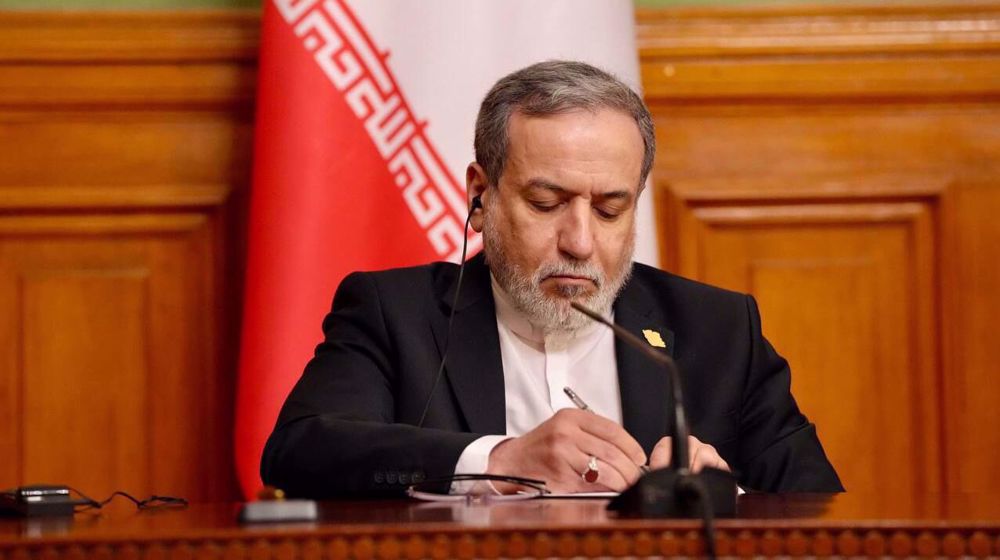
Foreign Minister Abbas Araghchi has called on the United Nations Security Council and member states to reject the new US campaign of economic terrorism against Iran, arguing that Washington is seeking to force other countries to abandon lawful economic relations with Tehran through threats of secondary sanctions.
In a letter addressed to UN Secretary-General Antonio Guterres, the Security Council’s president, and UN member states on Wednesday, the top diplomat said the measures announced by the United States recently under the so-called banner of “Operation Economic Expulsion” amounted to an attempt to impose US policy on sovereign states.

Araghchi urged the UN to condemn the measures, refrain from recognizing or implementing them, and press Washington to end threats and coercive measures against countries maintaining economic relations with the Islamic Republic.
‘US trying to impose its will extraterritorially’
According to the letter, the stated purpose of the US campaign is to end lawful economic relations with Iran by threatening third countries and entities with secondary sanctions and restrictions on access to the US financial system.
Araghchi argued that such measures amount to an effort to apply US laws and foreign-policy objectives beyond US territory and to compel other governments to change their independent economic policies.
Araghchi noted that the measures feature sanctions against individuals and entities “regardless of where they are located,” describing the drive as an attempt to constrain the economic decisions of other sovereign states through unilateral decisions made in Washington.
The foreign minister also argued that continued use of such measures could not establish a legal right to exercise unlimited extraterritorial jurisdiction, saying their purpose was to pressure third countries into adopting restrictions they had not independently accepted.
Humanitarian consequences
A central part of the letter concerned the impact of the US measures on Iranian civilians.
Araghchi denounced the United States for deliberately targeting civilians and said the measures were structured in a way that they would circumvent protections afforded to civilians under international law.
He said restrictions affecting access to food, medicine, medical equipment, energy, and other basic necessities could have consequences for rights, including the rights to life, health, food, and an adequate standard of living.
Araghchi asked the UN chief to examine their impact on access to food, medicine, healthcare, energy, transportation, humanitarian assistance, and other conditions necessary for a dignified life. He further called for relevant evidence to be preserved for possible future accountability proceedings.
The official also invoked a 2018 judgment and order of the International Court of Justice, arguing that the newly announced measures represented a departure from the court's ruling.
The letter recalled that on October 3 that year, the court unanimously ordered the United States to guarantee the freedom of export to Iran of “(1) medicines and medical devices; (2) foodstuffs and agricultural commodities; and (3) spare parts, equipment, and associated services (including warranty, maintenance, repair, and inspection services) necessary for the safety of civil aviation.”
According to the letter, the same order also required the United States to issue necessary licenses and authorizations and facilitate the transfer of related payments and other funds.
According to Araghchi, contravention of the ruling on the part of Washington carries serious consequences for the Iranian population.
Iran’s demands
The foreign minister presented three principal requests to the Security Council and UN membership.
First, he called for the condemnation and rejection of unilateral coercive measures and secondary sanctions intended to pressure sovereign states into changing their lawful economic relations.
Second, the official urged countries not to recognize, endorse or implement measures that would link their sovereign economic decisions to policies determined unilaterally by the United States.
Third, he called on the United States to immediately end threats and coercive measures aimed at compelling third countries and their nationals to change their economic relations and interests.
Iran’s parliament speaker scoffs at US treasury secretary’s contradictory ‘Economic D-Day’ remarks https://t.co/UH4rhzEUAZ
— Press TV 🔻 (@PressTV) August 26, 2026
‘A decisive moment for UN, member states’
Araghchi described the issue at hand as a broader test of the UN Charter's principles, writing that a “decisive moment” had arrived for the Security Council and UN member states.
He said the choice was between defending “the principles of sovereign equality, non-intervention, and respect for the sovereign rights of states” and submission to “the unilateralism and bullying of a rogue state.”
The letter also set out Iran's intention to pursue legal and diplomatic avenues over unlawful US measures.
Araghchi said Iran “reserves its right to pursue all available avenues to secure accountability, reparation, and redress,” and argued that the United States should bear responsibility for material and moral damage caused by the measures.
He said such responsibility could include restitution, compensation, and satisfaction in accordance with international law.
The letter further stated that the United States bears international responsibility and, where the relevant legal elements are established, individual criminal responsibility for consequences arising from unlawful measures targeting the Islamic Republic.
Araghchi concluded by asking Guterres to circulate the letter as an official document of the Security Council.
 This makes it easy to access the Press TV website