
Reparations: these days, this word has once again become a major point of contention between Iran and the United States. Iran says the United States should pay compensation for the damage caused by the ongoing war, the destruction resulting from US and Israeli attacks on Iran since February 28, 2026.
Donald Trump, however, has a different assertion. He says that if Iran wants compensation, then the United States wants compensation too; not just for the current war, but for what Trump describes as 50 years of damage caused by Iran's actions.
He has cited the deaths of American troops and even Iranian protesters as part of his claim.
"Now I am likewise demanding compensation from Iran, for all of the people that they have killed and gravely wounded with their roadside bombs and many conflicts, for which they are famous, as led initially by General Soleimani, including the families of those killed on the USS Cole and thousands of others killed in combat".
US President, Donald J Trump
So on the surface, the argument seems simple. Iran says, 'you caused the damage, so pay compensation'. America says, 'you caused damage too, so you should pay'.
But there is a more important question: If we are going to open the books, where should we begin?
Should we start where America wants us to, or should we go further back to where the story actually began?
For example, to the 1953 coup, when a nation's hopes for independence were crushed by a British plan carried out with American support, replacing the promise of freedom, democracy, independence, and economic prosperity with decades of dictatorship.
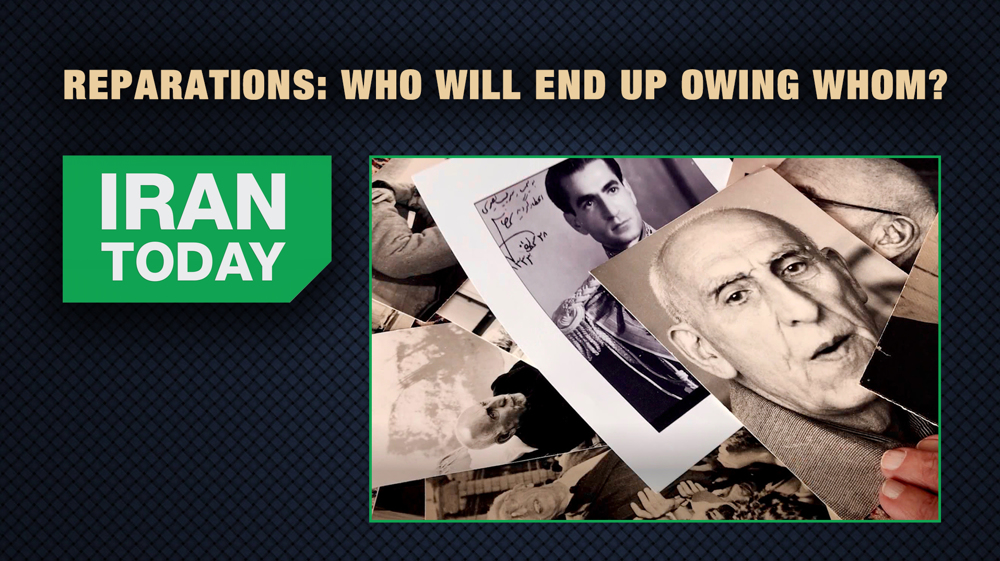
73 years have passed since the coup in Iran, in which the United States played the most important role. The operation that brought down the democratically elected Prime Minister Mohammad Mosaddegh matters because it reminds us of something important: that tension between Tehran and Washington did not begin with the ongoing war.
If the United States wants to bring history into the reparations ledger, why should it open the book at the very last page?
In March 1951, a movement led by the then Prime Minister Mohammad Mosaddegh, and supported by Ayatollah Seyyed Abolghasem Kashani, succeeded in nationalizing Iran's oil industry.
The goal was to end the control of the former Anglo-Iranian Oil Company over Iran’s oil resources and bring those resources under national control, so that oil revenues could be used to develop Iran, instead of filling the coffers of the colonial powers.
We have witnessed US interference in Iran's affairs since 1920. The United States has intervened in Iran on several occasions, and these actions date back to long before the establishment of the Islamic Republic.
The US has interfered in Iran's economic and political affairs on various fronts. In 1920, for example, when Britain entered Iran's oil sector and signed an agreement with Iran, the United States also entered the Iranian oil sector in that same year, seeking to exploit its resources.
Abolghasem Jarareh, Parliamentary National Security Committee
Today, America's role in that coup is no longer simply a matter of competing historical narratives.
Declassified documents from the US State Department and the CIA document the planning and execution of the operation to overthrow Mosaddegh's government.
Documents released by the US State Department between 2000 and 2007 reveal that Mr. Henderson, the US ambassador to Iran at the time, was closely monitoring developments in Iran, reporting on events and maintaining constant communication with the US government, he had arrived in Iran 48 hours before the 1953 coup, and at 6 p.m. on the evening before the coup, he informed the US State Department that he had arranged a meeting with Mohammad Mosaddegh.
Amir Makki, Iranian Historian

After the coup, relations between Iran and the United States entered a new phase.
When do you think should be considered the start of Iran-US tensions? Do you think it was the recent war, or the victory of the Islamic Revolution, or should we trace it back to the 1953 Coup?
After the coup, a seed was planted in the hearts of the Iranian people; the seed of hostility toward the United States.
The first phase of the structural conflict between Iran and the United States began essentially the morning after the coup.
Through the coup, the United States succeeded in entrenching its political and cultural influence in Iran bringing Mohammad Reza Pahlavi back to power, and suppressing the demands of the Iranian people.
Amir Makki, Iranian Historian
Mohammad Reza Shah remained on the throne, ruling Iran with an increasingly authoritarian approach, while maintaining a deeply subservient relationship with the United States and Britain.
America became the regime's principal ally. Military and security cooperation expanded.
SAVAK, Iran's notorious intelligence and security organization, was established in the late 1950s with the cooperation of the United States and Israel, making the political atmosphere in post-coup Iran even more suffocating and ensuring that few would dare to challenge the Shah.
From the establishment of Savak, the notorious intelligence organization under the Pahlavi regime, in 1956 or 1957, the Iranian people witnessed extensive American interference in Iran's affairs.
The Americans sent large numbers of military, economic, and cultural advisers to Iran.
There were even documents indicating that they wanted to make Iran one of the states of the United States.
We're seeing similar rhetoric today, with the US president making such remarks about Canada and pursuing ambitions of expansion everywhere.
Amir Makki, Iranian Historian

In the years that followed, Iran became one of Washington's most important military allies in the region, so much so that on the eve of the revolution, US President Jimmy Carter described Iran as an island of stability.
But inside Iran, a very different picture was taking shape-a country that, after a coup, was becoming increasingly dependent on a foreign power.
The Capitulation Law of 1964 completed that picture in the eyes of the Shah's opponents.
It granted broad legal immunity to American citizens and military advisers in Iran, opposition to that law became one of the major points of confrontation between Ayatollah Seyyed Ruhollah Khomeini and the Pahlavi regime, which eventually led to his exile.
From the capitulation law and the exile of Imam Khomeini to the victory of the Islamic Revolution and the issue of hostages-which incidents or factors actually contributed to the growing anti-American sentiment among Iranian people?
In 1963 and 1964 when Imam Khomeini was exiled, the issue was the diplomatic and legal immunity of all US military advisers and administrative personnel in Iran.
When this immunity was introduced, it was presented as part of the Vienna Convention in an effort to prevent public concern and curiosity; people were simply told that whatever was provided for under the Vienna Convention would also apply in Iran.
More importantly, even American employees who were paid by the Iranian government were covered by this immunity.
So, regardless of whether their actions in Iran were political or criminal, if they were found to have committed an offense, Iran's judicial authorities had no right to investigate or prosecute the case.
Amir Makki, Iranian Historian

14 years later, the Islamic Revolution overthrew the Shah, who had been supported by the United States.
The Islamic Revolution did not end the relationship; it transformed it completely.
On November 4, 1979, the US embassy in Tehran was taken over; Iran considered the embassy an American den of espionage, a place where a coup like the one in 1953 could once again be planned and carried out.
The Iranians were also demanding the extradition of the former Shah, who had fled to the United States. The Shah had taken billions of dollars in national wealth with him, and through decades of iron-fisted rule, had inflicted an even greater cost on Iran.
The United States, however, chose a different path. It imposed economic sanctions, froze Iranian assets, and increased political pressure, but just a few months later, Washington moved from sanctions to military action.
On April 24th, 1980, Operation Eagle Claw was started. American forces entered Iranian territory in an attempt to rescue the hostages. The operation failed, but for the history ledger, one fact had already been recorded: American military forces had entered Iranian territory.
Immediately after the US embassy takeover, the confrontation and hostility between the United States and Iran intensified.
Beginning in early 1980, we witnessed two consecutive coup attempts: the Tabbas operation and the Nojeh coup attempt, both of which failed.
We can also see signs of direct CIA involvement in these operations.
After the failure of those two attempts, we saw Iraq's Baathist regime launch an attack on Iran, beginning an imposed war that lasted eight years.
Amir Makki, Iranian Historian

And then there was the war. On September 22, 1980, Iraq invaded Iran. Eight years of war, hundreds of thousands killed and wounded, cities destroyed, and economic losses whose effects can still be seen in Iran's economic structure today.
The United States supported Iraq during the war, provided intelligence to Baghdad, and did not change its policy in response to Iraq's use of chemical weapons, which is clearly documented.
Declassified documents show that Washington knew Iraq was using chemical weapons against Iran while continuing to support Baghdad in an effort to prevent an Iranian victory.
On July 3rd, 1988, the American cruiser USS Vincennes shot down an Iranian passenger aircraft, Iran Air Flight 655, with 290 men, women, and children on board.
The United States said it had mistaken the airliner for military aircraft.
Can you please tell us how war reparations can be claimed; is the fact that a country has suffered damages in a war sufficient ground for claiming reparations?
Claims for compensation are very common in international relations. If we go back to World War II, for example, we can see that Germany is still paying compensation to Israel over claims that were made against it.
The United States itself has also paid compensation to Iran. In 1988 when a US warship shot down our passenger aircraft over the Persian Gulf, the incident was reported to the International Civil Aviation Organization, where the US responsibility was established.
Washington subsequently paid compensation to the families of the victims, including foreign nationals among those killed.
Hojatollah Soltani, Former Iranian Ambassador to Venezuela
Over the years, American military interventions in West Asia have left behind countless innocent victims and immeasurable human suffering.
The war against Iran is no exception. Beyond the headlines and geopolitical calculations are personal tragedies that rarely appear in the world's major news reports.
The military war ended, but the economic war continued. Over the following decades, US sanctions targeted Iran's oil industry, banking system, trade, and investment.
During Trump's maximum pressure campaign, Iran's oil exports fell dramatically.
Precisely calculating the impact of sanctions on Iran's economy is almost impossible because of their direct, indirect, and long-term effects.

So far, estimates of the impact of sanctions have varied depending on the source and methodology used. The figures range from $1 trillion to $2 trillion.
Since 1990, we have been subjected to severe financial sanctions.
Our oil industry, banks, and insurance sector have all been illegally sanctioned. They were imposed because we chose to be independent, based on our beliefs, we have supported the oppressed Palestinian people and never interfered in the affairs of other countries.
We have never launched an attack on another country.
Abolghasem Jarareh, Parliamentary National Security Committee
Sanctions have hurt Iran's economy in several ways, including lower economic growth, reduced output, and lost revenues and investment opportunities. Many potential business deals and joint economic projects never took place because of sanctions.
And then there's the issue of health. Restrictions on currency transfers and international banking have made it harder to purchase medicines directly, as a result, patients with serious illnesses such as cancer, hemophilia, multiple sclerosis, and transplant complications have at times faced shortages of essential medicines.
According to an article published in the Lancet in December 2025, on average, countries subjected to these sanctions experience a reduction of between 1.2 and 1.4 years in life expectancy, with women suffering more than men.
These losses are not merely collateral; they are evidence that sanctions can function as a weapon against the health of an entire population.
After years of negotiations, in 2015, Iran, the United States, and several other countries reached a nuclear agreement, perhaps hoping that it would mark the beginning of an end to the hostility between the two sides. Iran accepted extensive restrictions on its nuclear program.
Then came 2018, when newly elected US President Donald J Trump suddenly withdrew from the agreement without any clear justification. The maximum pressure campaign returned.

On January 3rd, 2020, General Qassem Soleimani was assassinated in Baghdad in a US strike ordered directly by President Trump.
The economic pressure on Iran continued to intensify. What the Trump administration called maximum pressure was aimed at increasing pressure on ordinary people, generating public dissatisfaction, bringing people onto the streets, and exploiting that situation.
That is what happened in early 2026; peaceful protests suddenly turned into organized street warfare, a bloody confrontation whose goal was the overthrow of the government.
Gradually, evidence of the involvement of Mossad and the CIA emerged, and interestingly, American officials showed little hesitation in acknowledging their involvement. For example, Mike Pompeo wrote on his X account, "Happy New Year to every Iranian in the streets, also to every Mossad agent walking beside them".
Despite the heavy human and financial losses inflicted on the country, the organized unrest failed to achieve its main objective-a coup like the one in 1953 that would bring down the government.
Article two; paragraph four of the United Nations Charter prohibits the use of force.
The Charter makes clear that a country cannot use force to attack another country unless it has authorization from the Security Council, and there is an established mechanism for that.
However, we have no confidence in the United Nations and the Security Council because we have seen violations against various countries, where the Security Council should intervene and take legal action.
Yet, unfortunately, we do not see that happening.
Abolghasem Jarareh, Parliamentary National Security Committee
It was in this context that the United States and Israel launched a direct military attack on Iran on February 28, supposedly to finish what had been left unfinished.
The war resulted in the deaths of several thousand Iranian civilians and the destruction of parts of the country's infrastructure.
This is the very war at the center of today's dispute over reparations.
Iran is demanding compensation for the damage inflicted on it. The United States says Iran should pay as well.
The basis of the American approach is a sense of imperial arrogance.
They are essentially taking a shot in the dark and seeking to claim compensation, but under international law and before the International Criminal Court, we too can pursue legal action because our country has been attacked.
We can seek to hold accountable the US leaders and the Zionist regime, which we hold responsible for the martyrdom of our people and our leader.
Abolghasem Jarareh, Parliamentary National Security Committee
A year earlier, in 2025, the United States and Israel had also directly attacked Iranian nuclear facilities, targeting Iran's peaceful nuclear program.
We can point to three principles of international law.
First, states are responsible for their conduct.
Second, international law recognizes the response of states, and Article 51 of the UN Charter recognizes the right to self-defense. Iran's response was fully consistent with international law and the UN Charter in defense of its sovereignty and the security of its people, and to repel aggression.
The third important principle is that if a state violates a fundamental principle of international law and it suffers damage as a result that state cannot demand compensation.
Hojatollah Soltani, Former Iranian Ambassador to Venezuela

The war launched by the United States, however, did not come without a cost to America itself.
By the end of July 2026, the direct cost of the war to the United States was estimated at around $37.5 billion, while the Trump administration requested tens of billions of dollars more to continue operations and replenish weapons stockpiles.
So the question is not whether the United States has suffered losses; it has. The question is who started the war, and can you demand compensation for the cost of responding to an attack without first calculating the cost of the attack itself?
That is where the issue of reparations goes beyond a political dispute. If we are going to open the book, then the entire book has to be opened.
In 2000, US think tanks were already discussing plans to bomb Iran's nuclear facilities. They said at the time that they intended to carry out such attacks using B-2 bombers, and ultimately it happened in 2026.
The United States has a long-standing hostility toward countries that refuse to be dependent on it, that do not fall for its promises, and as Trump would put it, are not compliant or easily controlled. They use every possible means to strike such countries.
Their own think tanks have openly argued that countries that confront them should be hit and then rebuilt again.
Amir Makki, Iranian Historian
America wants to open the ledger from the point where Iran responded, but Iran says, if you are going to open the book, open every page.
If we were to list US actions, there are dozens, even hundreds of cases in which it has violated Iran's sovereignty and rights, and it has yet to pay compensation.
One example is US involvement in the 1953 coup. According to statements by American officials, the coup was carried out with the support of the CIA and Britain. The Mossadegh government was overthrown, and afterward, they brought the Shah back to power.
So for many years, Iran's resources were exploited. The regime they installed under the Shah killed thousands of Iranians during protests.
Hojatollah Soltani, Former Iranian Ambassador to Venezuela
Perhaps the question should not be how much Iran should pay the United States in reparations.
The real question ought to be if we put all the losses together, who will be left owing money in the end?
 This makes it easy to access the Press TV website