
By Yousef Ramazani
The US-Israeli war of aggression launched in late February against the Islamic Republic of Iran was supposed to showcase the unchallenged dominance of the United States Navy.
Instead, it has become a case study in strategic overreach – exposing a naval fleet that is being steadily worn down by a resilient opponent, overstretched supply lines, and a crisis of morale that its command structure appears increasingly desperate to conceal.
The cumulative toll of naval accidents, logistical failures, media suppression, and declining troop morale paints a troubling portrait of a superpower struggling to preserve its naval supremacy in the face of a determined Iran that was subjected to an unprovoked and illegal aggression.
From the very outset of the war of aggression, which came amidst indirect diplomacy mediated by Oman, the United States has demonstrated a conspicuous – and operationally significant – reluctance to bring its most powerful naval assets close to the Iranian coastline.
This was not simply a matter of strategic preference but a direct consequence of Iran’s demonstrated anti-access and area-denial capabilities, which have fundamentally altered the calculus of American hostile naval operations in the region.
Rather than risk its capital ships in the confined waters of the Persian Gulf, the United States limited its naval offensive to striking targets in southern Iran from standoff distances, operating primarily in the Arabian Sea and Gulf of Oman, where its vessels have greater room to maneuver against incoming missiles and drones.
American military planners and commanders are acutely aware that the shallow waters of the Persian Gulf and the narrow approaches to the Strait of Hormuz present a uniquely hazardous environment for their destroyers and aircraft carriers.
Iran’s military has repeatedly demonstrated its ability to field a complex, layered threat network comprising shore-based anti-ship cruise missiles, coordinated swarms of fast-attack craft, and advanced unmanned aerial vehicles capable of precision strikes.
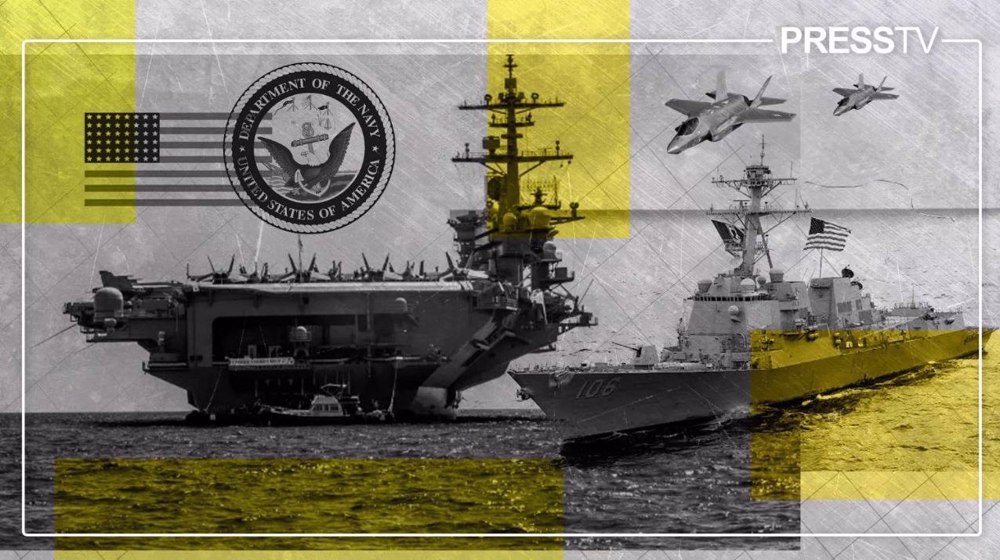
Rather than challenge this defensive umbrella directly, American warships, including the USS Abraham Lincoln, have remained well beyond the horizon, launching airstrikes from the Arabian Sea instead of closing the distance to secure more effective operational positioning.
Iranian naval commanders have described this as a successful strategy for denying the US fleet access to the Gulf of Oman and the Strait of Hormuz through the integrated use of missiles and drones. Iranian naval forces have successfully intercepted and pushed back American naval assets, compelling them to retreat as far as 400 kilometers from the strategic chokepoint.
For the first time in a major military confrontation since the Second World War, the United States was ostensibly fighting a naval war against a peer adversary largely from a standoff position, unable to project power directly into waters close to Iran.
The result represents a fundamental shift in the regional balance of naval power, challenging assumptions about American maritime dominance that military strategists may not have fully anticipated.

Catalogue of naval incidents and uncomfortable questions
As the war of aggression against Iran dragged on through the spring and summer of 2026, a series of incidents involving US warships raised serious questions about the fleet’s operational condition – and about the credibility of official American accounts.
While the Pentagon has maintained that these incidents are isolated mishaps unrelated to Iranian retaliatory operations, their frequency, timing, and circumstances point to a deeper systemic problem, one that Iranian military pressure may have exposed and compounded.
The distinction between genuine accidents and combat-related incidents has become increasingly difficult to establish as the war of aggression has intensified.
The most significant controversy centers on the aircraft carrier USS Abraham Lincoln, which has come to symbolize many of the strains confronting the American naval campaign against Iran.
Its deployment, extending beyond 270 days at sea without a conventional port call, would represent an extraordinary operational commitment for a US aircraft carrier. The prolonged deployment has led to the deterioration of the condition of the ship’s mechanical systems, as well as the physical and psychological well-being of its crew.
Reports from sailors’ families and military journalists have described serious shortages and deteriorating food quality, with some crew members receiving meals they considered insufficient or inedible. Such accounts have raised questions about whether sailors are receiving adequate nutrition to sustain the demands of prolonged combat operations.
Conditions aboard the Lincoln have generated further uproar. Crew members have described mold in showers, malfunctioning toilets, inconsistent laundry services, and persistent plumbing problems – conditions that, taken together, point to a severe deterioration in quality of life aboard the carrier.
The logistical failures have also been linked to disruptions in American naval support infrastructure. According to independent media accounts, Iranian retaliatory missile and drone strikes significantly damaged the key US naval support facility in Bahrain, the Fifth Fleet, on the opening day of the aggression against Iran. Such damage had significant implications for the fleet’s ability to sustain prolonged offensive operations in the region.
The loss of local support infrastructure, in turn, forced the Lincoln to depend more heavily on distant supply networks, including facilities at Diego Garcia more than 2,200 miles away. Such extended supply lines would inevitably complicate the timely delivery of food, spare parts, and other necessities during the protracted war of aggression against Iran and its allies.
The human cost of the prolonged deployment has been equally troubling.
The absence of regular liberty port calls, which is an important component of rest, morale, and psychological resilience during extended deployments, has contributed to exhaustion and mounting anxiety among sailors facing prolonged separation from their families.
In early August, a sailor aboard the Lincoln went overboard in an incident that officials subsequently characterized as a mental-health crisis, although few additional details were made public.
Accounts from family members have suggested that other sailors may have experienced similar crises during the extended deployment. These reports point to a broader problem of psychological strain that the Navy has struggled to address publicly.
The Pentagon, for its part, has consistently rejected reports that Iranian missiles have struck American warships. Yet the growing divergence between official statements, independent reporting, family accounts, and revelations from Iranian military sources has pointed to an attempt by the US Navy to hide the extent and magnitude of the simmering crisis.

Media blackout: Censoring the reality at sea
The Pentagon's response to these episodes has not been limited to carefully worded official statements denying any serious problems in an attempt to downplay the scale of the crisis.
It has also involved a heavy-handed and unprecedented attempt to control the information environment, most notably through the purging of senior leaders at Stars and Stripes, the military's own independent newspaper that has served American soldiers for generations.
On August 21, the Department of War fired editor-in-chief Erik Slavin, publisher Max Lederer, and West Asia correspondent Lara Korte, officially citing "insubordination" as the grounds for their dismissal.
The timing of these firings, coming just days after Stars and Stripes published extensive, well-sourced reports on the dire conditions, supply shortages, and mental health crises aboard the USS Abraham Lincoln, has raised serious questions about the Pentagon's motives.
The dismissals are especially significant given the unique institutional position that Stars and Stripes occupies in the American military media sphere.
The Pentagon had already been attempting to alter its organizational structure and editorial arrangements, and two members of the newspaper's publisher advisory board had filed a lawsuit saying the department's actions threatened the paper's independence and First Amendment protections.
For a government-funded publication that serves the military community to have its leadership purged after reporting on the hardships faced by soldiers during a deployment represents a stark and troubling example of institutional censorship, according to American military pundits.
The goal of this action, they say, is to silence those who would hold the military accountable and to sanitize the increasingly grim reality of the war of aggression against Iran for public consumption.
In doing so, the Pentagon has revealed its own fear that the truth about its naval crisis is more damaging to morale and public support than any report that Iranian media could produce.

Broken morale: US Navy's crisis of conviction
The root of these naval failures lies not in any single strike, logistical problem, or even a pattern of mechanical breakdowns, but in the collapse of morale among US soldiers who have been asked to fight a war of aggression they do not believe in.
That lack of conviction is translating into operational dysfunction, a breakdown in discipline, and a decline in the willingness of sailors and Marines to accept the risks and sacrifices that combat demands.
The strategic implications of this crisis are devastating for US military power in the region. The war has been characterized by many service members as having no morale behind it, with troops deployed to undesirable locations indefinitely and with no clear mission that they can personally support.
This sentiment is powerfully reflected in photographs that emerged from the Indian Ocean showing messages that US servicemen scribbled on the dust of an aircraft flap.
One message read: "Be a good guy and do what Israel tells you to."
Another mockingly referred to the operation as "Operation Epstein Fury," while a third derided the aggression, writing: "Peace deal number sixty-four incoming... all this for the Holy Land."
They are the cynical, bitter expressions of US combat soldiers who see their lives and service being leveraged for a cause they do not support.
The notion that the US military is fighting for a foreign land and at the behest of its political leadership is a corrosive idea that is destroying unit cohesion and trust in the chain of command, experts say.
A soldier or sailor who feels this way is not willing to risk their life for a mission they consider unjust or illegitimate. They are demoralized, resentful, and looking for ways to avoid the dangers of combat.
The lack of morale has also manifested in more direct and troubling ways, including reports of interpersonal violence and breakdowns in discipline aboard American warships.
Iranian media reported that seven American sailors had been killed and others injured in a violent brawl aboard the Abraham Lincoln, reflecting the broader context of a ship whose crew is under immense strain and whose command is struggling to maintain order under extraordinarily difficult circumstances.
Even the officially confirmed incidents, such as the sailor who went overboard in August, point to a psychological crisis that extends far beyond the usual stresses of military deployment.

Pattern reveals a fleet in decline
When taken together, the events of the past few months paint a deeply troubling picture of a naval power struggling to maintain its dominance in the face of the resilient Iranian responses.
The USS Gerald R. Ford fire in March, the USS Benfold engineering failure in July, the USS Zumwalt fire in April, and the relentless retaliatory attacks on American destroyers in the Strait of Hormuz all point to the same conclusion: the United States entered this aggression with a fleet already operating at the limits of its capacity, and the war has pushed it beyond what it can sustainably endure.
These are not isolated coincidences but symptoms of a deeper systemic problem that has been exposed by the pressures of sustained combat operations against a capable opponent.
The USS Gerald R. Ford experienced a fire in its main laundry spaces on March 12 while operating in the Red Sea, an incident that the US Navy described as non-combat-related.
However, subsequent reporting indicated that the consequences were more extensive than the initial announcement suggested, with many sailors treated for smoke exposure and approximately one hundred berths affected.
The fire eventually forced the carrier to leave the immediate operational area for repairs, a significant loss of combat capability at a critical moment in the aggression.
The USS Benfold engineering failure on July 24 was another significant incident that, while occurring outside the regional theater, belongs in the wider pattern of naval mishaps occurring during a period when the fleet was under unusually heavy demand.
The guided-missile destroyer lost power for four days, leaving approximately three hundred sailors without normal access to drinking water, meals, functioning toilets, and air conditioning.
The ship had to be towed to Subic Bay in the Philippines for repairs.
While this incident cannot responsibly be described as directly caused by the Iranian strikes, it is connected at the institutional level because the Pacific theater was being asked to absorb the consequences of the West Asian deployment.
When the USS George Washington was sent toward West Asia to relieve the Lincoln, the Pacific temporarily faced a reduced carrier presence, and the remaining ships were under increased strain.

Strategic victory for Iran
During the 40-day war of aggression against Iran, the US Navy was defeated through a thousand strategic, logistical, and psychological cuts, each one cumulatively devastating.
Iran has established a potent defensive zone that keeps American carriers away, its missiles have shattered the logistical network of the Fifth Fleet, and the resulting chaos has been compounded by a crisis of morale that the US command structure is attempting to hide through increasingly aggressive censorship of its own military media.
The image of the US Navy, forced to fire at Iranian targets from afar while its sailors scrawl cynical graffiti on the wings of their own aircraft, is a portrait of a fleet in decline and decay, bled white by a power it cannot overpower and a war it cannot win.
The events of 2026, from the Lincoln's supply crisis to the sacking of its own journalists, demonstrate that the United States' greatest vulnerability in this aggression is not an enemy missile or drone, but the hollowing out of its own military's soul.
When service members no longer believe in the justice of their mission, when they see themselves as pawns in a geopolitical game that serves foreign interests, the willingness to fight and die for the flag evaporates, and no amount of advanced weaponry can compensate for that loss.
The longer the aggression continues, the more pronounced these problems will become.
 This makes it easy to access the Press TV website