
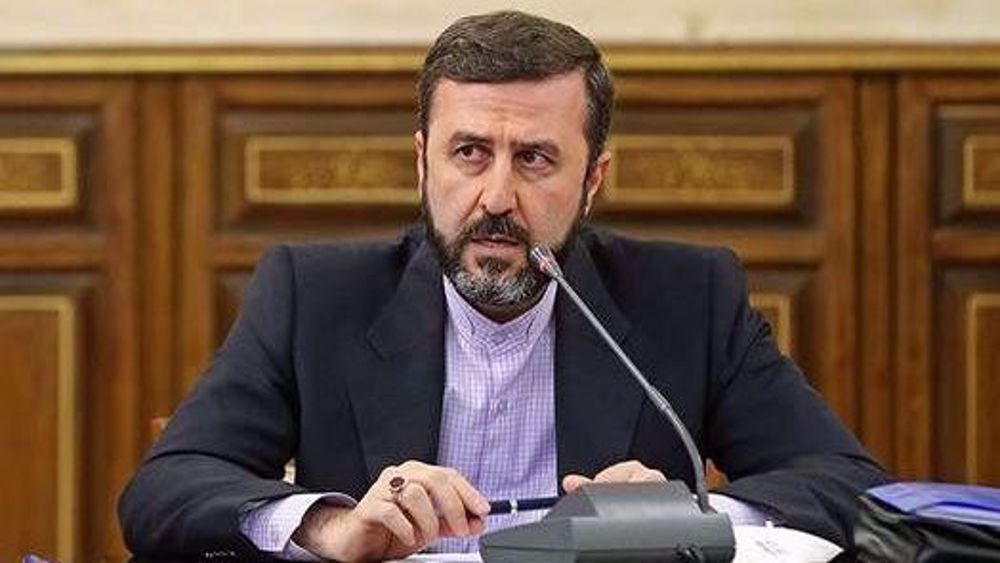
Iran’s deputy foreign minister for legal and international affairs details a temporary arrangement between the Islamic Republic and Oman concerning the Strait of Hormuz, while asserting that reopening of the waterway hinges on realization of Tehran’s demands.
Remarking on Tuesday, Kazem Gharibabadi detailed the arrangement that he identified as tentative pending establishment of a “permanent route” during further negotiations between the two sides that are expected to take between 30 and 60 days.
Iran, Oman discuss ‘phased framework’ for reopening Strait of Hormuzhttps://t.co/eLizC3MxF6
— Press TV 🔻 (@PressTV) August 25, 2026
Iran closed the chokepoint following the launch of the latest bout of unprovoked American-Israeli aggression against the country on February 28.
The Islamic Republic and the United States agreed on a 60-day reopening period as part of a Pakistan-mediated memorandum of understanding in June, but American violations forced Tehran to reestablish the closure.
Tehran has conditioned reopening of the waterway on realization of a number of prerequisites, including cessation of American interference in regional maritime traffic.
According to Gharibabadi, under the arrangement involving Iran and Oman, the southern route of the Strait of Hormuz will be closed. As part of its violations of the MoU, the US would try to illegally escort vessels through the southern route that runs along the Omani coastline.
Oman has accepted the closure, the official said, adding that the move would be communicated to the International Maritime Organization (IMO).
Under the arrangement, “vessels entering the Persian Gulf will use Iranian waters, while vessels leaving the Persian Gulf will use Omani territorial waters,” the senior diplomat stated. “Vessels would pass through Iranian waters in both directions,” he added.
He described the arrangement as functioning “like a two-way highway,” with a total width of approximately seven nautical miles.
Gharibabadi stressed that the arrangement agreed with with Oman does not mean that the Strait of Hormuz will be reopened immediately. He said the issue of the arrangement and the question of reopening the strait were separate matters.
Iran’s ‘definitive demands’ for reopening strait
The official underlined that the waterway will remain closed if Iran’s requirements for its reopening are not met.
He said the demands include the complete lifting of the illegal economic blockade targeting the Islamic Republic, durable cessation of aggression on all fronts, including Lebanon, and clarification of the situation concerning the blockade of Yemen.
Gharibabadi attributed the enhanced position of the strait in Iran’s view to the developments that took place following the launch of the unprovoked American-Israeli aggression. “Following the 40-day war, the Strait of Hormuz has become a matter of Iran’s national security,” he said.
Iran to neutralize economic pressure, keep Hormuz closed until US fulfils commitments: Security chiefhttps://t.co/wNxKiNGWYm
— Press TV 🔻 (@PressTV) August 23, 2026
The official was apparently referring to how Iran’s adversaries and their allies would use the waterway to meet their military and economic needs at the same time as they were targeting the Islamic Republic.
“Therefore, fundamental changes were required in the routes used for maritime entry and exit,” he noted.
‘Arrangement does not equal reopening’
Gharibabadi reiterated that the arrangement with Oman did not by itself constitute a reopening of the Strait of Hormuz.
He underscored that the Strait of Hormuz had only two littoral states, Iran and Oman, adding that, upon agreeing on a permanent arrangement, that arrangement is intended to replace the previous maritime traffic separation scheme.
 This makes it easy to access the Press TV website