

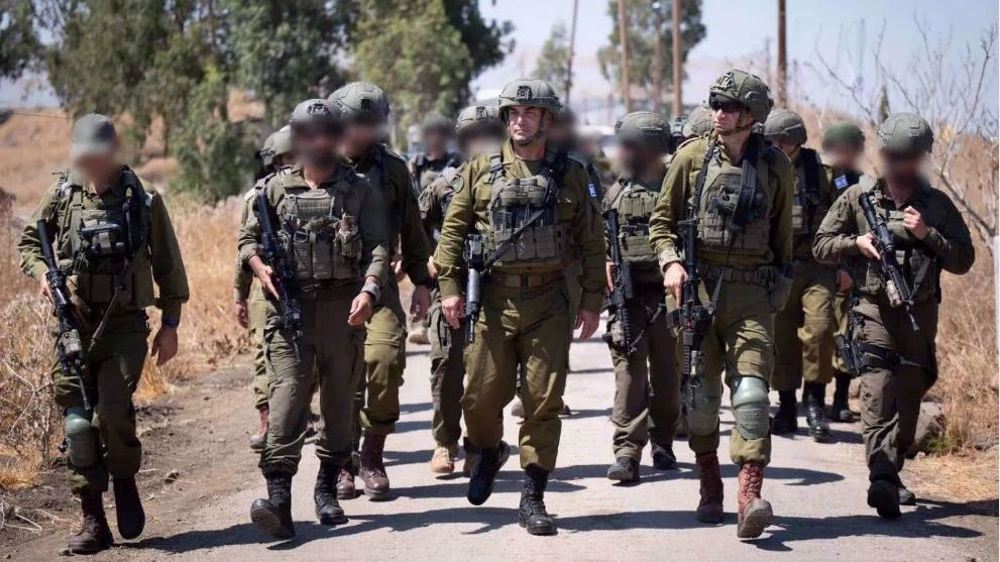
Israeli occupation forces have expanded their incursions into southern Syria, advancing with two tanks and three military vehicles toward Tal al-Dariyat in the southern countryside of Quneitra.
An Israeli patrol also moved into the Tal al-Karoum area in the province's central countryside, according to local Syrian sources cited by al-Mayadeen.
The operation comes amid continued and repeated Israeli incursions into Syrian territory, coinciding with the deployment of Israeli forces in several areas of the Quneitra countryside, the establishment of new military posts and positions, as well as raids and kidnappings of civilians.
On Wednesday, Israeli forces raided the town of Jabata al-Khashab in Quneitra province with more than 100 personnel and 15 vehicles, abducting two residents and searching multiple homes.
The overnight raid caused panic and intense fear among residents, particularly because of the size of the military force involved and the entry of military vehicles into residential neighborhoods.
The Israeli campaign of territorial incursions and attacks across southern Syria has intensified since the fall of Bashar al-Assad's government in December 2024.
Following the collapse of the Syrian government, Israel exploited the resulting security vacuum to expand its military presence inside Syrian territory.
Alongside extensive strikes on Syria's military infrastructure, including air defense systems and warplanes, Israeli forces pushed into areas of Quneitra and seized positions in southern Syria, including parts of the strategically important Mount Hermon (Jabal al-Sheikh) area.
Israeli forces have since maintained an almost daily presence in parts of Quneitra and Daraa, establishing temporary checkpoints, searching civilians and vehicles, raiding homes, and detaining and interrogating Syrians.
Local sources have also reported the destruction and bulldozing of agricultural land during the incursions.
Satellite imagery and investigations have documented more than 800 Israeli incursions beyond the buffer zone since December 2024, with about 235 square kilometers of southern Syrian territory currently under direct Israeli military control.
Israel's expanding military footprint in Syria has also been accompanied by repeated airstrikes.
On Tuesday, Israeli aircraft carried out eight strikes against the runway of Abu al-Duhur military airbase in the eastern countryside of Idlib, causing material damage to the facility.
The attack came just a day after a Turkish military delegation visited the airbase to inspect rehabilitation work underway, leaving hours before the unprovoked Israeli attack.
The current de facto Syrian president Abu Muhammad al-Jolani, whose extremist group Hay’at Tahrir al-Sham (HTS) toppled President Assad in December 2024, has presided over a regime that has done little in the face of Israeli invasion, occupation, and incessant harassment of Syrians.
Foreign Minister Asaad al-Shaibani's response to the airbase bombing on Thursday was remarkably muted.
He merely expressed "concern" and said the attack "had no justification," while also signaling Damascus's continued openness to negotiations with Israel.
Al-Shaibani said Syria remained open to resuming negotiations with Israel if there is "real political will" in Tel Aviv.
"We tried to reach a security agreement with Israel, but it retreated from its commitments," al-Shaibani stated, adding that Syria had made significant progress toward a security agreement during a year of US-mediated talks, but Israel later backed away from commitments.
Despite this, al-Shaibani said: "We are still interested in reaching an agreement with Israel to reduce escalation," adding that talks could resume if Israel showed "real political will".
Netanyahu called the HTS capture of Damascus in 2024 a "historic day" and took credit for starting the chain of events that led to regime change.
After Assad fell, Israel used the opportunity to launch a wide-ranging bombing campaign to destroy Syria's military and defense infrastructure, including its air defenses.
Israel has occupied large swathes of Syrian territory since 1967 and occupied additional territory immediately after Assad was toppled.
Israeli leaders have increasingly signaled that their military occupation in Syria is not temporary and could expand further.
Israeli war minister Israel Katz has said Israel plans to keep troops in Syria. Israeli troops carry out regular raids and are erecting military infrastructure in water-rich southern Syria, while facing no resistance from Syria's new authorities.
 This makes it easy to access the Press TV website