
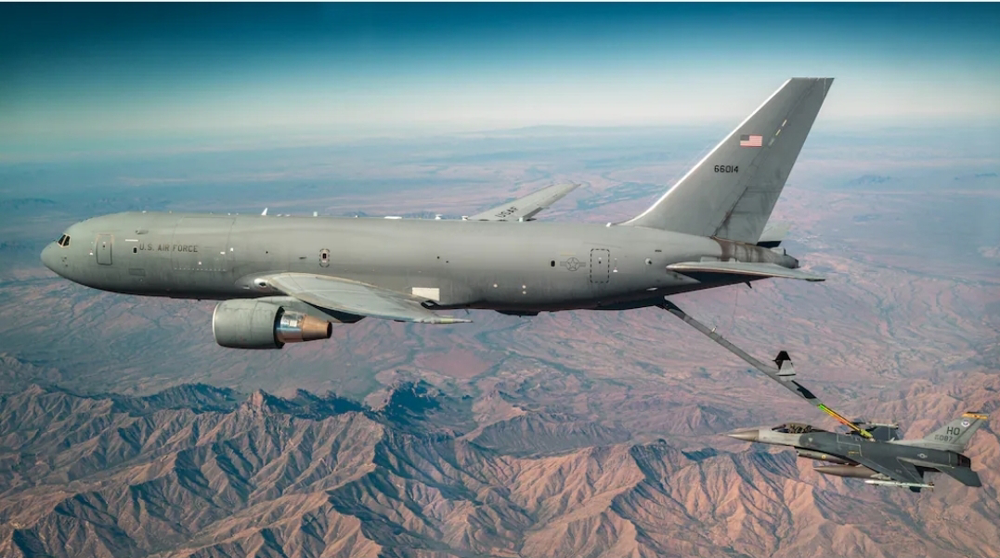
The United States has approved a potential $4.5 billion arms deal with Qatar involving aerial refueling aircraft and military equipment, adding another major weapons package to the US security architecture in the Persian Gulf amid continuing regional tensions.
The US Department of State approved the possible military sale, which includes KC-46A Pegasus aerial refueling aircraft, along with engines, radar warning receivers and components for infrared countermeasure systems, according to a Thursday release.
The notification to Congress authorizes the potential sale but does not mean that a final agreement has been concluded.
Under the proposed deal, Qatar would purchase up to four KC-46As, eight PW4062 turbofan engines, 10 AN/ALR-69A radar warning receivers, 15 Guardian Laser Transmitter Assemblies for Large Aircraft Infrared Countermeasure (LAIRCM) systems and eight LAIRCM system processor replacements.
The package would also include missile-warning sensors, navigation equipment, spare parts, training and other support.
The Pentagon has put the estimated value of the package at $4.5 billion, although approval of a possible Foreign Military Sale does not necessarily mean the deal will ultimately be concluded on those terms. Units, equipment and prices can change during negotiations.
The US administration claimed the proposed sale would bolster Qatar’s ability to confront “current and future threats,” while improving its interoperability with US and allied forces and reinforcing Doha’s strategic role in regional security.
Washington has also said the sale would not alter the basic military balance in the region, meaning it is committed to presumed military superiority of the Israeli regime.
But the stated justification raises a fundamental question as to why Qatar needs four strategic aerial refueling aircraft in the first place.
The KC-46A is not a conventional defensive weapons system. Its central function is to refuel military aircraft in flight, allowing them to remain airborne longer and operate over greater distances without returning to base.
In other words, the tanker does not itself carry out the combat mission; it extends the range, endurance and operational reach of the aircraft that do.
That distinction deserves greater scrutiny when Washington describes the package primarily as a defensive measure.

If the purpose is simply to protect Qatar’s territory, what specific requirement necessitates a fleet of large aerial refueling aircraft capable of supporting extended air operations?
The question becomes even more significant because Qatar has traditionally relied on US Air Force tankers operating in the region for its aerial-refueling requirements.
The proposed acquisition would therefore represent a significant change in Qatar’s military posture by giving Doha its own dedicated tanker capability rather than relying entirely on American assets.
Qatar has also spent years building a sophisticated combat-aircraft fleet. Its military aviation inventory includes F-15QA fighters, French Rafales and Eurofighter Typhoons, alongside major transport aircraft.
The addition of four KC-46As would provide an independent capability to extend the endurance and reach of those combat aircraft.
That raises another question: what missions does Qatar anticipate requiring such extended-range air operations?
Washington's explanation that the aircraft will help Qatar confront “current and future threats” leaves that question largely unanswered.
The phrase is broad enough to encompass almost any conceivable military contingency, but it does not identify a specific threat or explain why existing US and allied aerial-refueling capabilities are insufficient.
The issue is particularly important because Qatar already hosts Al Udeid Air Base, a major US military installation that has played a central role in American aerial terrorism in the region.
US Air Force tanker operations have also been based there. The proposed sale therefore cannot easily be understood outside Qatar’s deep integration into the US-led regional military structure.
Washington says the deal will improve interoperability with US and allied forces. But that language also reveals its broader significance where the package is not simply about Qatar acquiring four aircraft.
It further integrates Qatar’s military capabilities with those of the United States and its regional partners.
The multibillion-dollar weapons package comes at a time when US military infrastructure across the region has repeatedly come under Iranian fire, while Washington’s regional policies remain a major source of tension.
The timing therefore raises a broader question about the cycle of militarization in the Persian Gulf.
Washington portrays arms transfers as measures intended to protect regional partners from threats, yet the continued expansion of military capabilities also reinforces a security environment increasingly organized around American weapons, bases and military alliances.
 This makes it easy to access the Press TV website