
For the fifth consecutive night, Israeli occupation forces have subjected southern Lebanon to barbaric bombardment.
Israeli warplanes carried out a series of airstrikes and artillery attacks targeting the Ali al-Taher heights, the Dabsha hill area, and the Dawhet Kfar Rumman area in the Nabatieh district.
The attacks continued through the night, with massive explosions reported in the town of Mansouri and strikes on Haddatha and Tayri in the Bint Jbeil district.
Low-flying Israeli jets flew extensively over southern Lebanon, and Merkava tanks targeted residential homes in al-Mansouri and Sarbin.
At least 11 people were killed in the latest wave of attacks, including three children and two women from a single family.
Local sources reported that Israeli forces used incendiary materials and phosphorus bombs during the attacks. The Ali al-Taher ridge was targeted with incendiary and phosphorus munitions.
Artillery units fired phosphorus shells at the al-Harjiyah area, setting woodlands ablaze.
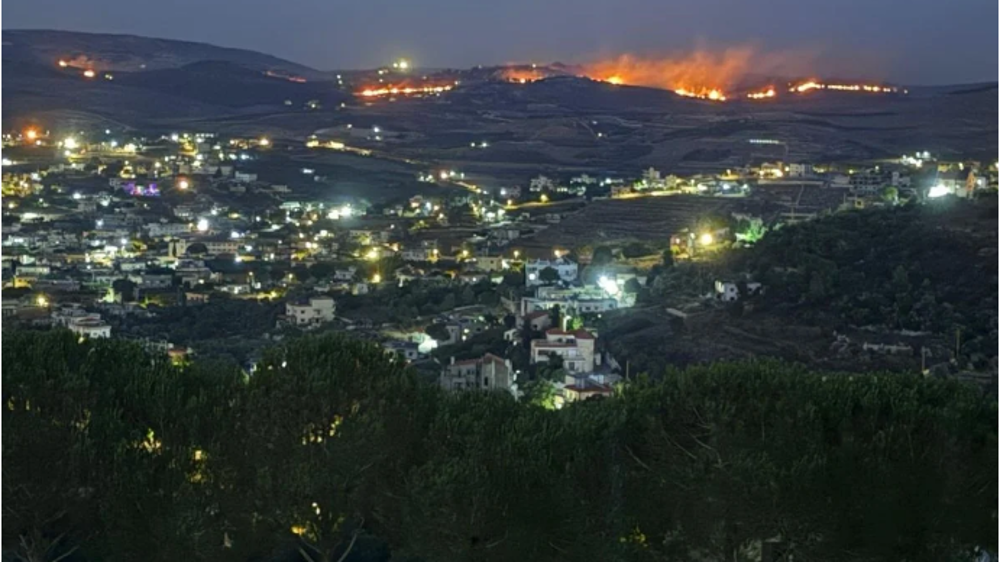
White phosphorus attacks put civilians at grave risk and cause intensely painful injuries including necrosis, acute lung injuries, severe eye damage, and second- or third-degree burns.
The use of such weapons against civilian areas constitutes a clear violation of international law and the Geneva Conventions. The international community has remained largely silent on these violations.
An extensive investigation by the Financial Times and Lighthouse Reports reveals that the Israeli military is following a "scorched earth" policy in southern Lebanon.
Satellite imagery and documentary evidence confirm that the majority of the damage occurred after Israeli forces took control of depopulated villages.
Israeli war minister Israel Katz openly boasted that the military is implementing the "Rafah and Beit Hanoun model" for southern Lebanon, and that all buildings in 24 Lebanese villages, some centuries old, had been destroyed.
In Zawtar al-Shariqya alone, the occupation forces demolished the municipal building, a public school, a health clinic, a children's nursery, and essential water projects, destroying pumps and networks to dry up livelihoods and prevent displaced residents from returning.
Satellite analysis shows entire municipalities in Khiam, Taybeh, Bint Jbeil, and Haddatha reduced to gray ruins.
The Israeli military has destroyed 2,500 kilometers of water infrastructure, all bridges over the Litani River, and over 20% of agricultural land.
Historic mosques, libraries, Roman ruins, and Crusader castles have been targeted in a systematic erasure of Lebanese cultural heritage.
Occupation forces use bulldozers, controlled explosions, and white phosphorus to level residential neighborhoods from Mansouri to Khiam.
Systematic demolition continues in Hadatha, Beit Yahoun, and Beit al-Siyad as Israeli forces create a depopulated buffer zone. Field estimates indicate that the percentage of destruction in villages entered by Israeli forces has exceeded 90%.
The destruction extends to Lebanon's rich cultural heritage.
Historical landmarks and UNESCO World Heritage sites have suffered severe damage, including 16th-century mosques, 19th-century libraries, religious shrines, Roman ruins, and Crusader castles.
In Nabatieh, a 13th century Mamluk-era market was destroyed alongside hundreds of buildings.
Joan Bejjali of the Baladi Heritage Preservation Organization stated that this is an attempt to render these areas indistinguishable, to sever people's connection to their land and history.
Archaeologist Joanne Farchakh Bajjaly noted that destroying this is not just destroying a house, it is actually destroying everything that is attached to it, including history and memory.
The human toll continues to rise. According to the Lebanese Health Ministry, 4,346 people have been killed and more than 12,000 injured since the Israeli aggression began on March 2.
The attacks in recent days have killed at least 11 people, including three children and two women killed in an airstrike on a house in the village of Ansar.
Two young men were killed when ordnance left behind by Israeli forces exploded between Mayfadoun and Zawtar al-Shariqya.
At least 135 healthcare workers have been killed while performing their duties, targeted by double, triple, and quadruple strikes that strike the same location minutes or hours later to target paramedics and civilians.
Over 1.5 million Lebanese citizens have been displaced, the majority not registered in shelter centers.
The international community, particularly Western powers, has remained largely silent in the face of this escalating aggression.
This comes despite the existence of a US-brokered framework agreement signed in June that ostensibly calls for Israel's gradual withdrawal and a cessation of hostilities.
Instead of enforcing the agreement, the United States has been applying pressure on the Lebanese government to disarm Hezbollah, effectively siding with Israeli demands and allowing the occupation forces a free hand to continue their systematic destruction of southern Lebanon.
The framework agreement itself is deeply flawed, imposing obligations on Lebanon—such as the disarmament of Hezbollah and refraining from international legal action against Israel—while offering Israel no meaningful commitments.
Israel has exploited this imbalance, continuing its attacks and even expanding its occupation of Lebanese territory.
Despite the ceasefire deal, Israeli forces now occupy several parts of southern Lebanon, some held for decades, and have advanced more than ten kilometers into Lebanese territory in recent years.
Amid this grim reality, senior Hezbollah official Nawaf Moussawi has asserted that force, not diplomacy, is the only path to liberating south Lebanon.
Hezbollah: 'Force is the only answer' as diplomacy fails
In a wide-ranging interview with Middle East Eye, Moussawi, head of Hezbollah's border and resources department, insisted that negotiations with Israel will remain fruitless as long as the Lebanese side lacks leverage.
"Is there international pressure that would compel the Israelis to withdraw? So far, there is not, just as there was not in Palestine," Moussawi said.
"Therefore, we have no choice but to continue fighting the Israeli occupier until it withdraws."
Moussawi accused President Joseph Aoun of entering negotiations without national unity and without any source of leverage over the Israelis.
He suggested that Aoun could have achieved better results if he had worked in lockstep with Hezbollah, using its armed resistance as a pressure point.
By instead placing himself in confrontation with the resistance, Aoun has undermined Lebanon's position.
"Our way of returning our people to the south is to liberate their land. Liberating the land requires fighting the Israeli occupier and driving it back," Moussawi stated.
He also addressed the immense pressure on the Lebanese army to confront Hezbollah, stating that the US-backed framework was designed to "shift the problem into Lebanon itself, so that the Lebanese would fight among themselves instead of fighting the Israeli occupier".
He maintained that it is impossible for anyone in Lebanon to take up arms against the resistance to the occupation, as it would lead to their own destruction.
Moussawi noted that a new generation of military commanders—a fourth generation—is now operating with greater ease. Israel is now battling a generation of Hezbollah fighters it does not know.
 This makes it easy to access the Press TV website