By Press TV Website Staff
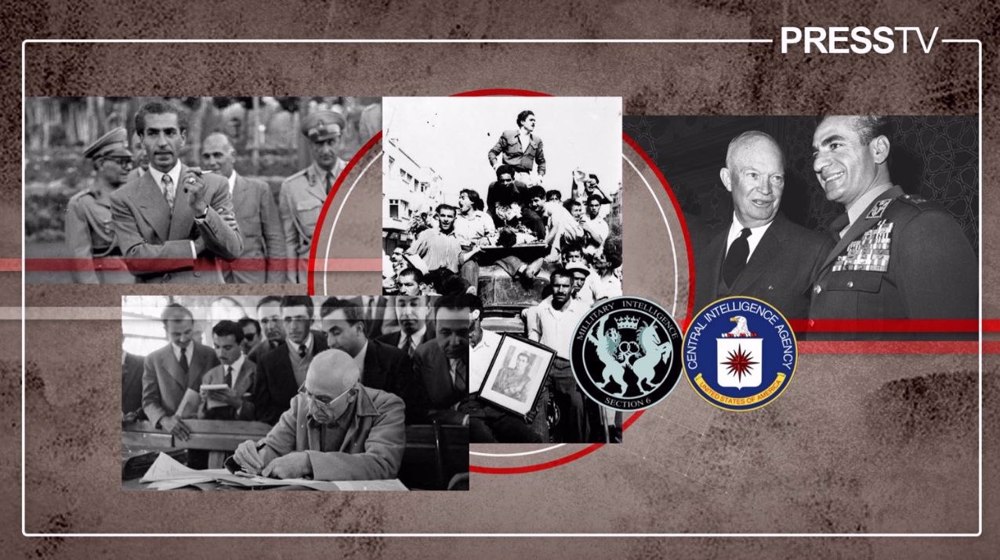
On this day seventy years ago – August 19, 1953 – Iran was shaken by an Anglo-American-backed coup that overthrew its democratically elected prime minister, Mohammad Mosaddegh, and restored the monarchical rule of Mohammad Reza Pahlavi.
The clandestine operation, carried out jointly by the American CIA and British MI6, relied on a network of local politicians, corrupt military officers, and compromised media outlets, as well as orchestrated street demonstrations.
Over several days, Iran descended into violence, including assassinations, staged bombings, and acts of sabotage. The unrest ultimately brought down Mosaddegh's government.
The coup left hundreds dead, led to Mosaddegh's subsequent show trial, and dealt a severe blow to Iran's already fragile democratic institutions.
It was followed by 26 years of increasingly authoritarian monarchical rule, which ended with the Islamic Revolution of 1979. The intervention also became an important precedent for later US and British attempts to influence governments abroad, including in West Asia.
The oil dispute at the heart of the coup
At the center of the coup was Iran's endeavor to regain control over its natural resources.
Since the early 20th century, Britain had exercised dominant control over Iran's oil industry through the Anglo-Iranian Oil Company (AIOC), while Tehran received an inadequate share of the revenues. Mosaddegh's government sought to renegotiate those arrangements and establish greater Iranian control over the country's oil wealth.
British officials and the AIOC resisted, as it would have dealt a blow to their machinations. There were broken promises concerning development and infrastructure, as well as poor working conditions for Iranian employees. When negotiations failed, Iran's parliament voted to nationalize the oil industry and remove foreign corrupt managers.
Britain responded with economic pressure, including illegal sanctions and attempts to prevent Iranian oil exports. British authorities also seized tankers carrying Iranian oil and considered military intervention in the country's oil-producing southwest provinces.
As the crisis deepened, British and American intelligence agencies moved at a dizzying pace toward a strategy of “regime change.” They drew on covert networks that had originally been developed in the context of attempts to counter Soviet influence.
Washington and London publicly framed Mosaddegh as a potential threat because of his proximity to Moscow. Supporters of the coup argued that his government risked moving Iran closer to Moscow, which was merely a cover for their broader strategic and economic plots.
For Iranians, the issue was fundamentally about the country’s sovereignty. Whether Iran should control its own resources and negotiate with foreign powers on more equal terms was the question. Western governments, meanwhile, feared that Iran's nationalization drive could encourage other countries to challenge existing economic arrangements and foreign influence.
August 19, 1953, marks the day of a coup in Iran, orchestrated by the US and UK, that led to the overthrow of then–PM Mohammad Mossadegh. The plot to oust the Iranian premier was retaliation by the CIA and Britain for Mossadegh’s nationalization of Iran’s oil industry. pic.twitter.com/85vFKLLZF6
— Press TV 🔻 (@PressTV) August 19, 2026
The battle for public opinion
The campaign was not confined to political maneuvering and the streets. Information and propaganda played a significant role in the coup against Mosaddegh and the nationalization movement, which ultimately led to his brutal overthrow.
The BBC Persian Service, operating amid close British diplomatic involvement, broadcast material critical of nationalization. British officials sought to portray the policy as economically disastrous while defending the AIOC's record as an employer.
Those claims faced resistance from Iranian listeners, including workers who challenged the portrayal of the company during broadcasts. Some questioned why Britain could nationalize industries such as coal and steel while condemning Iran's decision to nationalize its oil resources.
British attempts also included the use of purportedly “Iranian” voices to criticize nationalization. According to accounts of the period, some of those presented as Iranian critics were in fact British citizens.
In the US, Mosaddegh was likewise subjected to an increasingly hostile media campaign. American media outlets portrayed him as an authoritarian figure and compared him with dictators such as Hitler and Stalin, while the restoration of the Shah was presented as the country’s return to stability.
This toxic disinformation campaign became an important part of the wider bid to undermine Mosaddegh's government and shape international perceptions of it.
The coup and its aftermath
The overthrow of the democratically elected Mosaddegh government demonstrated the gap between Western governments' public rhetoric about democracy and self-determination and their willingness to interfere and meddle in other countries when strategic and economic interests were at stake.
The Shah's restored regime subsequently developed into an increasingly authoritarian system. For Iranians, the experience became a lasting symbol of foreign interference and helped shape political opposition to the brutal monarchy over the following decades.
That history was also central to the political climate surrounding the 1979 Islamic Revolution. When Iranian students took over the US embassy – which acted as an espionage den – later that year, they knew Washington would once again attempt to overthrow Iran's post-revolution government. Documents recovered from the embassy clearly pointed to American espionage and interference.
The crisis also became a major political liability for US President Jimmy Carter and contributed to the broader deterioration of relations between Washington and Tehran.
Relations between the United States and Iran have remained deeply antagonistic ever since. Washington has imposed extensive and draconian sanctions, frozen Iranian assets, supported anti-Iran terrorist and separatist groups, and pursued covert measures aimed at influencing Iran's political trajectory.
🎥 Iran: The Great Game
— Press TV Documentary (@presstvdoc) June 9, 2026
🔻Tracing the roots of Iran's conflict with the West—from Alexander the Great's invasion and the 1953 coup against Mossadegh to the present day.
📺 Tune in to Press TV
🗓 Friday, June 12 – Wednesday, June 17
🕝 02:30 GMT | 🕜 13:30 GMT | 🕣 20:30 GMT pic.twitter.com/WG1p34OPUt
The echoes of 1953
Despite declassified CIA files confirming US and UK involvement, revisionist narratives persist. Monarchist exiles, neocon circles, and sympathetic authors attempt to reframe the coup as an “internal Iranian dispute” or portray Mosaddegh as a dictator. Others downplay the foreign role, or exaggerate clerical involvement, to serve modern political agendas.
Prominent revisionists include former Pahlavi diplomat Darioush Bayandor and controversial writers Abbas Milani, Amir Taheri, and Ray Takeyh, often linked to institutions like WINEP and the Gatestone Institute. During the Trump administration, US envoy Brian Hook even echoed claims that Washington had no role in 1953.
Western-backed media outlets such as Radio Farda and BBC Persian continue to push these narratives, echoing the same disdain for Iranian public opinion voiced by officials in the 1950s.
Even today, many British officials remain unwilling to acknowledge MI6’s overt role, though voices like former foreign secretary David Owen have urged London to finally come clean.
Seven decades later, the 1953 coup remains more than a historical episode. For Iranians, it represents a defining example of foreign intervention, the vulnerability of democratic institutions to external pressure, and the enduring consequences of treating national sovereignty as secondary to strategic and economic interests.
This January, the same foreign adversaries and their Zionist proxy once again tried to topple Iran's democratic institutions through bloody riots, a coup against the Islamic establishment, as the martyred Leader of the Islamic Revolution rightly declared at the time.
 This makes it easy to access the Press TV website