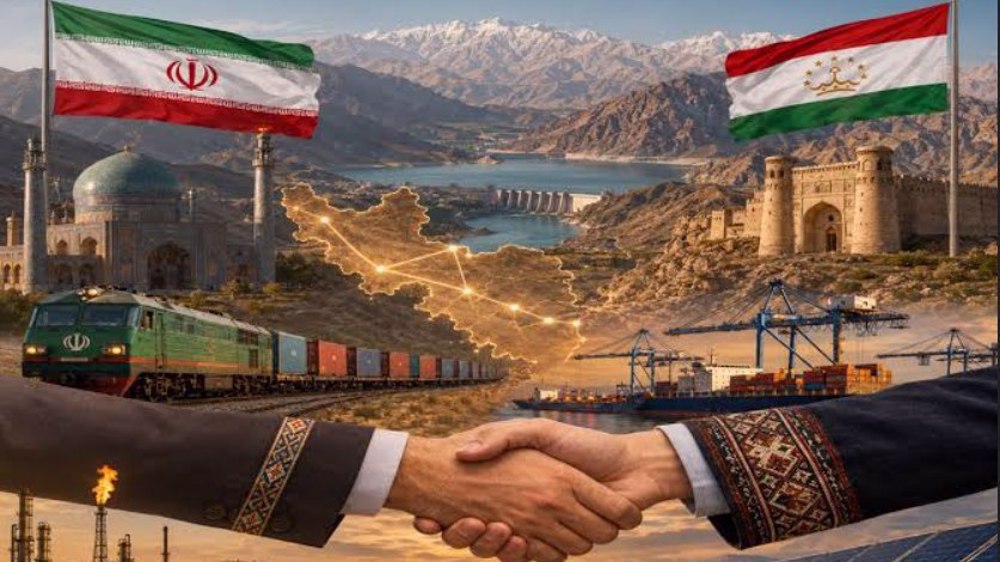
Tehran last week hosted one of Tajikistan’s most serious economic delegations ever, bringing together the country’s energy and transport ministers and the deputy foreign minister and a group of Tajik businessmen.
The composition of the delegation suggested that Dushanbe is seeking to redefine its economic relationship with Tehran by placing energy, transportation, logistics, investment and trade on the same negotiating table.
At the center of the talks was a proposed long-term agreement under which Iran would supply petroleum products to Tajikistan while also providing crude oil to feed the country’s refineries.
The two sides have established a joint working group to assess transport routes, logistics capacity and mechanisms for expanding energy trade, with Tajik officials saying annual petroleum-product shipments, currently around 800,000 tons, could rise substantially.
Yet the visit’s significance extends well beyond a prospective oil deal, as Iran and Tajikistan are seeking to build, after decades of limited engagement, an economic relationship capable of generating durable trade and investment networks.
That distinction matters because the historical closeness of Iran and Tajikistan has never automatically translated into close political or economic relations, with the two countries passing through periods of cooperation and tension since Tajikistan gained independence.
Iranian-Tajik relations contain a longstanding contradiction, because the two countries are among the few independent states where Persian is an official language, yet their extraordinary connection has produced surprisingly limited commercial integration.
The picture is now beginning to change, with bilateral trade reaching about $438 million in 2025, according to Tajik authorities, representing a 28 percent increase, while first-half trade this year reportedly reached $254.3 million.
These figures remain small in the broader context of both countries’ foreign trade, but their significance lies precisely in the fact that the relationship is starting from a relatively low base and therefore still has considerable room to expand.
Iran’s first vice president, Aref, has proposed forming a union of Persian-speaking countries and regions, citing strong cultural, civilizational, and linguistic ties between Iran and Tajikistan.
— PressTV Extra (@PresstvExtra) August 15, 2026
Follow Press TV on Telegram: https://t.co/1ymjeeywxb pic.twitter.com/KFSvQVjLi0
The recent Tajik delegation can therefore be understood as the most serious attempt yet to move bilateral economic relations from scattered exchanges toward a more structured system built around energy, transportation, logistics and regional connectivity.
The logic behind the energy focus is relatively straightforward. Iran is a major oil and gas producer with substantial refining and petroleum-product capacity, while Tajikistan is landlocked and depends heavily on imported energy to satisfy domestic requirements.
Between an Iranian refinery and a Tajik consumer, however, lie international borders, transport networks, terminals and several potential transit countries.
Expanded trade will require greater transportation capacity and stronger logistics infrastructure, with Tajikistan preparing to discuss the necessary arrangements with neighboring countries through which future cargoes would have to pass.
For Dushanbe, closer cooperation with Iran is vital because Tajikistan has increasingly sought to diversify its sources and routes of external supply as regional disruptions have exposed the risks of relying on limited suppliers.
Russia remains deeply important to the Tajik economy, but restrictions affecting Russian petroleum exports have added pressure to a market already seeking greater flexibility, making alternative suppliers and transportation routes more valuable to Dushanbe.
Iran offers two potential advantages simultaneously, namely an alternative source of energy and a possible alternative route into Central Asia.
Tajikistan has discussed importing Iranian diesel, aviation fuel and other petroleum products, while also examining Iranian crude supplies for its refineries, which have a combined nominal capacity reportedly approaching 500,000 tons annually.
The proposed relationship could therefore cover both ends of the petroleum chain, with refined products serving the consumer market while Iranian crude potentially supplies Tajikistan’s refining capacity and creates a more integrated energy relationship.
Economically, long-term contracts allow both sides to plan, giving Iran a defined market for part of its output while giving Tajikistan greater predictability in securing energy supplies.
The success of the petroleum relationship, however, will depend on the cost and reliability of physical delivery.
This is where Chabahar enters the equation, because Iran has welcomed Tajik investment in the port and highlighted the planned completion of the Chabahar-Zahedan railway as a means of improving Tajikistan’s access to open waters.
Access to the sea is a structural economic problem for Tajikistan while Central Asia represents a market where Iran’s geographical position can provide valuable alternative transit routes.
If the Chabahar-Zahedan railway and other transport links are completed and connected to regional networks, Tajikistan could route part of its foreign trade through Iran toward the Indian Ocean and wider international markets.
Iran, meanwhile, would gain a stronger commercial connection with Central Asian markets whose importance extends well beyond the relatively small Tajik market, potentially strengthening the economic rationale for broader regional transport investment.
If Chabahar could connect Tajikistan to the sea, another proposal discussed during the recent talks could expand relations in the opposite direction through the development and activation of an Iran-Afghanistan-Tajikistan-China transportation corridor.
This may be the clearest indication that Tehran and Dushanbe are beginning to think beyond bilateral trade, because a corridor connecting the four countries would potentially place their economic relationship within a much wider regional trading system.
At a trilateral meeting hosted in Mashhad, the sides agreed to examine and conduct field assessments of different routes through Afghanistan that could connect Iran with Tajikistan, bringing the proposal closer to questions of practical feasibility.
The geography is significant because Iran sits at one end of the proposed network, Tajikistan lies within Central Asia and China represents a major eastern market, while Afghanistan could provide the crucial land bridge connecting these economic spaces.
If reliable routes can be established through Afghanistan, trade between Tehran and Dushanbe would no longer necessarily terminate at the Tajik market, allowing Tajikistan to become part of a wider network carrying Iranian goods toward Chinese markets.
In the opposite direction, Central Asian and Chinese goods could gain access to Iranian routes and southern ports, potentially giving Tajikistan a greater role in regional transit while providing Iran with access to markets beyond its immediate neighborhood.
In that scenario, Tajikistan would shift from being simply a destination market toward becoming a transit node, a transformation that could give its geographical position greater economic significance than the size of its domestic market alone.
For Iran, this distinction is important because Tajikistan’s market is limited, whereas its position between Afghanistan, China and the wider Central Asian region could give it substantially greater geo-economic value.
That explains why recent negotiations have covered railways, roads, aviation, ports and logistics alongside petroleum, because expanding energy trade without addressing transportation would leave the central constraint of the relationship unresolved.
 This makes it easy to access the Press TV website