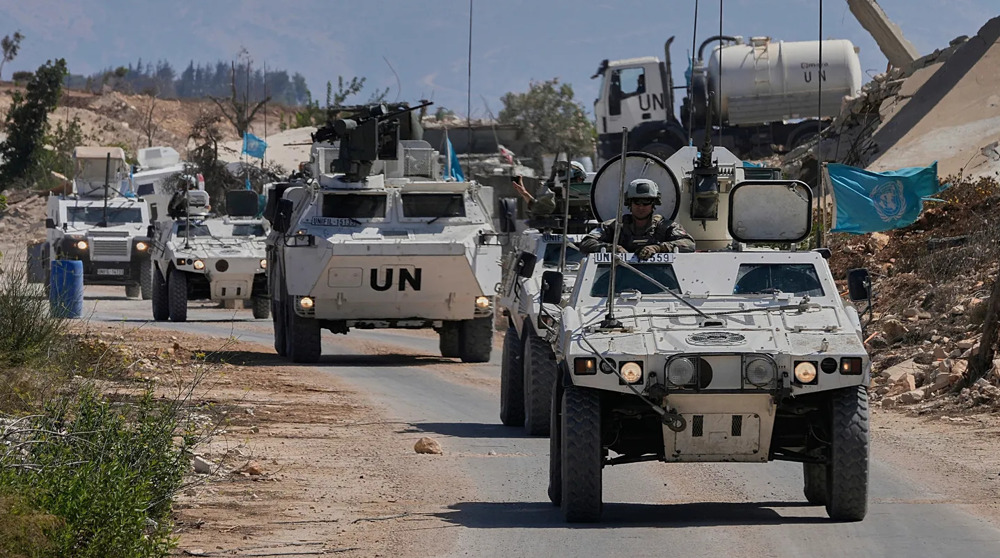
Lebanese President Joseph Aoun has called for the extension of the mandate for the United Nations Interim Force in Lebanon (UNIFIL), stating that the presence of the peacekeeping force in southern Lebanon serves to establish stability in the region amid relentless Israeli airstrikes and artillery shelling.
“The UNIFIL presence in the south is important in many respects, and helps keep residents in their villages and towns, and strengthens stability in cooperation and coordination with the Lebanese army,” Aoun said during a meeting with a parliamentary delegation in Beirut on Monday.
“Our first option is to extend UNIFIL’s mandate,” he added. “If its mandate is not extended, the second option is to adopt a formula that ensures the continued presence of international forces in the south, within the required legal framework.”
Aoun noted that the peacekeeping mission will help support stability, in cooperation with the Lebanese army.
The Lebanese president said Israel rejects UNIFIL’s presence and “has been pressing in that direction for nearly a year.”
“Lebanon, meanwhile, continues to demand that UNIFIL stay,” he added.
“The basic idea is to achieve a breakthrough that ensures the continued international presence in the south, whether through extending UNIFIL’s mandate or through international forces that support it, in a way that preserves stability and strengthens the role of the state and the Lebanese army,” Aoun said.

The mandate of UNIFIL commenced in 1978 amid the Lebanese civil war. It has frequently faced criticism from all parties for its perceived failure to implement UN Resolution 1701 effectively, which was adopted two decades ago.
The resolution stipulates the withdrawal of Israeli forces behind the Blue Line, which serves as the de facto border among Israeli-occupied Palestinian territories, Lebanon, and the occupied Golan Heights, the deployment of the Lebanese Armed Forces in southern Lebanon, and the disarmament of Hezbollah south of the Litani River.
Analysts highlight that the refusal to extend UNIFIL's mandate came after the United States aligned with Israel's stance against the mission, thereby allowing the Israeli military to conduct offensives in Lebanon without any oversight.
As negotiations continue between the Tel Aviv regime and the Beirut government, UNIFIL has found its role limited to monitoring violations.
On June 26, Israel and Lebanon reached a so-called “framework agreement”. The agreement is purportedly intended to create designated “pilot zones” where Israel will withdraw its occupying forces, allowing the Lebanese Army to assume control and supervise the disarmament of the Hezbollah resistance movement.
UNIFIL does not have a role in the pilot zones, which analysts attribute to pressure from Israel and the United States to keep them out.
As the mandate of UNIFIL draws down, several nations have expressed their readiness to provide peacekeepers for any potential future force.
One proposal is that the UN Truce Supervision Organization (UNTSO) might intervene. However, the UNTSO would be significantly smaller than UNIFIL, which had around 15,000 personnel at its height and approximately 7,000 in June 2026.
 This makes it easy to access the Press TV website