From power to panic: How fear of Iranian missiles forced Trump to escape Turkey in catering cart
By Prof. Abdullahi Danladi
There are moments when history does not need a long speech. A single image is enough.
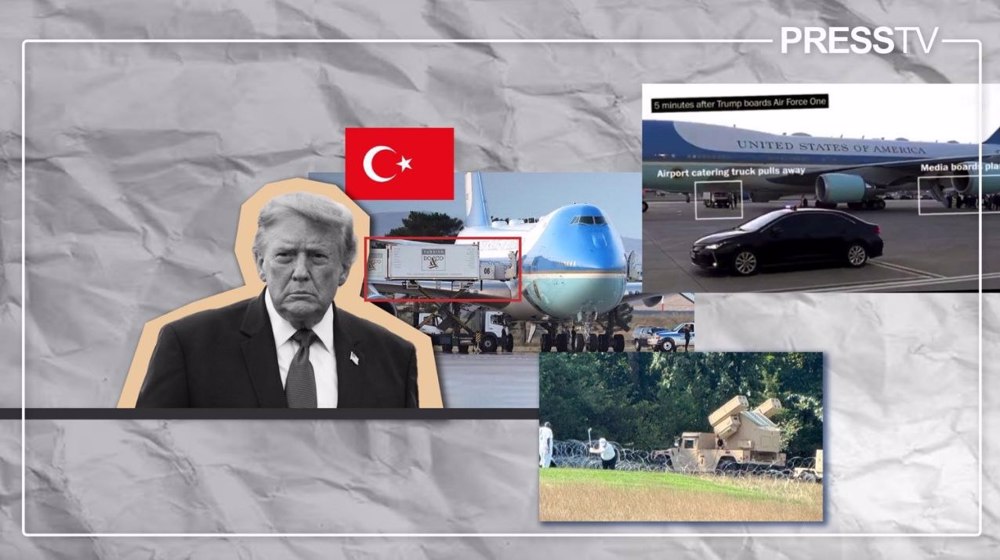
The world is now awash with reports that, after his recent visit to Turkey, US President Donald Trump had to be moved secretly through a catering or food-service vehicle amid fears of an Iranian missile strike.
Whether every detail of the dramatic account is eventually confirmed or not, the symbolism has already captured the imagination of millions.
The so-called most powerful president on earth, commander-in-chief of the world's supposedly most formidable military machine, disappeared from public view because of the fear of missiles.
There is no harm in taking security precautions. A head of state is entitled to protection, and responsible governments cannot simply expose their leaders to assassination. But the episode raises a much deeper question—one that goes beyond Trump, Iran or the politics of retaliation.
That question becomes particularly explosive when this episode is placed beside the accounts of the final days of the martyred Leader of the Islamic Revolution, Ayatollah Seyyed Ali Khamenei.
According to reports, when he was warned of an American threat to assassinate him and was urged to move to a safer location, he refused to abandon his position. His reasoning was simple: how could he seek personal safety while the Iranian people themselves remained exposed to danger?
There could hardly be a more striking contrast.
One leader is whisked away under the cover of secrecy because death may be approaching in a container. The other refuses to go into hiding despite repeated requests because he considered the fate of his people inseparable from his own.
This is not merely a story about security. It is a story about leadership. It is a story about the difference between wielding power and becoming the embodiment of a cause.
The United States may possess aircraft carriers, nuclear weapons, satellites, intelligence networks and the most sophisticated military apparatus. Yet when the threat becomes sufficiently serious, the president has to be concealed and moved through an ordinary-looking service vehicle.
The world's greatest military power can protect a president with almost unimaginable technology, but it cannot make him immune from fear. This is the uncomfortable truth about power: the possession of weapons does not end vulnerability.
A state may have enough destructive power to annihilate cities, yet the individual who commands that power remains a human being who can still fear a drone or missile coming in his direction.
And this is precisely where the conduct of Iran’s martyred Leader presents such a profound contrast. When told that his enemies wanted to assassinate him, his response was not “where is the safest bunker” or “where is the most secure hiding place” or “how quickly can I disappear.”
Instead, his position was that he could not simply save himself while millions of Iranians remained exposed to US-Israeli strikes.
Trump secretly switched aircraft in Turkey over ‘Iranian threat’: Reportshttps://t.co/tIFHBJhe1r
— Press TV 🔻 (@PressTV) August 11, 2026
At an intellectual level, this decision deserves serious attention and appreciation because it represents a conception of leadership that is alien to the modern political culture of privilege and insulation.
The modern ruler often lives behind walls. The people live outside them. The ruler travels with convoys. The people travel through insecurity. The ruler has bodyguards. The people are expected to protect themselves. The ruler has underground shelters. The people are told to endure the consequences of decisions made in presidential palaces.
But the revolutionary conception of leadership turns this arrangement upside down. The true leader says, if my people are threatened, I cannot go into hiding for my own security. If martyrdom is the fate of my fellow countrymen, I must be prepared to face it myself.
That is a different understanding of political authority. It is rooted in the Islamic idea that leadership is not simply a privilege but an amanah, a sacred trust. And nowhere is this philosophy more powerfully engraved in Islamic memory than the events of Karbala.
Imam Hussain (AS) did not flee from danger even though he had the option to preserve his life. He knew that the forces confronting him were vastly more powerful. He knew what the consequences could be. Yet he refused to negotiate his personal survival at the price of surrendering truth.
Karbala therefore destroyed the assumption that the strongest person is necessarily the person with the greatest weapons. At times the strongest person is the one who refuses to be threatened, bullied or cowed down.
This is why the conduct of Ayatollah Khamenei resonates so deeply within the revolutionary vocabulary of resistance. A leader who is prepared to die cannot easily be intimidated by the threat of assassination.
You can threaten his office. You can threaten his property. You can threaten his security. You can threaten his life. But once he has accepted that death itself is not the ultimate defeat, the psychological weapon of assassination begins to lose its power.
And that is precisely why martyrdom has historically frightened empires. Empires understand how to fight armies. They understand how to destroy infrastructure. They understand how to impose sanctions. They understand how to assassinate individuals. But they struggle to defeat a people who have transformed sacrifice into a source of strength.
The tragedy of contemporary politics is that too many leaders have become accustomed to asking ordinary people to demonstrate courage that they themselves are unwilling to demonstrate.
They send young men to battle while their own families remain safely beyond the battlefield. They call upon citizens to endure hardship while their own lives remain insulated from it. They speak of sacrifice from heavily fortified compounds.
And when danger arrives, their first instinct is often not to stand among the people but to disappear behind layers of security. This is why the contrast between Trump and Ayatollah Khamenei has become so clear.
Video shows Trump secretly switching planes while departing from Turkey amid a potential threat.
— PressTV Extra (@PresstvExtra) August 11, 2026
Follow: https://t.co/RuQCIFWYoj pic.twitter.com/4ak0vWWj2U
It is not simply that one travelled in a food-service vehicle and the other refused to hide. It is that the two images represent two radically different psychological relationships with power.
Of course, responsible security measures are not cowardice. No serious observer should argue that a political leader must deliberately expose himself to assassination merely to prove courage.
A leader has a duty to preserve his capacity to serve his people. But there is a profound difference between reasonable protection and detachment from the fate of the people. The real test comes when personal safety conflicts with collective security and solidarity.
And that is where the decision taken by Ayatollah Khamenei becomes so powerful. He refused to abandon his people not because he believed himself physically invincible and not because he did not understand the capacity of his enemies.
But because he regarded leadership as inseparable from responsibility. This is the kind of leadership that cannot be manufactured by public-relations consultants. It cannot be purchased with billions of dollars. It cannot be produced by military technology. It is formed by faith and conviction.
And this is the lesson that the world's powerful should fear more than any missile. A leader who fears death can be controlled by the threat of death. A leader who has accepted martyrdom cannot easily be controlled by it.
The missile may destroy the body. The assassination may remove the individual. But it does not necessarily destroy the idea for which that person was prepared to die.
Indeed, history repeatedly demonstrates the opposite: sometimes the death of a committed leader gives his cause a life far greater than the individual could have achieved while alive.
Karbala is the ultimate example. The martyrdom of Imam Hussain (AS) did not bury his message. It immortalized it. The attempt to extinguish resistance became the mechanism through which resistance acquired an eternal vocabulary.
History will ultimately judge leaders by many things—their policies, their victories, their mistakes and their consequences. But history will also ask a simpler question: When there was a threat, where was the leader? Was he behind the people? Was he in front of them? Or was he simply hiding somewhere for his own safety?
Professor Abdullahi Danladi is a member of the Islamic Movement in Nigeria.
(The views expressed in this article do not necessarily reflect those of Press TV.)
Sayyed Hasan Nasrallah: The voice, presence, and legacy that shaped resistance for decades
Blood on their hands: NATO chief’s confession proves Europe enabled US-Israeli war against Iran
Minab’s school bell rings through grief as 168 empty desks stand as silent witnesses



Netanyahu begs UAE leader to publicly deny warning of Al-Aqsa Flood operation: Report
Media reports of Iran showing nuclear flexibility false; US trapped in Hormuz Strait: Source
Israeli minister calls for taking away hope of rebuilding Gaza to push Palestinians out
VIDEO | Press TV's news headlines
VIDEO | Gaza’s hidden crisis: Thousands face hearing loss amid war and collapsing healthcare
VIDEO | Flooded Bangkok street turns into floating market
Domestically produced insulin to enter Iranian market for first time in January
New front will open if Iran is attacked again, Leader’s advisor warns


 PressTV NEWSLETTER
now
PressTV NEWSLETTER
now
 This makes it easy to access the Press TV website
