Iran’s new military appointments signal ‘offensive’ posture toward US, Israel: Analyst
By Press TV Website Staff
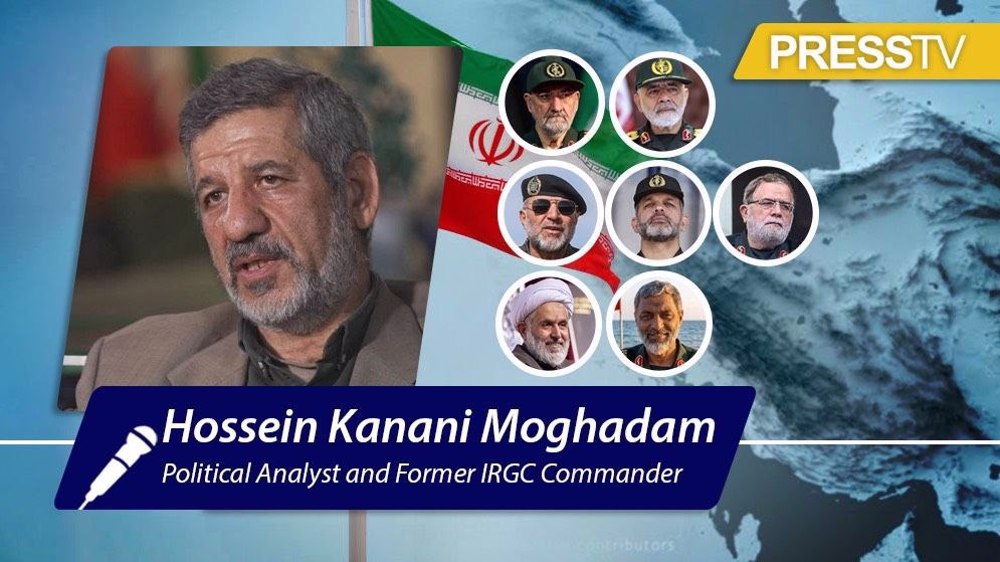
The new appointments to Iran’s top military and security posts signal a more offensive posture toward the United States and the Israeli regime, according to an Iranian political and military analyst.
Speaking to the Press TV website, Hossein Kanani Moghaddam, a former senior commander of the Islamic Revolution Guards Corps (IRGC), said the changes are aimed at accelerating decision-making and enhancing military responsiveness.
“The rearrangement of the military and security structure that was carried out indicates an offensive military posture in confronting threats from the United States and the Israeli regime,” he said.
On Monday, the Leader of the Islamic Revolution, Ayatollah Seyyed Mojtaba Khamenei, appointed new figures to six senior military posts. The move followed the appointment of former IRGC commander-in-chief Mohsen Rezaei as secretary of the Supreme National Security Council (SNSC).
In decrees issued on Monday, Major General Ali Abdollahi was appointed chief of staff of the Armed Forces, with Brigadier General Kioumars Heidari named as his deputy.
Major General Ahmad Vahidi was appointed commander-in-chief of the IRGC, with Major General Mostafa Izadi as his second-in-command. Rear Admiral Ali Ozamaei was named commander of the IRGC Navy, while Hossein Taeb was appointed head of the Basij Organization.
✍️ Feature - Who’s who: Meet Iran’s new top military officials appointed by Leader
— Press TV 🔻 (@PressTV) August 10, 2026
By Mina Mosallanejadhttps://t.co/GnFgxKNjeC
A day earlier, Ayatollah Khamenei had appointed Rezaei as his representative to the country’s top security body. President Masoud Pezeshkian subsequently appointed him secretary of the SNSC, Iran’s highest security decision-making institution.
Kanani Moghaddam said the new appointments would help accelerate decision-making in the security and defense arena.
“As a result of these appointments, forces have been brought under greater coordination, the gap in decision-making between the military branches has been shortened, and the speed of decision-making and response has increased,” he said. “One could almost say that our armed forces have become a rapid-reaction force.”
He added that, based on his familiarity with the newly appointed commanders, many have stronger field and operational backgrounds and are well positioned to expand operations beyond Iran’s borders.
“I know these friends, and they are more field-oriented and operational, and they have the capability to expand operations beyond the borders,” the former senior IRGC commander told the Press TV website.
He stressed that Iran’s security doctrine includes an “offensive hybrid-war” component, saying this dimension should be taken into account when assessing the country’s new military command structure.
The appointments come months after the US-Israeli war of aggression, which led to the assassination of Leader of the Islamic Revolution Ayatollah Seyyed Ali Khamenei, as well as senior officials and military commanders, apart from civilians, including school children.
✍🏻 Profile: Mohsen Rezaei, veteran IRGC commander and Iran’s new top security official
— Press TV 🔻 (@PressTV) August 9, 2026
By Mina Mosallanejadhttps://t.co/5slUXyIj2B
Iran responded with strikes on US and Israeli assets across the region, inflicting heavy blows and forcing them to unilaterally seek a truce.
The Islamabad memorandum of understanding (MoU), signed in mid-June, was intended to bring the imposed war to a permanent end.
However, after Washington violated provisions concerning the Strait of Hormuz in a fresh round of aggression against Iran, Tehran responded with retaliatory attacks on US-run bases and assets across the region, including in Bahrain, Kuwait and Jordan.
With firefighting currently paused amid Iranian-Omani negotiations over the management of the Strait of Hormuz, the United States has continued an illegal maritime blockade while threatening further military aggression against the Islamic Republic.
Kanani Moghaddam said the broader confrontation should ultimately be viewed through the prism of military power rather than diplomacy alone.
“I believe that no peace happens without war,” he told the Press TV website.
“We can reach a lasting peace when, in a direct war, we achieve the consolidation of our power. At that point, the enemy retreats and lasting peace is achieved. Otherwise, nothing will be gained through negotiations and ceasefires followed by another war; this cycle will continue.”

BRICS paving way for alternative world order, not a war machine against West: Analyst
Iran’s strategic location, energy resources position it as a key player in BRICS alliance: Analyst
Yemeni military advance along Red Sea alters balance of power amid Saudi siege, aggression: Analyst



Army spox: Saudi Arabia launches over 30 airstrikes across Yemen in 24 hours
VIDEO | News Review: Israel settlement expansion
Israel violates Gaza ceasefire over 5,100 times, kills 1,421 Palestinians: Gaza Media Office
VIDEO | Russia holds events under title of Iran’s Culture Week
Republicans distancing themselves from Trump ahead of US midterms
Pezeshkian: Expanding Iran-Azerbaijan rail, air links key to strengthening ties
Iranian engineering students hold lectures at US-bombed B1 mega-bridge
VIDEO | Press TV's news headlines


 PressTV NEWSLETTER
now
PressTV NEWSLETTER
now
 This makes it easy to access the Press TV website
