Strait of Hormuz will reopen only when US accepts Iran’s conditions: SNSC chief
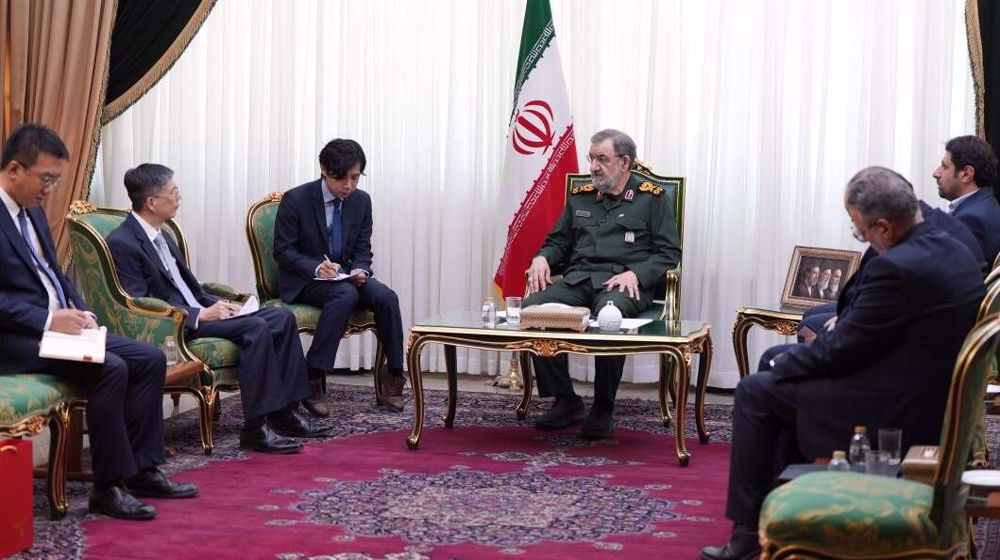
Iran’s top security official says the full reopening of the Strait of Hormuz in the Persian Gulf, where Iran has imposed restrictions on transit since early March because of the US-Israeli aggression against the country, will only happen when the United States accepts Iran’s conditions.
Mohsen Rezaei, the newly appointed head of the Supreme National Security Council (SNSC), told Chinese Ambassador to Tehran Zong Piyu in a Tuesday meeting that the US must end the war on Iran and its regional allies and release Iran's blocked funds for a full reopening of the Strait of Hormuz.
“As long as the US does not change its behavior and accept Iran's conditions, the Strait of Hormuz will not be reopened,” Rezaei said in the meeting.
He said Iran has also communicated some other conditions to the US through intermediaries that have been involved in indirect negotiations between the two sides in the past weeks.
Rezaei reiterated that if Iran and Oman, the other littoral state in the Strait of Hormuz, reach an agreement on the transit routes in the waterway, that agreement will have no impact on Iran’s decision to close or reopen the strait.
Mohsen Rezaei:
— Press TV 🔻 (@PressTV) August 11, 2026
IRAN’s message is clear: the Strait of Hormuz will not reopen until the U.S. ends the war and blockade, releases Iran’s frozen assets, and agrees to a region-wide ceasefire, including in Lebanon and Gaza. Until all conditions are met, the Strait will remain closed. pic.twitter.com/t5KVxr42Ap
That comes as the United States is desperately seeking to persuade Iran through mediators to reopen Hormuz, as its closure has caused a major rise in international energy and fertilizer prices.
Iran and the US signed a memorandum of understanding (MoU) in June that allowed Iran to manage the strait and gradually return transit to normal levels, in return for the US lifting its sanctions and blockade on the country.
However, Iran reinstated restrictions in Hormuz after the US violated the terms of the MoU by seeking to undermine Iran's management over the strait.
In his meeting with the Chinese ambassador to Iran, Rezaei appreciated as “a positive step” China's decision to oppose an “anti-Iranian and illegal” draft resolution presented at the UN Security Council during the US-Israeli war of aggression on Iran in March.
He also hailed the strategic partnership between Iran and China and the fact that the two countries are members of key international pacts such as the Shanghai Cooperation Organization and BRICS, saying the partnership can serve as a great capacity for the development of bilateral relations in the future.
Zong Piyu, for his part, reiterated China’s opposition to the US and Israeli military aggression on Iran.
He said Chinese President Xi Jinping has put forward a four-point initiative to establish peace and stability in West Asia.
“We believe that Iran, in addition to its strength, possesses prudence and wisdom and is capable of managing the situation,” he said, according to a readout of his remarks provided by the SNSC media office.
‘Clear message is US must end war, blockade’
The Iranian security chief also posted a message on X pertaining to the issue of the Strait of Hormuz.
“IRAN’s message is clear: the Strait of Hormuz will not reopen until the U.S. ends the war and blockade, releases Iran’s frozen assets, and agrees to a region-wide ceasefire, including in Lebanon and Gaza.”
Rezaei reiterated in the post that “Until all conditions are met, the Strait will remain closed.”
Iran’s army chief urges enhanced coordination in armed forces for stronger deterrence
Baghaei says Iran defending human values, warns of ‘colonialism’ return
Leader’s advisor says West Asia not 'backyard of West'



US-Israeli soldier who took part in Gaza genocide commits suicide in New York
Deadly clash aboard US carrier Abraham Lincoln leaves 7 dead, several injured: Report
Strait of Hormuz will reopen only when US accepts Iran’s conditions: SNSC chief
Iran’s army chief urges enhanced coordination in armed forces for stronger deterrence
Baghaei says Iran defending human values, warns of ‘colonialism’ return
VIDEO | Press TV's news headlines
Leader’s advisor says West Asia not 'backyard of West'
Iranian weightlifter wins nine golds, breaks three world youth records in Tashkent


 PressTV NEWSLETTER
now
PressTV NEWSLETTER
now
 This makes it easy to access the Press TV website
