Who’s who: Meet Iran’s new top military officials appointed by Leader
By Mina Mosallanejad
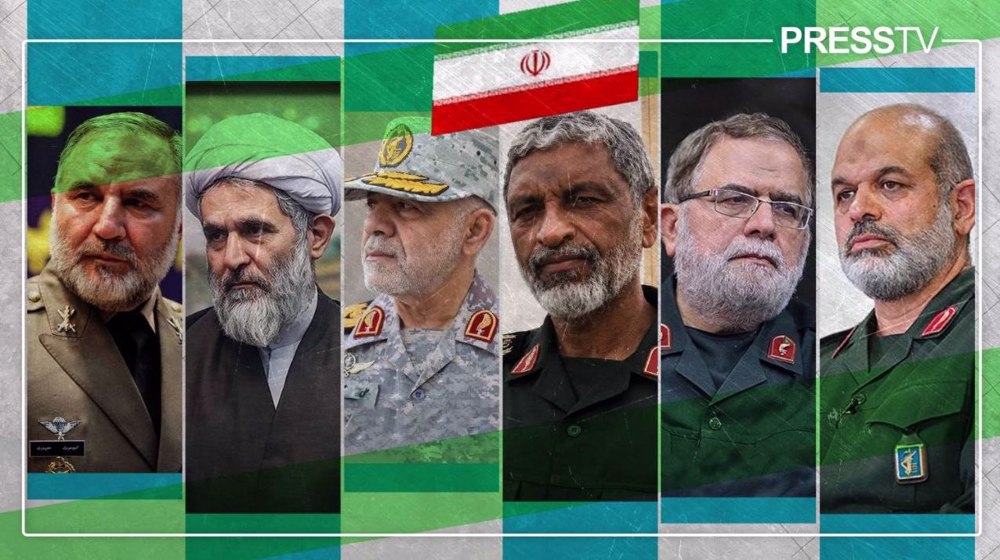
Leader of the Islamic Revolution Ayatollah Seyyed Mojtaba Hosseini Khamenei announced a series of important high-level military and security appointments on Monday.
The appointments come following the martyrdom of several senior military commanders and security officials during the recent US-Israeli war of aggression against the Islamic Republic.
The new command structure is reinforced by the appointment of Major General Ali Abdollahi as Chief of the General Staff, replacing Major General Abdolrahim Mousavi.
Brigadier General Kioumars Heydari, formerly commander of the Army Ground Forces, has been appointed the deputy of the Chief of the General Staff.
Brigadier General Ahmad Vahidi, a veteran commander and former defense minister, has been appointed Commander-in-Chief of the Islamic Revolution Guards Corps (IRGC), replacing Major General Mohammad Pakpour.
Major General Mostafa Izadi, a veteran of the Sacred Defense, has been appointed deputy chief of the IRGC, while Rear Admiral Ali Ozamaei, a senior IRGC Navy commander, has been appointed Commander of the IRGC Navy, replacing Rear Admiral Alireza Tangsiri.
Hossein Taeb, the former IRGC intelligence chief, has been named the commander of the Basij organisation, replacing Gholamreza Soleimani.
Below are brief profiles of the newly appointed commanders:
Major General Ali Abdollahi (Chief of the General Staff)
Major General Ali Abdollahi, born in 1959 in northern Gilan province, is one of the most senior military commanders in the country.
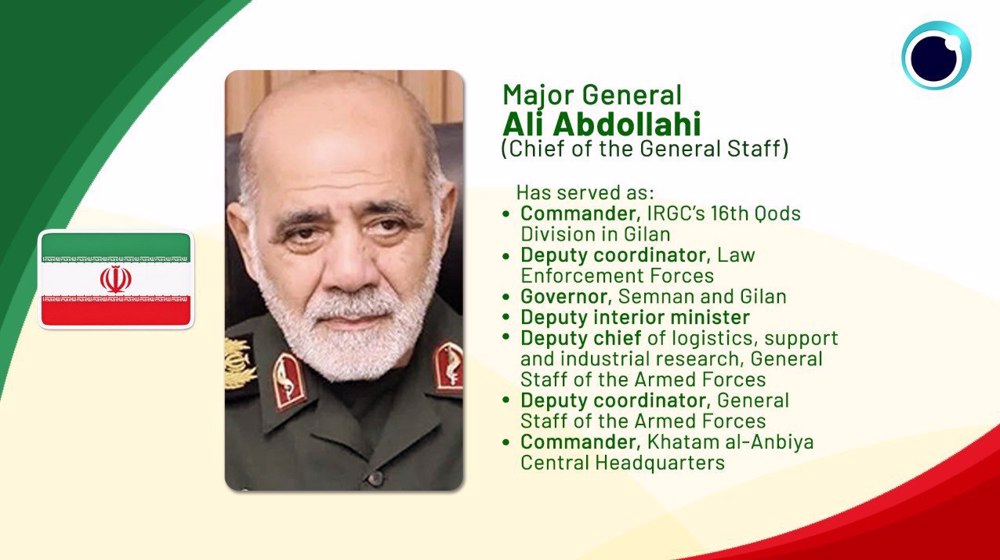
Following the 1979 Islamic Revolution and the establishment of the IRGC, Abdollahi joined the force in May 1979 and served in the organization during the 8-year imposed war on Iran.
From 1987 to 1991, he commanded the IRGC’s 16th Qods Division in Gilan. From 1997 to 2001, he served as deputy to Mohammad-Baqer Qalibaf, then commander of the IRGC Air Force.
From 2001 to 2002, he served as deputy coordinator of Iran’s Law Enforcement Forces. Between 2002 and 2005, he served as deputy commander of the Law Enforcement Forces and briefly served as acting commander of the force in 2005.
Under the ninth administration, Abdollahi served as governor of central Semnan province from 2005 to 2007 and governor of Gilan province from 2007 to 2009.
Under the tenth administration, he served as deputy interior minister for security and law enforcement affairs from 2009 to 2014. From 2014 to 2016, he served as deputy chief of logistics, support and industrial research at the General Staff of the Armed Forces.
From 2016 to 2025, he served as deputy coordinator of the General Staff of the Armed Forces.
Since July 2025, he has served as commander of the Khatam al-Anbiya Central Headquarters, and since March 2026, he has served as acting chief of the General Staff of the Armed Forces.
Brigadier General Kioumars Heydari (Deputy of the Chief of the General Staff)
Brigadier General Kioumars Heydari, born in 1964 in Kermanshah, is a senior commander of the Islamic Republic of Iran Army (Artesh).
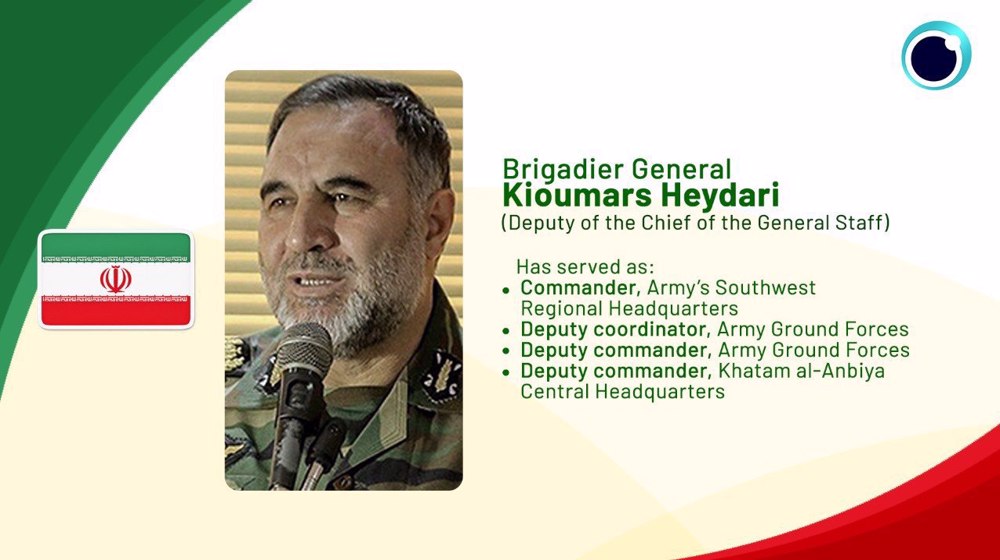
He began his military career in 1982 during the Iraq-imposed war on Iran as a volunteer member of the Basij and joined the Islamic Republic of Iran Army in 1984.
From 1998 to 2005, Heydari commanded the Army’s Southwest Regional Headquarters.
From 2005 to 2008, he served as deputy coordinator of the Army Ground Forces, and from 2008 to 2016, he served for more than eight years as deputy commander of the Army Ground Forces.
From November 2016 to December 2025, he served as the 17th commander of the Islamic Republic of Iran Army Ground Forces.
Since December 2025, he has served as deputy commander of the Khatam al-Anbiya Central Headquarters.
Brigadier General Ahmad Vahidi (IRGC commander-in-chief)
Brigadier General Ahmad Vahidi was born in 1959 in Shiraz. He is a well-known figure in Iran’s military and security establishment.
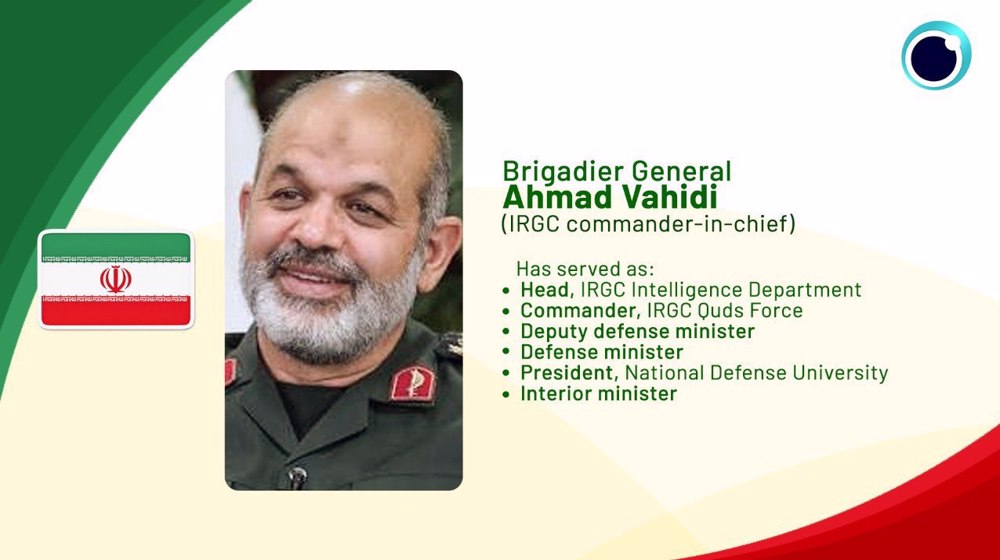
Vahidi holds a bachelor’s degree in electronic engineering, as well as a master’s degree and a PhD in strategic studies.
He joined the IRGC in 1980 and held several key positions during the eight-year imposed war on Iran by the Iraqi Ba’athist regime.
From around 1985 to 1988, he served as head of the IRGC Intelligence Department, and from 1988 to 1997, he commanded the IRGC Quds Force.
During the eighth administration, from 2003 to 2005, Vahidi served as deputy defense minister for planning and programs. During the ninth administration, from 2005 to 2009, he again served as deputy defense minister. During this period, he focused on the development of domestic missile and drone production.
Under the tenth administration, between 2013 and 2016, he served as minister of defense and armed forces logistics. From 2013 to 2016, he headed the Defense Strategic Research Center, and from 2016 to 2021, he served as president of the National Defense University.
During the administration of President Ebrahim Raeisi, Vahidi served as interior minister for three years – from 2021 to 2024.
In December 2025, the martyred Leader of the Islamic Revolution, Ayatollah Seyyed Ali Khamenei, appointed Vahidi as the deputy commander of the IRGC.
Following the martyrdom of Major General Mohammad Pakpour, commander-in-chief of the IRGC, in US and Israeli attacks on February 28, Brigadier General Vahidi was chosen as the caretaker commander of the IRGC.
Major General Mostafa Izadi (IRGC deputy commander-in-chief)
Major General Mostafa Izadi Najafabadi was born in 1956 in Najafabad, central Isfahan province.
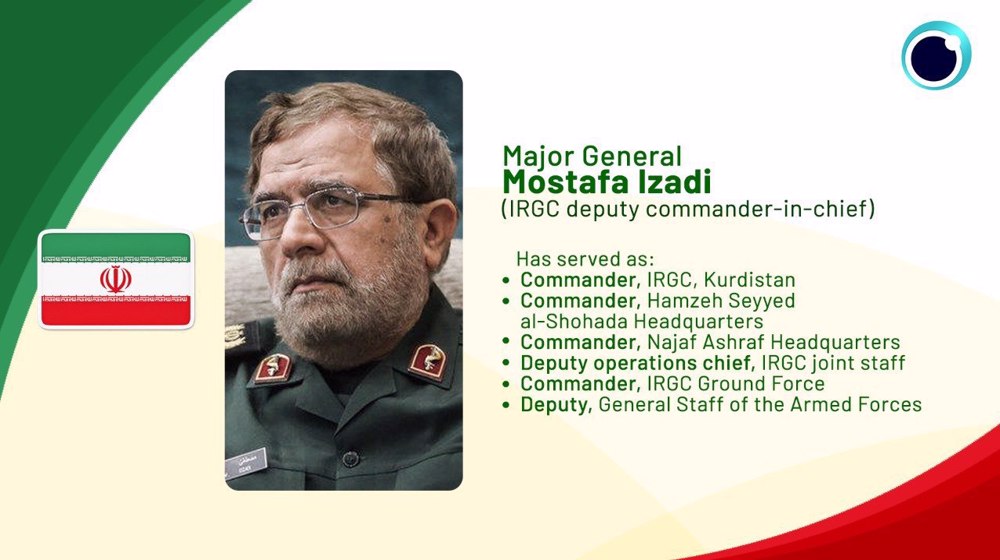
Izadi holds a bachelor’s degree in electronic engineering from K.N. Toosi University of Technology and began his military career in the IRGC after the Islamic Revolution in 1979.
During the eight-year imposed war on Iran, he was considered one of the IRGC’s influential mid-ranking commanders.
From 1982 to 1983, he served as commander of the IRGC in bordering Kurdistan province. From 1983 to 1985, he commanded the Hamzeh Seyyed al-Shohada Headquarters; and from 1985 to 1987, he commanded the Najaf Ashraf Headquarters.
From 1987 to 1989, he served as deputy operations chief of the IRGC Joint Staff, and from 1989 to 1992, he commanded the IRGC Ground Forces.
Between 1993 and 2006, Izadi served as deputy head of planning, programs, and budget at the General Staff of the Armed Forces.
He currently serves as deputy for strategic affairs and oversight at the General Staff of the Armed Forces. He also commands the Cyber and Emerging Threats Headquarters of the Khatam al-Anbiya Central Headquarters.
He is one of nine senior military commanders in Iran’s armed forces holding the rank of major general.
Rear Admiral Ali Ozamaei (IRGC Navy commander)
Rear Admiral Ali Ozamaei, born in Hormozgan province in southern Iran, began his military career during the Ba’athist regime’s war on Iran in the 1980s with the IRGC in Hormozgan and later joined the IRGC Navy.
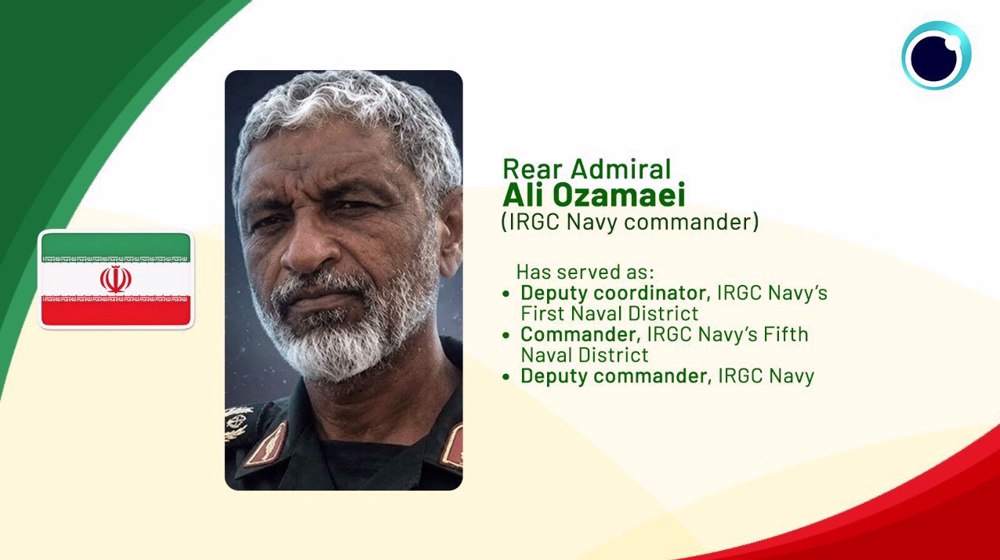
From the mid-2000s to 2010, he served as deputy coordinator of the IRGC Navy’s First Naval District, and from 2010 to 2012, he served as deputy commander of the district.
From November 2012 to 2025, he commanded the IRGC Navy’s Fifth Naval District.
The district’s headquarters is located in Bandar Lengeh, and its area of operations extends from the east of Qeshm Island to the west of Kish Island and includes the three Iranian islands in the Persian Gulf.
His 13-year tenure as commander of the district was one of the longest periods of command at the level of an IRGC naval district.
In April 2022, he was promoted from the rank of brigadier general second class to brigadier general.
In 2025, he was appointed deputy commander of the IRGC Navy, with Rear Admiral Alireza Tangsiri as his superior.
Following the martyrdom of Tangsiri in a US-Israeli attack on Bandar Abbas in April 2026, the IRGC Public Relations Office announced in a statement on July 4 that Ozamaei had been appointed acting commander of the IRGC Navy.
The appointment was formally announced in a decree issued by the Leader of the Islamic Revolution on Monday.
Hossein Taeb (Basij organisation commander)
Hossein Taeb was born in 1963 in the capital Tehran. He joined the IRGC in 1982.
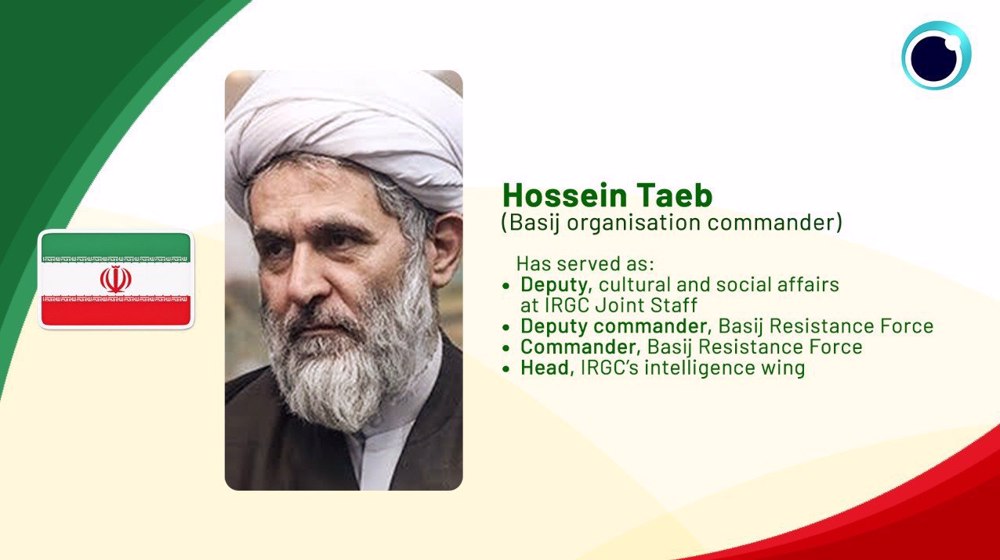
From 2005 to 2007, Taeb served as deputy for cultural and social affairs at the IRGC Joint Staff.
From 2007 to 2008, he served as deputy commander of the Basij Resistance Force, and from 2008 to 2009, he commanded the Basij Resistance Force.
In 2009, he was appointed as head of the IRGC’s intelligence wing and served in that position until 2022, when he was replaced by Mohammad Kazemi. His long tenure at the helm of the IRGC intelligence saw significant breakthroughs.
In 2022, he was sanctioned by the US Department of State.
In June 2022, after stepping down as the IRGC intelligence chief, he was appointed as an adviser to the IRGC commander-in-chief.
US defeat against Iran shows Zionist grip on Washington; popular struggle should break it: Activist
AI failed in enemy’s war against Iran: IRGC spokesman
Iran’s ground forces on full alert, ready to ‘cut off feet’ of any invading troops: Cmdr.



Israel to expand three settlements in occupied East al-Quds with 3,400 settler units
VIDEO | Iran has every right to avoid being attacked: Journalist
Yemeni forces strike Saudi-backed mercenaries for second straight day
US must submit to new order in Persian Gulf: Iran deputy Parliament speaker
Who’s who: Meet Iran’s new top military officials appointed by Leader
Parents of Minab boy killed in US strike visit Hiroshima on US atomic bombing anniversary
Leader makes new appointments to top military posts; Vahidi named IRGC commander
Israeli forces, settlers intensify attacks across occupied West Bank


 PressTV NEWSLETTER
now
PressTV NEWSLETTER
now
 This makes it easy to access the Press TV website
