At least 34 die as 60,000 cross into Spain’s Ceuta
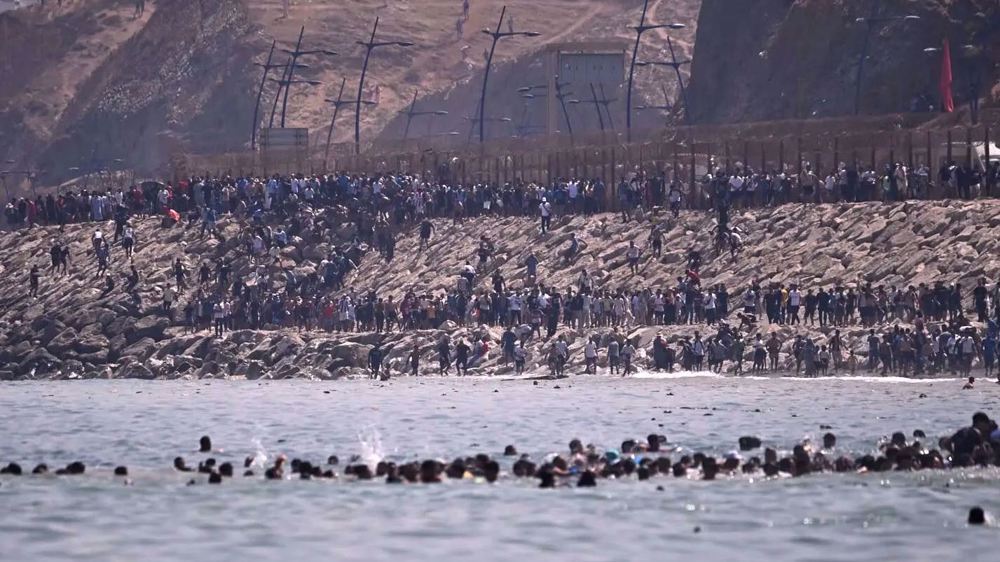
At least 34 migrants have died trying to reach Ceuta as about 60,000 have crossed into the Spanish enclave from Morocco in the past 24 hours.
Ceuta’s President Juan Jesús Vivas said on Friday that some 60,000 have crossed into the Spanish enclave in the past 24 hours. The number is equivalent to 70% of the autonomous city’s 84,000 population.
“The situation that Ceuta is going through is absolutely unsustainable,” he said.
Clashes have erupted between security forces and migrants on the Moroccan side of the border since Thursday. Arrests were also reported.
On Friday, Spanish Prime Minister Pedro Sánchez condemned the breach of the border as “a violation of Spain’s territorial integrity.”
He blamed human smugglers for the crisis, saying they “deceive so many young people, and ultimately lead many of them to their deaths — whether in the ocean or, as in this case, at Spain’s border in the autonomous city of Ceuta.”
Hundreds of thousands of migrants entered the Spanish enclave of Ceuta by land and sea, prompting local authorities to declare a state of emergency.
— PressTV Extra (@PresstvExtra) July 31, 2026
Follow: https://t.co/7Dg3b41hTx pic.twitter.com/JPp4eIfZwz
Live footage of the border showed Moroccan forces using tear gas to disperse hundreds of migrants gathered on a hill overlooking Ceuta, while others continued to swim to the Spanish territory.
At the same time, many migrants walked back from Ceuta toward Morocco to return home.
Rachid Sbihi, head of the association that represents Spain's Guardia Civil in Ceuta, called the situation a “serious humanitarian crisis,” noting that thousands of migrants, including unaccompanied children, were left sleeping in parks and on sidewalks, while others roamed the streets aimlessly.
“People are still entering. The reinforcements, including Spanish military troops, that have arrived are only helping the injured and other humanitarian efforts,” he said. “It’s chaotic.”
According to Sbihi, among those who died, many drowned. Some were also killed in a stampede to cross the breakwater fence at Tarajal beach, an urban beach near a border checkpoint with Morocco.
Ahmed Karim, a 33-year old Moroccan, said he had entered Ceuta because of the lack of jobs in his country.
“Many people want to go to Europe, America, but they don’t have the opportunity,” he said.
Authorities in both Ceuta and Madrid attributed the mass influx of migrants to a recent decision by Spain’s Supreme Court that ruled migrants arriving by sea could not be summarily deported, unlike those who cross by land or climb the border fence.
Watch as Moroccan trucks transport migrants to the Spanish border at the enclave of Ceuta.
— PressTV Extra (@PresstvExtra) July 31, 2026
Follow Press TV on Telegram: https://t.co/h0eMpifVIe pic.twitter.com/ZrTLFBYmxO
Sánchez noted that migrant smugglers misinterpreted the ruling.
“It appears that this interpretation of the Supreme Court’s ruling spread like wildfire over the past few hours through the networks of human trafficking organizations, triggering the kind of mass surge we witnessed yesterday,” Sánchez said.
Some Moroccan activists expressed doubt that the ruling was behind the latest developments, arguing most migrants would have been unaware of such legal decisions.
Migrants from Morocco also attempted to cross into Melilla, another Spanish autonomous city on the North African coast.
Clashes also erupted between migrants and police in the Moroccan town of Bni Nsar which borders the Spanish territory. Local media and rights groups reported injuries among security forces and the arrest of dozens of people trying to cross.
Many Moroccans consider Ceuta and Melilla to be occupied territory.
Ceuta has been governed by Spain since 1580 and its mixed population of Christians and Muslims, Spanish and Moroccan residents and day workers, lives in relative harmony.

Libya’s Gaddafi fatally shot Imam Musa Sadr in chest: Report
Libya’s NOC warns of force majeure at country’s largest refinery after drone strikes
Polisario terror bid emerges amid Ceuta crisis, deepening US-Israel-Morocco ties



‘New tactics’ will crush any future aggression, Iran’s Army warns
Israel, US repeat Saddam’s miscalculation about Iran: Expediency Council chief
VIDEO | Ayatollah Khamenei and eight years of imposed war
Trump can’t impose his power on Iran; we withstand whatever warfare: Parliament speaker
VIDEO | Israeli attacks escalate in Lebanon as US-brokered deal yields only concessions: Press TV reporter
Eleven injured as gunman opens fire near high school in western Turkey
China condemns US extortion of Iranian airlines, rejects Washington’s ‘illegal’ sanctions threats
VIDEO | Strikes hit areas in south Lebanon where Israeli regime claims to control


 PressTV NEWSLETTER
now
PressTV NEWSLETTER
now
 This makes it easy to access the Press TV website
