
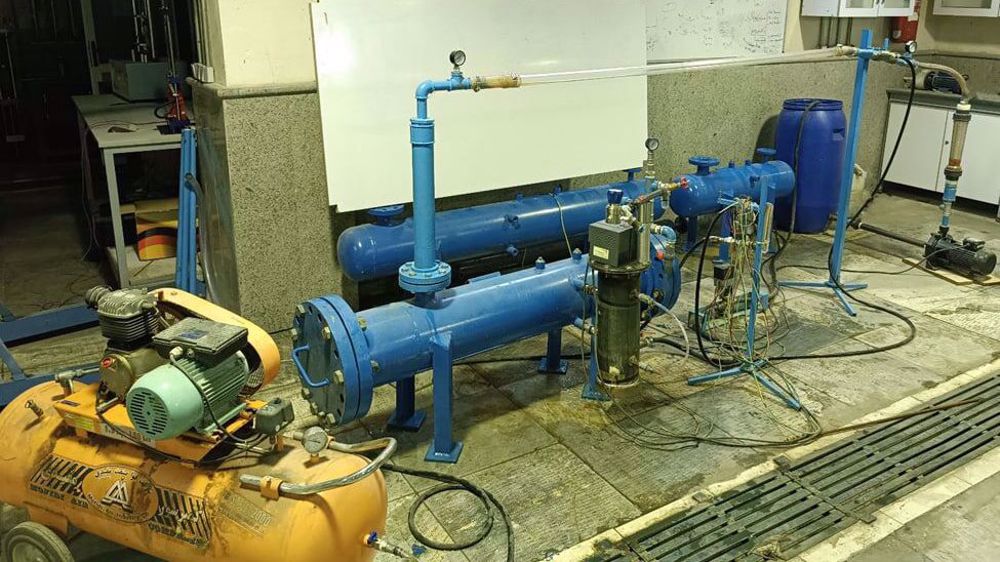
Researchers at Iran's Amirkabir University of Technology have developed an indigenous intelligent production management system that can increase oil recovery in surface storage facilities by up to 59 percent over the lifetime of an oil field while reducing maintenance costs and optimizing production without human intervention.
Developed by PhD researcher Mehdi Fadaei, the project integrates wells, pipelines, and surface processing facilities into a single smart production network that continuously adjusts operating conditions to maximize efficiency.
"Our research was aimed at developing an integrated production model capable of controlling and optimizing the parameters that directly affect oil and gas production," Fadaei said.
He explained that conventional production systems mainly rely on surface operating parameters such as wellhead pressure and production flow rates. As reservoir conditions gradually change, however, these systems become less efficient, reducing production and increasing operational costs.
One of the biggest challenges, he said, is the formation of liquid slugs inside pipelines, particularly in reservoirs with gas caps. These slugs can damage surface equipment, disrupt multiphase separators and even force production shutdowns.
🔰Researchers at Amir Kabir University of Technology develop an AI-powered smart production system that optimizes oil and gas field operations
— Iran First (@IranFirst_PTV) July 27, 2026
Simulations show the integrated technology can boost oil recovery by up to 59% in 20 years while reducing maintenance costs.#IranFirst pic.twitter.com/cRwxzRO8aS
"For the first time, we have designed an intelligent integrated system that prevents liquid slug formation in pipelines and continuously optimizes multiphase separation throughout the entire life of an oil field," Fadaei said.
At the heart of the project is an intelligent separator that operates fully automatically without human intervention, Fadaei added.
The system, he noted, removes liquid slugs, maintains optimal operating conditions and prevents even microscopic liquid droplets from entering the gas stream, improving the quality of feed delivered to refineries and petrochemical plants.
According to the research team, simulations based on a real oil field showed that the technology could increase the amount of oil recovered in surface storage facilities by as much as 59 percent over a 20-year production period compared with conventional production systems.
"The system not only increases production but also reduces maintenance costs, prevents operational disruptions and automatically manages oil and gas field operations," Fadaei said. "It can be deployed in both low-pressure and high-pressure reservoirs."
The researcher said the laboratory-scale system was built entirely with indigenous equipment.
Although similar research facilities exist at only a handful of leading universities worldwide, including institutions in the United States, Norway, the Netherlands and Scotland, he said the Iranian platform offers greater flexibility, precision and technical sophistication.
The project also produced new design equations for multiphase separators after researchers found that widely used semi-empirical models contained significant inaccuracies. Those findings have already been published in several international scientific journals, according to Fadaei.
The intelligent production model incorporates predictive technologies, including Kalman filtering and advanced optimal control algorithms, to manage real oil fields more efficiently. Results from this part of the research were published in Scientific Reports, a peer-reviewed journal in the Nature portfolio, he highlighted.
Overall, the research has resulted in 15 scientific papers and is expected to provide Iran's oil and gas industry with a fully indigenous technology capable of increasing production, improving operational reliability and lowering long-term operating costs, Fadaei noted.
 This makes it easy to access the Press TV website