In the rubble of Minab school, 62 body parts of 32 students are found but still no trace of Makan
By Maryam Bashirpour
On the morning of February 28, the sky over Minab, a nondescript city in southern Iran’s Hormozgan province, was clear. Students of Shajareh Tayyebeh School entered the courtyard one by one – girls wearing white headscarves and boys carrying colorful schoolbags.
It was around 10:45 a.m. local time, only a few minutes before the recess bell was due to ring. Then, all of a sudden, the azure sky roared. Three consecutive explosions ripped through the school building. One missile after another left a trail of death and destruction.
A “triple-tap” strike descended upon the elementary school. The roof of the school, decorated with pink flowers and green leaves, collapsed onto the children beneath it.
The triple strike, known in military terminology as a “triple-tap” attack, completely destroyed the school. Three missiles struck the same location in quick succession, precisely where children had sought safety under the protection of their teachers.
No one ever heard the recess bell again. There was a silence of a graveyard.
An analysis of satellite imagery and an examination of the missile debris by media outlets concluded that the munitions used in the attack were American-made Tomahawk cruise missiles – a weapon produced and possessed by the United States.
CNN, otherwise known for distorted Iran coverage, analyzed video footage of the moment of impact and confirmed that the missiles used were American Tomahawk cruise missiles.
But more horrifying than the weapon itself was the tactic. The school was not struck once – it was targeted three separate times in quick succession.
This “triple-tap” pattern is specifically designed to ensure that everyone inside a targeted building is killed. It is a tactic commonly employed to destroy a military target, not one that could plausibly result from an accidental strike on an elementary school.
From the very first hours after the gruesome attack, the US and the Israeli regime refused to accept responsibility for the diabolic war crime. US President Donald Trump blamed Iran, claiming that Iranian missiles “lack precision.” The truth was far too clear to conceal.
As the evidence revealed, the attack was carried out using American-made Tomahawk cruise missiles. Independent military experts who analyzed footage identified the missile in its terminal phase of flight as an American Tomahawk.
A senior analyst at McKenzie Intelligence Services stated that the missile displayed “all the hallmarks of a US Tomahawk in its terminal phase.” Wes Bryant, a national security analyst who previously served in the US Air Force, ALSO confirmed that it was a Tomahawk missile and said the evidence pointed to “a deliberate and highly precise American operation.”
Newly uncovered remains of massacred Minab schoolchildren buried
— PressTV Extra (@PresstvExtra) July 22, 2026
Follow: https://t.co/RuQCIFWYoj pic.twitter.com/sGjv08GxGR
A CNN investigation published earlier this month revealed an even greater scandal. According to the report, senior US military commanders approved the strikes despite warnings from Pentagon intelligence systems that the intelligence used to identify the targets was outdated.
Even The New York Times wrote in its analysis that the strike on the Minab school resulted from “a targeting error caused by outdated intelligence supplied by the US Defense Intelligence Agency.”
But what possible justification can there be for a “targeting error” when three missiles, one after another, strike the exact same school?
Months after the horrific crime, search and recovery operations at the school and its surrounding areas finally led to the discovery of 62 fragments of the bodies of students. Following DNA testing, the identities of 32 of them were confirmed.
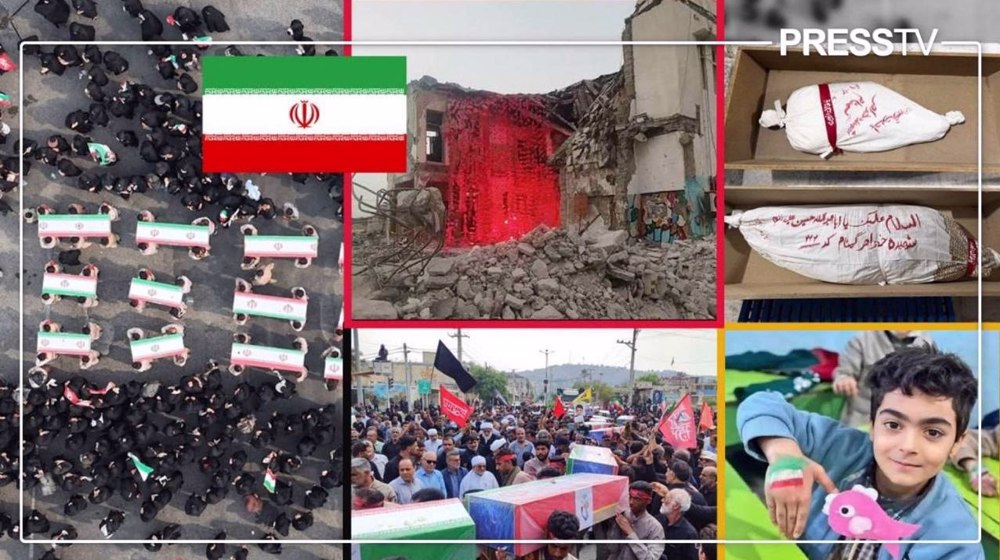
Five months later, Minab was plunged into mourning once again. The city dressed once more in black. Once again, coffins were carried on the shoulders of grieving mourners.
There were mothers who, only a few months earlier, had placed schoolbags into their children’s hands, straightened their headscarves, watched them walk away, and smiled. Now, those same mothers – and those same fathers – with those very same hands, accompanied coffins that had replaced those colorful schoolbags.
No one had ever told them that saying farewell to a fragment of body could be even more agonizing than bidding farewell to an intact body.
On Wednesday morning, the small coffins began moving through the crowded streets of Minab again. But this time, no heavy coffins rested upon the shoulders of the mourners. Each coffin contained only a few fragments of bone wrapped in white cloth, the remains of children who had once entered that school laughing, jumping and frolicking.
On the shoulders of the grieving people of Minab were small boxes containing 62 body fragments of 32 children: A tiny hand severed at the wrist. A foot still enclosed in the charred remains of a plastic sandal. A torso without limbs.
It was a procession of dismembered body parts – a modern-day Karbala – passing before cameras while much of the world’s mainstream media cowardly refused to broadcast the images. Mothers and fathers stood side by side, bidding farewell one last time to whatever remained of their slain children.
Among the crowd, cries of grief echoed through the streets, not merely for the martyrdom of their loved ones, but for the manner in which they had been killed.
After nearly five months, the remains of the Minab students martyred in the brutal US-Israeli attacks on southern Iran have been found and are being prepared for burial.
— PressTV Extra (@PresstvExtra) July 22, 2026
Follow: https://t.co/RuQCIFXwdR pic.twitter.com/6Ri3j07uuL
But one coffin remained empty. Amid so much sorrow and the pangs of separation, one story was more heartbreaking than all the others: the story of Makan Nasiri, a first-grade student at Shajareh Tayyebeh School whose remains are yet to be discovered.
He was a boy with bright eyes and a sweet smile that revealed the gap left by one of his baby teeth. He was the top student in his class, always brimming with energy and ready with answers to teacher’s questions. Not a single piece of his body has been found so far.
Even among those 62 recovered fragments, there was still no trace of Makan. All that remained of him was one shoe and a bloodstained blue sweater, pulled from beneath the rubble after the February 28 bombing of the school.
Today, these belongings are preserved in a glass display case inside the mosque next to the school. Makan’s father, Cyrus Nasiri, searched tirelessly through the ruins from the day of the attack and for many days afterward, hoping to find even the smallest trace of his son.
In the weeks that followed, every time news emerged that another body fragment had been discovered, the crestfallen father returned to the bombing site.
“Even if they found just one fingernail, I would come back,” he said in an interview. In another interview, his eyes filled with tears, asking: “Where am I supposed to look for my son?”
In a war where precision-guided missiles can select their targets with millimeter accuracy, how could a seven-year-old child have been struck “by mistake”?
Makan’s case was ultimately closed under the designation “missing.” A boy who had gone to school one fine morning carrying his books and backpack never returned home. Not even a single body part remained for his family to bury.
The US initially denied any responsibility for the attack, but the truth has a way of revealing itself. But to this day, it has neither issued an official apology nor paid any compensation. A Pentagon investigation, requested by US senators, has still not been released.
The United Nations and some human rights organizations reluctantly condemned the attack.
Ravina Shamdasani, spokesperson for the UN Human Rights Office, said: “The families of the little girls who were killed deserve the truth.” Yet the truth remains imprisoned inside the Pentagon’s sealed files, suppressing the dark truth about the daylight terror.
'Which peace have you chosen': Mother of 7-year-old Makan Nasiri writes letter to FIFA presidenthttps://t.co/plh7BeubNN
— Press TV 🔻 (@PressTV) June 12, 2026
If such an attack had taken place at a school in New York or London or Sydney, how would the world have reacted? Would it still have been called “a mistake”? Would investigations have been delayed for months? Would the world have decided to move on?
With their blood upon the shattered walls of their school, the children of Minab forever inscribed the names of those responsible for this unforgivable crime. And one day, the world will have to answer for its silence, the criminal silence.
The words of Makan’s grieving mother stand as a permanent indictment of the Great Satan and its Zionist servants: “They killed my son twice. Once with their missile, and once again with their silence.”
The school in Minab has been destroyed. But Iran’s historical memory will never be destroyed. So long as the questions surrounding Makan remain unanswered, the collective conscience of the world will also remain buried beneath the ruins of that school.
Sixty-two body fragments belonging to 32 martyred students have now been laid to rest. But one child is still lost amid the rubble of history.
Tonight, the waters of the Persian Gulf are calmer, as though they know that sixty-two fragments of light have finally returned to the embrace of Minab’s soil. The whisper carried by those waves is no longer one of pain, but of peace after five months of agonizing wait.
It is the story of a child named Makan, a child whom America did not even allow to be returned to the embrace of his bereaved family. The spirit of that boy, who had once gone to school to learn the alphabet, smiling through the gap left by his missing baby tooth, now learns new letters above these fallen bodies.
With the indelible ink of innocent blood and American savagery, the little boy writes a new story for the nations of the world – a story written in ink that no rain and no breeze will ever be able to wash away.
This is not the end of a journey. It is a new beginning for the history of this land – a history written in blood and turned with pride.
Maryam Bashirpour is a university researcher and writer based in Tehran.
(The views expressed in this article do not necessarily reflect those of Press TV)
Pete Hegseth’s Senate grilling reveals the road to America’s biggest military catastrophe in Iran
Strait of Hormuz as strategic fulcrum: Iran’s credible deterrence and the limits of US coercion
At Ayatollah Khamenei's funeral, I witnessed Iran's soul through grief, poetry, and unshaken dignity



Yemen: Saudi Arabia’s halt to blockade, aggression only way to end fighting
VIDEO | 16th BRICS health ministers’ meeting concludes in India
VIDEO | It was clear that the goals could not be achieved: Writer and podcaster
VIDEO | Venezuelans reject Zionism and foreign interference
Israeli airstrike kills police chief in northern Gaza: Officials
Arab Parliament denounces increasing settler assaults in occupied West Bank
Israeli forces demolish homes in south Lebanon as US-sponsored talks continue
Yemen hits Saudi Aramco oil facilities in retaliation for Hudaydah airstrikes


 PressTV NEWSLETTER
now
PressTV NEWSLETTER
now
 This makes it easy to access the Press TV website
