

Iran has mocked the United States for “solving” its domestic hunger problem by simply stopping reports while lecturing other countries on the issue.
Iran’s Foreign Ministry spokesman Esmaeil Baghaei made the remarks in an X post on Friday after US President Donald Trump claimed that Iran has “a hunger problem” and his deputy JD Vance alleged that the country’s unfrozen assets could help “feed” its people.
Baghaei cited a report by the World Hunger Education Service that found more than 47 million people in the United States, including 1 in 5 children, cannot consistently access or afford enough nutritious food to live healthy lives.
Charity begins at home — and it is desperately needed there.
— Esmaeil Baqaei (@IRIMFA_SPOX) June 26, 2026
As reported by World Hunger Education Service, more than 47 million people in the United States, including 1 in 5 children, cannot consistently access or afford enough nutritious food to live healthy lives. Since 2020,… pic.twitter.com/TM5AWNACnC
He further referred to another report by the NGO Feeding America that said 47 million Americans struggle daily with hunger.
“The ‘solution’ from US authorities? In September 2024, the USDA (US Department of Agriculture) quietly terminated its 30-year-old annual report on household food insecurity — effectively ending the official tracking and acknowledgment of hunger in America,” the spokesman said.
“So, after ‘solving’ domestic hunger by simply stopping the reports, Washington now feels qualified to lecture the world about hunger elsewhere.”
Baghaei added, “Charity begins at home — and it is desperately needed there.”
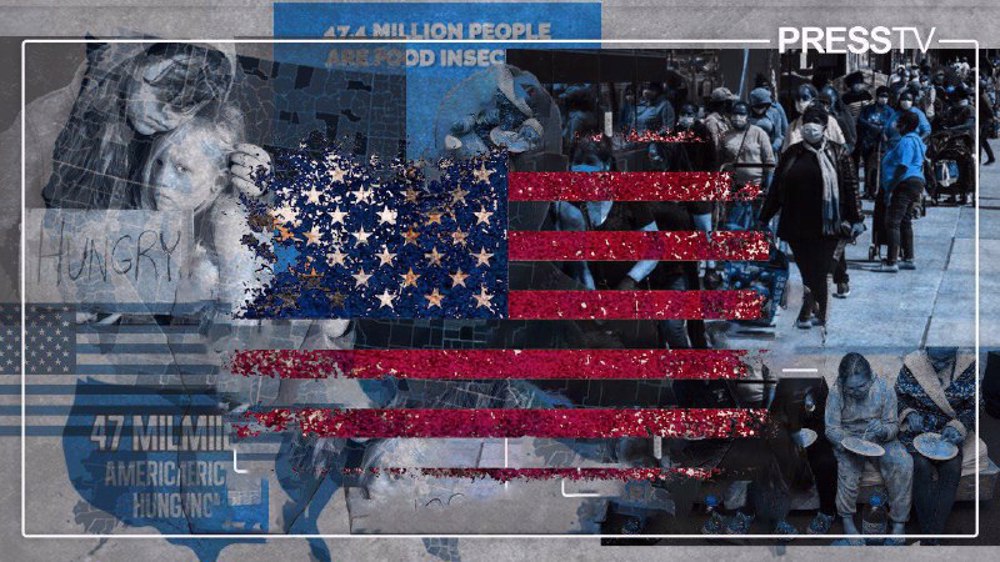
The latest Household Food Security report released by the US Department of Agriculture’s Economic Research Service for 2024 revealed that 47.9 million people lived in food-insecure households last year.
One in seven households (13.7 percent) in America experienced food insecurity, or lack of access to an affordable, nutritious diet, in 2024, according to the report. About 14.1 million American children lived in households that experienced food insecurity in 2024, a slight increase from the 13.8 million children reported in 2023.
The findings highlighted a deepening crisis in the US amid cuts to the Supplemental Nutrition Assistance Program (SNAP), which enables low-income households to afford more healthy foods and boosts families’ food purchases.
Because the USDA's 2025 survey data which would have been released in 2026 was canceled, no official government data on hunger for 2026 is available.
However, the Federal Reserve Bank of New York has stepped in to fill the gap. In a report released in May 2026, the New York Fed presented new findings on food insecurity based on its Survey of Consumer Expectations.
The New York Fed survey found a "remarkable increase in food insecurity," particularly among lower-income, lower-educated households, and households with young children.
The survey noted that between late 2025 and early 2026, the share of households reporting they had to skip meals or had insufficient food rose.
For households earning under $50,000 a year, the rate of those reporting not having enough food or kids missing meals reached 19.7% in early 2026, up from 16% in late 2025.
Nationwide, the share of households with limited or uncertain access to adequate food more than doubled from 4% in June 2020 to 10% in early 2026.
 This makes it easy to access the Press TV website