At ECO meeting, Iran’s top environment official condemns US-Israeli attacks on protected areas

Iran’s vice president and head of the Department of Environment has strongly condemned US-Israeli attacks on protected environmental and civilian sites in the country in their latest aggression against the country, during an Economic Cooperation Organization (ECO) gathering.
During a meeting of the ECO Ministers of Environment in Tehran on Wednesday, Shina Ansari said that US-Israeli strikes on Iranian territory have caused “irreparable damage” to protected areas and sensitive ecosystems.
The aggression targeted civilian infrastructure as well as environmentally sensitive regions, including areas around the Persian Gulf and the Sea of Oman, she noted.
Ansari stated that “two lawless regimes, the US and the Israeli regime,” carried out an unprovoked and illegal assault, adding that the strikes resulted in harm to non-military sites, including protected environmental zones, while noting that the consequences extend beyond national borders and threaten regional ecological stability.
“These brutal crimes, particularly the bloodshed caused by the attack on a school in Minab and a girls’ sports club in Lamerd, must be condemned by all advocates of freedom,” she added.
“Continued inaction by international institutions will only erode the remaining trust in ineffective global mechanisms,” she warned.
She further thanked ECO member states for their positions on the aggression, saying Iran appreciates “the principled stances of the majority of member countries” in response to the attacks.
Ansari further highlighted the need for strengthening regional multilateralism, saying it would help reduce the influence of external actors in the region and support stability
The US-Israeli aggression against Iran began on February 28 with airstrikes targeting senior Iranian officials and commanders.
The aggression killed over 3,300 Iranians and caused damage to the country's civilian and economic infrastructure.
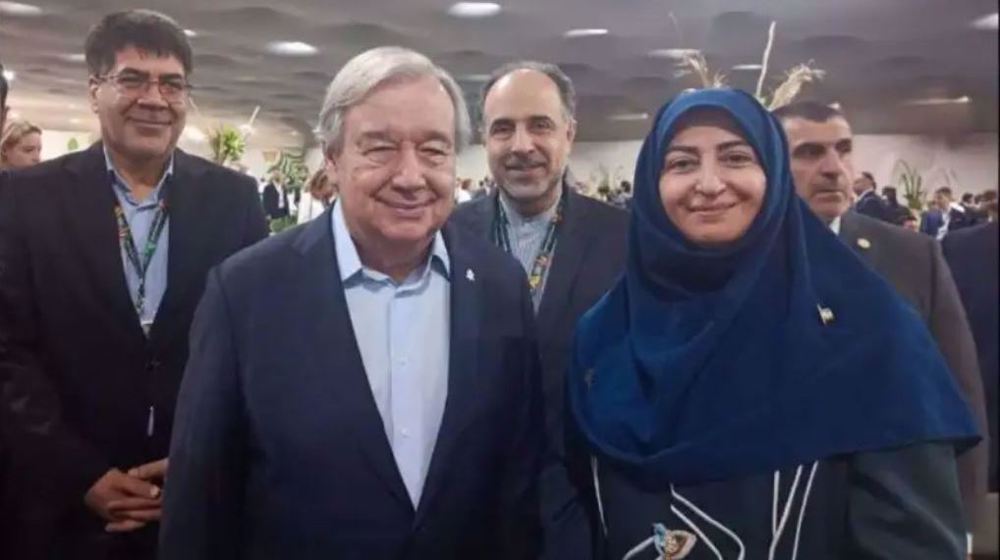
Beyond the political statements, Ansari devoted part of her address to shared environmental challenges facing ECO countries.
She said member states are linked not only by historical and economic ties but also by environmental risks that directly affect public health, security, and sustainable development.
She said the ECO region is among the most vulnerable in the world to climate change, pointing to rising temperatures, repeated droughts, declining water resources, land degradation, and increasing biodiversity loss.
“No country can confront complex environmental challenges alone,” she said, adding that regional cooperation is “an unavoidable necessity” for ensuring a sustainable future.
She expressed Iran’s readiness to expand scientific, technical, and operational cooperation within the ECO framework and to play an active role in joint regional initiatives.
The official concluded by expressing hope that the outcomes of the meeting would lead to practical cooperation and tangible progress for environmental protection and sustainable development across the region.
Hezbollah MP: Trump unwillingly acknowledged Iran’s key role on global stage
Iran FM discusses regional developments in phone talks with Pakistani, Omani counterparts
Araghchi: Arbaeen is grand display of Iran-Iraq national unity



Iran-Oman shipping talks unrelated to immediate Hormuz reopening: Report
Yemeni Armed Forces target another Saudi oil tanker in Red Sea
US pressuring African states to abandon ICC or face consequences: Report
UK court protects anti-Zionist beliefs
Palestinians: 112 Gaza bodies reveal scale of Israeli crimes after three years
Iran, Pakistan commit to $10 billion trade goal with new partnership deal
Israel burns over 120 hectares of centuries-old olive groves in south Lebanon
US investigates airspace safety incident involving Trump helicopter




 PressTV NEWSLETTER now
  This makes it easy to access the Press TV website