
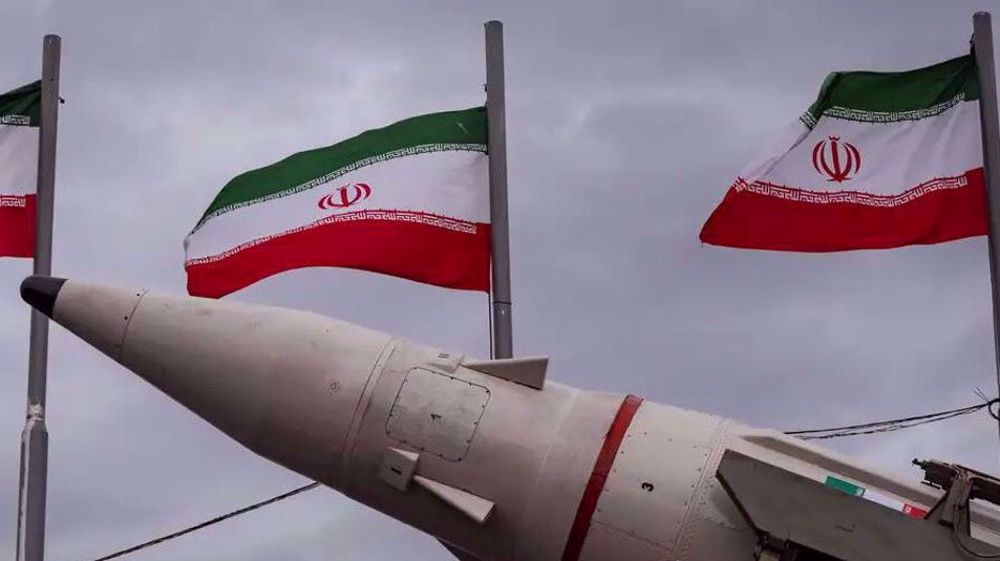
The political deputy of the Islamic Revolution Guards Corps Navy says the US is “begging” for an agreement with Iran, amid the impacts of its illegal aggression against the Islamic Republic on fuel prices and its allies in the region.
Mohammad Akbarzadeh made the remarks in a nightly gathering at the Enqelab square in the city of Zanjan on Tuesday where participants reaffirmed their support for the Islamic establishment and Iran’s armed forces.
Referring to the decline of American hegemony, Akbarzadeh said, "Regional countries and global powers have come to the realization that America is no longer able to provide security for its allies."
He stressed that the US made a “miscalculation” when it thought that it could contain the power of the Islamic Republic through military attacks, sanctions, or inciting sedition.
The IRGC official added that Iran's precise retaliatory attacks against the enemies’ targets have refuted previous Western claims that Iran was displaying "mock” missiles.
He added that Iran’s closure of the Strait of Hormuz and the US’ inability to respond has proved Iran's power, stressing, "They cannot do a damn thing."
Stressing that the deterrence and readiness of the Iranian armed forces have become greater than before, Akbarzadeh said, "Based on my field visits to the southern coastlines and islands, I emphasize that the armed forces are fully ready and in the event of any possible attack, Iran's response will be much stronger than before."
“Accordingly, America and the Zionist regime have left war as a last resort and have no choice,” he added.
Referring to the changing balance in the current situation, Akbarzadeh said Iran has managed to “bring America to its knees in various fields and gain advantage from it.”
Comparing Iran's power with other world powers such as China and Russia in the face of their challenges such as Taiwan and Ukraine, respectively, he said “Iran has been very successful in thwarting America's goals."
Akbarzadeh warned US President Donald] Trump “any military action such as an amphibious operation will result in nothing but failure and disgrace for the United States."
Elsewhere in his remarks, he noted that the Israeli regime is collapsing, according to the predictions of the martyred Leader of the Islamic Revolution Ayatollah Seyyed Ali Khamenei.
“The Islamic Republic has become the main obstacle to the realization of the Zionist regime's projects”, including Abraham accords and expanding Israel from the Nile to the Euphrates River.
He also attributed the country’s victory to the Iranian nation’s steadfastness.
Iranian forces’ readiness deterred enemy
The commander of the IRGC’s 31st Ashura Division Brigadier General Alireza Madani emphasized that "the readiness of the Iranian armed forces at the borders has stripped the enemy of the courage to attack and launch a ground attack."
Madani also hailed the unity of the Iranian people and their participation in the nighty gatherings for more than 80 days as part of the country’s power.
“Unity is the factor behind this power, and maintaining it will bring Iran ultimate victory,” he told reporters on Tuesday, noting that the recent and previous US-Israeli aggressions have revived the true unity of all people.
Madani added that the readiness of the people and the Basij volunteer forces “have ensured that we are not short of manpower to protect the borders, and that the enemy does not dare invade.”
He stressed that “well-equipped, fearless forces” at border areas are ready to sacrifice their lives for the country.
The commander noted that Iran is now a superpower because it has stood firm against the US and another world power, and has now reached the stage of proving its superpower status to its enemies.
The US and Israel started a fresh round of aerial aggression on Iran on February 28, some eight months after they carried out unprovoked attacks on the country.
Iran began to swiftly retaliate against the strikes by launching barrages of missiles and drone attacks on the Israeli-occupied territories as well as on US bases and interests in regional countries.
Iran also shut down the Strait of Hormuz to enemies and their allies following the launch of the unprovoked war.
On April 8, a Pakistan-brokered ceasefire took effect but negotiations that followed did not reach an agreement due to excessive demands by the US. The ceasefire was later extended unilaterally by Washington.
Iran began exercising far stricter controls last month after US President Donald Trump announced an illegal blockade of Iranian vessels and ports in violation of the terms of the Pakistan-brokered ceasefire.
 This makes it easy to access the Press TV website