
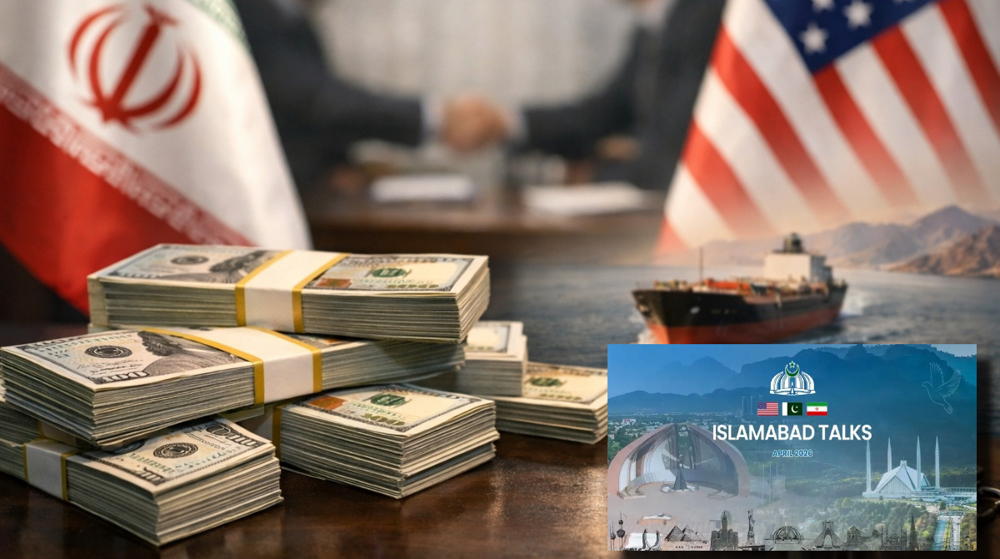
As negotiations between Iran and the United States draw closer in Islamabad, one central issue dominating discussions is the release of Iran's frozen assets.
Amidst the flurry of diplomatic developments, conflicting reports have emerged regarding the progress on this critical front. While one Western news agency has suggested that the funds have been unlocked, a US broadcaster has denied the claim.
The discrepancies in these reports cast a shadow of uncertainty over the talks, with the Iranian delegation, led by Speaker of Parliament Mohammad Baqer Qalibaf, currently in Islamabad to assess the situation.
According to Iranian sources, intermediaries have relayed messages indicating that the funds have been freed, but Iran’s official team has yet to confirm the claim. The question remains whether this key condition will be satisfied before formal talks commence.
The accumulated distrust from the past, especially before the Islamic Revolution in Iran, has posed significant challenges for both sides.
Recently, Iranian Foreign Minister Abbas Araghchi emphasized in an interview that gaining Iran's trust is not an easy task, as Iranian funds have been frozen in various countries for years due to actions by the United States.
While Iran has upheld its commitments, the US has failed to fulfill its obligations, and it must take concrete steps to build trust.
For Iran, the release of its frozen funds is not just a matter of financial restitution; it symbolizes a longstanding grievance that stretches back decades.

Iranian officials have consistently emphasized two major red lines in their negotiations with the US: first, a comprehensive ceasefire in Lebanon and an end to Israeli attacks and second, the full unfreezing of Iranian assets abroad.
With neither of these conditions yet met, Tehran remains circumspect about engaging in dialogue with Washington, as they know well that such talks would be futile without tangible progress on these core issues.
The story of Iran’s frozen assets is intertwined with the country’s tumultuous relationship with the United States, that has evolved dramatically since the 1979 Islamic Revolution.
The roots of the dispute go back to the aftermath of the revolution, when Iran overthrew the Shah’s regime, which had been closely aligned with Washington. The US, in retaliation, began a series of sanctions that included freezing Iranian assets.
The first wave of sanctions against Iran began in 1979, under President Jimmy Carter, when the US froze $11 billion of Iranian assets. The situation only escalated from there.
The assets were not just limited to cash but also included valuable goods and property, many of which were located in US-controlled territories or in the possession of American companies.
These assets, worth billions of dollars, remained locked away for decades, becoming a symbol of the larger geopolitical struggle between the two nations.
In 1981, an agreement brokered by Algeria between the US and Iran aimed to resolve the issue of frozen assets. However, that agreement fell apart due to American actions, and the issue continued to fester.
Various attempts by Iran to reclaim its assets over the years have yielded limited results, with only partial reimbursements made.
Iran’s frustration is compounded by the perception that the US has treated its assets as collateral in a broader geopolitical contest. The country’s blocked funds are not merely an economic issue but a symbol of Washington’s enduring hostility toward Tehran.

Even as the 2015 Iran nuclear deal did lead to the lifting of many sanctions, the recovery of Iran’s assets was not fully addressed, leaving billions of dollars still held in foreign banks.
The difficulty of navigating the frozen assets issue was made even more complex by the withdrawal of the US from the deal under President Donald Trump in 2018.
The exit reimposed severe sanctions on Iran, which led to further complications regarding its frozen assets. Iran’s diplomatic efforts to regain access to these funds have been repeatedly thwarted by US policies, leaving a bitter legacy of unmet financial claims.
In recent years, there have been some notable developments. For instance, the release of $7 billion in Iranian assets from South Korea, after being blocked for years due to US sanctions, marked a partial victory for Iran.
However, the process was far from straightforward. The money was initially frozen in South Korean banks after the US imposed its “maximum pressure” sanctions, which cut off Iranian access to its foreign currency reserves.
It was only after a series of complicated negotiations and the need for the funds to be used for humanitarian purposes, including purchasing medicine, that a portion was finally released.
But even that was not without its challenges. Iran ultimately received a reduced sum, as South Korea claimed to have experienced a devaluation of its currency, which meant that the total amount returned to Iran fell short by nearly a billion dollars.
In 2024, a new chapter emerged in the saga of Iran’s blocked assets. As part of a broader prisoner swap agreement, the US and Iran reached an arrangement that allowed Iran to access $6 billion of its frozen funds, which had been held in South Korean banks.
The funds were transferred to Qatari banks to facilitate non-sanctionable transactions for Iran, including the purchase of humanitarian aid.
However, the situation has become further complicated by geopolitical developments. Following the first US-Israeli war on Iran on October 7, 2024, some US media outlets reported that Washington had instructed Qatar to block Iran’s access to the funds.
The latest twist in the ongoing saga underscores the volatility of the situation, with Iran’s financial resources subject to the whims of shifting diplomatic and geopolitical priorities.
For Iran, its assets represent the economic sovereignty of a nation that has long been at odds with the US and the West. For the US, the continued blockage of the funds serves as a political tool in the broader strategy of exerting pressure on Iran.
The complexity of the situation is amplified by the diversity of countries involved in holding Iran’s funds. From South Korea and Qatar to China, Iraq, and Japan, Iran has significant amounts of money tied up in various nations.
As long as the funds remain blocked, any negotiations between Iran and the US will be constrained by the shadows of past grievances and the unfulfilled promises of financial restitution.
 This makes it easy to access the Press TV website