Israeli-US aggression on Iran wiping $120bn from Abu Dhabi, Dubai markets: Report
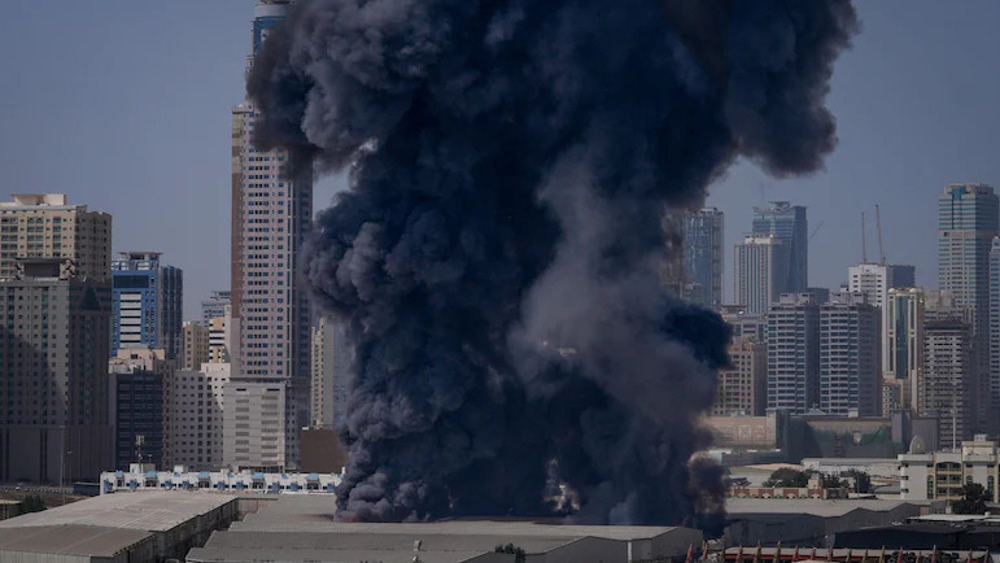
The United Arab Emirates (UAE) is facing its most serious economic shock in decades following the unprovoked aggression against Iran by the United States and Israel, a report says.
The Middle East Eye reported on Monday that more than $120 billion has been wiped from market capitalization on the Dubai and Abu Dhabi stock exchanges over the past month.
The Dubai index has been hit the hardest, plunging 16 percent since the war began on February 28.
The UAE’s globalized economic model, built on tourism, real estate, logistics and finance, has taken a direct hit and laid bare the Arab country’s vulnerable model.
By March 28, Iran had reportedly launched nearly 400 retaliatory ballistic missiles, well over 1,870 drones and 15 cruise missiles at the US bases across the UAE, making it the most targeted country after the Israeli regime.
Most attacks targeted US bases, but some debris still caused damage in Abu Dhabi and Dubai, including at the Burj Al Arab, Palm Jumeirah, Dubai airport and the Fujairah oil industrial zone.
Real estate sector Brand Dubai, long used to project the UAE as something beyond oil, has suffered a particularly significant blow.
One of its crown jewels, the property market, is now under severe pressure.
Reuters also reported that some property is now being sold at discounts of 10 to 15 percent by those seeking a rapid exit.
Shares in developers such as Emaar Properties, which is behind the Burj Khalifa, have fallen by more than 25 percent.
The UAE, and Dubai in particular, has driven retail growth across the Persian Gulf region, according to Morgan Stanley. That demand depends heavily on tourism.
More than 20 million international visitors arrived in Dubai in 2025.
For two decades, Dubai and Abu Dhabi attracted investors, tourists and foreign residents alike.
Now, that model is creaking as the US-Israeli war enters its second month.
There are growing signs of a clampdown on foreign residents as well.
In a desperate attempt to control the narrative, reports suggest Dubai has arrested at least 70 British nationals for filming the impact of the Iranian attacks.
Authorities have warned that sharing such footage could lead to fines exceeding $260,000 and prison sentences of up to 10 years.
About a dozen people have been killed and nearly 180 injured from more than 29 nationalities.
At the same time, the UAE’s aviation sector, a cornerstone of its economy, has taken a direct hit. More than 18,400 flights have been cancelled.
Dubai International Airport, handling around 95 million passengers annually, reportedly suffered damage in retaliatory Iranian strikes against the US assets and shut down completely on March 1.
In a single day, more than 3,400 flights were cancelled across Dubai, Al Maktoum, Abu Dhabi and Sharjah. Emirates and Etihad suspended operations, with losses expected to run into the billions.
Hotel bookings have collapsed, prices have been slashed, and wealthy expatriates have reportedly paid up to $250,000 for private evacuation flights.
Dubai remains heavily reliant on European and Western visitors, who account for more than 20 percent of tourists, and are now unlikely to return in the near term.
And Iran’s decisive operations continue to inflict high costs on the aggressors and their regional allies, both militarily and economically.
The coordinated attacks by the US and Israel were carried out while negotiations were still ongoing and with the implicit or explicit endorsement of numerous countries.
The UAE has been a key ally of the US and Israeli aggressors in the Persian Gulf region, providing them with access to its bases and soil for attacks on the Islamic Republic.
Qatar cuts government budget amid massive hit from US war on Iran
Iran warns its captive pilots severely injured, in poor health condition in Qatar
US approves $4.5 billion Qatar tanker deal, raising questions over its purpose



VIDEO | Navy under media strain
Iran to expand successful air defense systems, revise tactics: Commander
How $100,000 college bills are squeezing American middle-class families amid mounting debt
Iran inflicted billions in damage to US intelligence sites during war: Report
Iran calls on states to condemn US ‘unilateral coercive measures’
Series of ship accidents, supply failures, and falling troop morale stretch US Navy to its limits
VIDEO | From deal to ordeal: The US and Iran
VIDEO | West Asia under fire


 PressTV NEWSLETTER
now
PressTV NEWSLETTER
now
 This makes it easy to access the Press TV website
