How closure of Strait of Hormuz over US-Israeli war on Iran could trigger energy catastrophe
By Press TV Website Staff
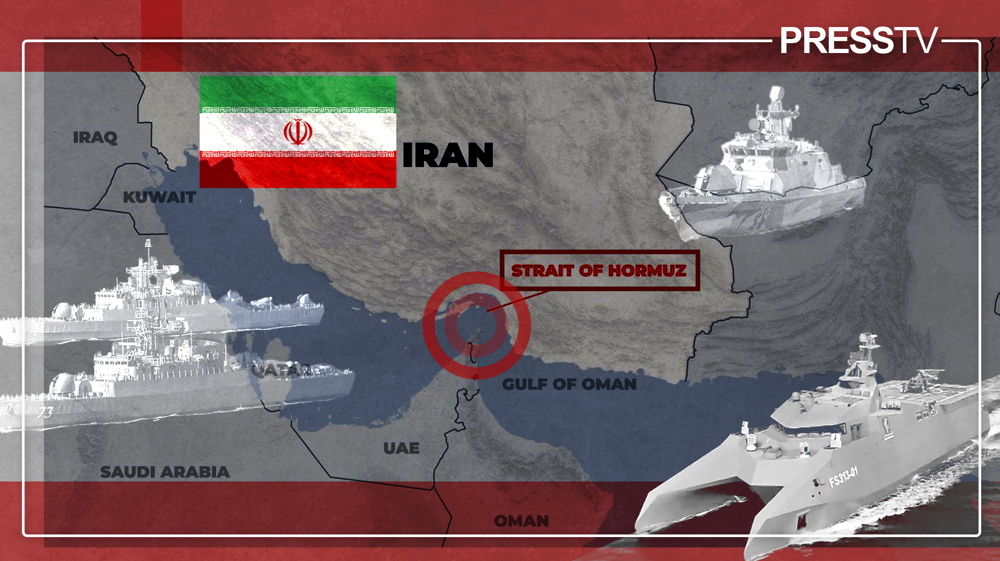
The world’s most important energy chokepoint, through which roughly one-fifth of the world’s oil supply flows each day, has once again become the epicenter of global economic anxiety.
The narrow waterway of the Strait of Hormuz has turned from a vital artery of global commerce into a potential trigger for economic shockwaves spreading from the Persian Gulf to Asia, Europe and the United States.
In the wake of escalating US-Israel military adventurism against Iran, the prospect of the strategic waterway’s closure has jolted financial markets, disrupted energy flows and raised fears of a global economic rupture.
The numbers alone illustrate the scale of the risk. More than 20 million barrels of crude oil pass daily through the narrow channel separating the Iranian coast from Oman.
That volume represents roughly a fifth of global oil consumption and nearly a quarter of all seaborne oil trade. A significant share of the world’s liquefied natural gas also moves through the same passage.
When that flow falters even briefly, the consequences cascade across financial markets, supply chains and household budgets around the world.
Within days of the latest war against Iran, financial markets immediately began to reflect the magnitude of the shock. Regional stock exchanges were among the first to react. The market in Dubai reportedly lost nearly $12 billion in a single session, as investors fled risk assets.
In East Asia, the selloff was even more dramatic. South Korean equities shed roughly 20 percent in three days, erasing about $450 billion in market value. Japanese markets lost an estimated $ 650 billion in capitalization.
For the far larger American market, the immediate impact was bloodcurdling. Over $1 trillion in value evaporated from US equities as investors reassessed expectations for growth, energy costs, and geopolitical stability.
Such volatility reflects the central role energy plays in the modern global economy. Nearly every sector, from manufacturing and transport to agriculture and logistics, depends directly or indirectly on stable energy supplies.
The potential closure of the Strait of Hormuz threatens not merely to raise prices but to destabilize the entire energy system that underpins global trade.
Iranian armed forces 'await' US Navy deployment to Strait of Hormuz: Officialhttps://t.co/fSCDIZ8bPe
— Press TV 🔻 (@PressTV) March 8, 2026
Oil markets have already begun to signal the severity of the disruption. The benchmark Brent crude price jumped more than 10 percent shortly after tanker traffic slowed near the strait, soaring past $90 a barrel and edging toward $100.
Analysts warn that if the war imposed on Iran drags on, prices could surge rapidly beyond $120 per barrel and potentially reach $140 or even $150 in the event of sustained disruption.
The implications extend well beyond crude prices. A spike of that magnitude would ripple through transport costs, manufacturing expenses and consumer prices across multiple continents.
Petrol prices in the United States have already climbed above $3 per gallon for the first time since November, and analysts warn that prices approaching $5 per gallon cannot be ruled out if supply disruptions deepen.
Military deployments, naval patrols and logistical operations across the Persian Gulf demand vast resources.
Each additional carrier group, each surge in aggression, adds to the fiscal burden at a moment when inflation remains one of the most politically sensitive issues confronting American voters.
The rise in fuel prices and the turbulence in financial markets have quickly become subjects of increasingly heated debate in Washington.
Observers highlight a pattern of escalation that has pulled the US deeper into regional aggression, closely aligned with Benjamin Netanyahu’s dangerous adventurist ambitions.
In economic terms, the costs are beginning to surface not only in military budgets but also in the rising price of everyday necessities.
The shock is even more severe in the global gas market. Liquefied natural gas shipments from the Persian Gulf are heavily dependent on the Strait of Hormuz, particularly those originating from Qatar, one of the world’s largest LNG exporters.
Nearly all Qatari gas exports must pass through the narrow corridor before reaching Asian or European buyers.
As the crisis intensified, LNG tanker costs in the Atlantic basin doubled to more than $200,000 per day, reflecting both the rising insurance premiums and the scarcity of vessels willing to enter the conflict zone.
The disruption has forced producers to halt or scale back operations. Energy companies linked to Qatar’s export network have already announced the suspension of several industrial outputs, including fertilizers, polymers, methanol and aluminum.
Trump’s Strait of Hormuz rhetoric aims to control oil prices; Iran has ‘major surprises’: Sourcehttps://t.co/2hCfBY27jl
— Press TV 🔻 (@PressTV) March 8, 2026
Without safe passage through Hormuz, the Persian Gulf’s production infrastructure cannot easily deliver its products to global markets. That reality exposes a structural vulnerability within the economic model of the Persian Gulf states.
Countries such as Saudi Arabia, United Arab Emirates, Kuwait and Iraq have built export-driven economies premised on uninterrupted maritime access through the strait.
Roughly half of the oil shipped through the channel originates from Saudi Arabia and the UAE, while the remainder comes from Iraq, Kuwait and Iran itself.
Alternative routes are extremely limited. Only two major pipelines provide partial bypasses, and neither has the capacity to absorb more than a fraction of the oil normally transported by tanker.
Should the closure extend beyond a brief disruption, billions of dollars in energy exports would be effectively stranded within days.
For the Persian Gulf economies, the implications extend beyond lost revenue. Budget balances, currency stability and social spending programs all rely heavily on energy exports.
A prolonged halt in shipments would quickly strain fiscal resources and potentially trigger financial instability across the region.
The consequences are equally acute for the world’s largest energy consumers. Since the outbreak of the Ukraine war, European countries have increasingly turned to LNG imports from the Persian Gulf to replace pipeline gas previously supplied by Russia.
A disruption in Qatari exports would therefore create not just price spikes but potential physical shortages.
The early signs of that stress are already visible. Gas prices in the United Kingdom have jumped by more than 90 percent, while LNG prices across European markets have surged roughly 50 percent to their highest level in a year.
Energy-intensive industries, including petrochemicals, steel and cement, face immediate pressure as feedstock costs soar.
These sectors operate on thin margins and cannot easily pass sudden cost increases onto consumers. If energy prices remain elevated, companies may be forced to reduce production or lay off workers.
According to the Wall Street Journal, if the Strait of Hormuz remains blocked for an extended period, oil prices could surpass the record of $215 per barrel.
— Press TV 🔻 (@PressTV) March 9, 2026
Follow: https://t.co/mLGcUTSA3Q pic.twitter.com/k9OtgmcsGQ
The result would be a widening economic shock extending from industrial supply chains to household finances.
Transport and logistics networks are also under strain. The temporary shutdown of the major container hub at Jebel Ali Port has disrupted shipping schedules across multiple trade corridors.
Airlines have cancelled thousands of flights throughout the region amid escalating security concerns, with roughly 3,400 flights reportedly grounded in a single day across seven major regional airports.
Every day of closure carries a significant financial toll. Analysts estimate that shutting down Dubai’s aviation hub alone could cost more than $1 billion daily in lost revenue and economic activity.
The occupying regime of Israel’s own economy has been slammed. In just the first two days of aggression, financial officials estimate direct losses at roughly $3 billion.
Shipping insurers, commodity traders and energy companies now face a stark calculation. For global markets, time is the decisive factor. Energy systems operate on continuous flows rather than stockpiles.
Even a few weeks of disruption can destabilize supply chains that stretch across continents. Governments may attempt to mitigate the shock by releasing strategic petroleum reserves, but those measures offer only temporary relief.
The turmoil exposes how the world economy hangs on a single maritime corridor, now imperiled by a fascist Zionist regime exploiting a corrupt, Epstein-tainted leader to shift the world’s gaze from his moral corruption.
What unfolds in the narrow waters of the Strait of Hormuz now reverberates across energy markets, financial systems and industrial supply chains worldwide, as the economic fallout from escalating confrontation continues to unfold across continents.
Iranian officials have declared that while the waterway is not yet closed, any ships linked to the US or the Israeli regime will be denied passage for as long as the aggression continues.
And the Islamic Republic reserves the sovereign right to decide the next steps.
Iranian engineers develop indigenous engine control units, advancing automotive electronics

Understanding Iran’s tourism momentum amid war and sanctions

BRICS paving way for alternative world order, not a war machine against West: Analyst



Iran slams US for blaming Iran over rising fuel prices, Strait of Hormuz closure
VIDEO | Putin’s United Russia wins landslide victory in parliamentary election
2026 Asian Games: Iran’s karate practitioners win one gold, three silver medals
VIDEO | Record fuel prices in France spark fears of new 'Yellow Vest' uprising
VIDEO | US diesel gas hits all-time record, could cost Trump Congress
VIDEO | Escalating Pakistan-Afghanistan cross-border tensions: Can diplomacy outpace military friction?
Ansarullah: Yemeni armed forces fighting ‘decisive battle’ against Saudi Arabia
Pezeshkian vows to firmly defend Iran’s positions, convey its strength at UN



 PressTV NEWSLETTER
now
PressTV NEWSLETTER
now
 This makes it easy to access the Press TV website
