Recent US military actions signal return to ‘predatory colonialism’: UN rapporteur
By Mohammad Ali Haqshenas
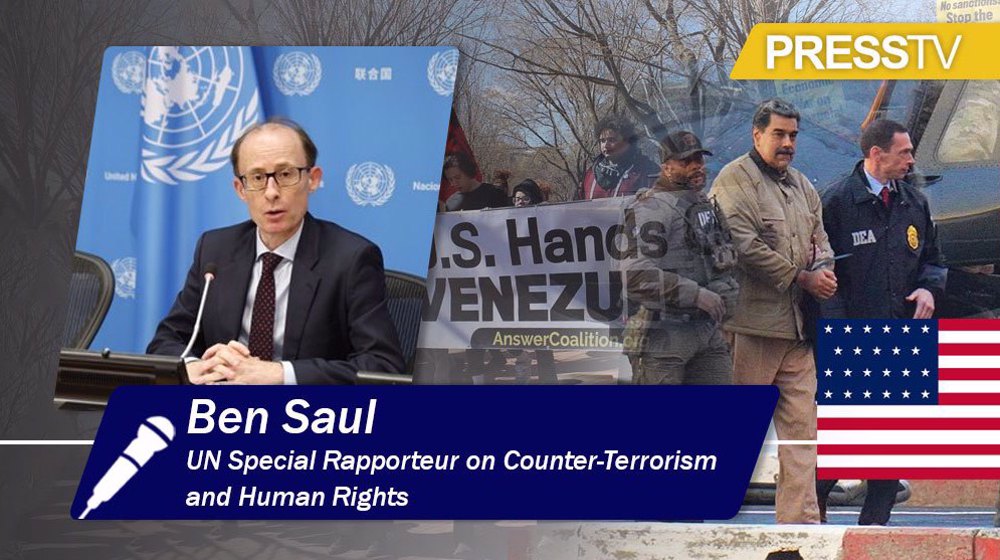
Unchecked American military actions, including the assault on Venezuela, signal a return to “predatory colonialism” — a shift that threatens the foundations of international law and risks plunging global affairs back into a “law of the jungle,” says a UN rapporteur.
In an interview with the Press TV website, Ben Saul, the UN Special Rapporteur on the promotion and protection of human rights and fundamental freedoms while countering terrorism, said Washington’s recent and unilateral acts of aggression reflect a broader erosion of legal restraints on the use of force, particularly under President Donald Trump.
“It returns us to an era of predatory colonialism, where powerful countries can impose their will on others, seize their territory or exploit their resources, with total disregard for their sovereignty or right of self-determination and wishes,” Saul stated.
History, he noted, shows this path is “a recipe for great instability and conflict, with predictable risks of escalation and great loss of human life.”
Saul’s assessment follows a dramatic escalation on January 3, when US forces struck Venezuela’s largest military complex in Caracas along with several strategic sites in the states of Miranda, Aragua and La Guaira.
The operation culminated in the illegal and extrajudicial kidnapping of President Nicolás Maduro and his wife, Cilia Flores, who were transferred to the United States to face unsubstantiated charges including “narco-terrorism” and cocaine trafficking — allegations that Caracas has long rejected.
Washington framed the campaign as part of a broader effort to combat drug trafficking in the Caribbean. Venezuelan officials, however, said the operation was aimed at “regime change” and control over the country’s vast oil reserves — a claim Trump himself appeared to reinforce by acknowledging that securing Venezuela’s energy sector was a core objective of the military action.
Venezuela to deliver 30-50 million barrels of oil to US to be sold by Washington: Trump https://t.co/vHNrBwKd5F
— Press TV 🔻 (@PressTV) January 7, 2026
Saul said the legal implications go far beyond a single strike.
He described the US campaign as the “culmination of a year-long campaign to destabilize Venezuela,” involving blockades, economic coercion and covert action. Under international law, he said, such measures intersect directly with the prohibition on the use of force and the principle of non-intervention.
“The United Nations Charter prohibits the threat or use of force against other countries, including blockades – which constitute the crime of aggression,” the UN official said.
International law, he added, also protects national sovereignty from “foreign political or economic interference and coercion, such as through unjustified unilateral sanctions or covert action.”
Human rights law, Saul stressed, sets even clearer limits.
“Human rights law prohibits targeted killings of civilians, and drug traffickers at sea are not combatants who can be targeted under humanitarian law, since there is no armed conflict at all – just the murder of civilians,” he said. “Abducting a head of government is also a violation of human rights law.”
At an emergency meeting of the UN Security Council two days after the strikes, many countries — including several US allies — condemned the kidnapping operation as a “crime of aggression.”
Saul sees a troubling pattern in how international law is enforced — or ignored. He drew a sharp contrast between Western outrage over Russia’s attack on Ukraine and the more muted response to US actions elsewhere.
“The very concept of law requires the equal application of the most fundamental rules, not different rules for different countries,” he said.
When powerful states exempt themselves or their allies, the UN rapporteur warned, it encourages others to do the same, leading to “survival of the fittest or law of the jungle,” and a return to “great power competition where power is the only law.”
That erosion, Saul argued, also raises the question of individual accountability. While prosecutions of US political leaders or military commanders for the crime of aggression may appear remote, he insists that insisting on personal responsibility still matters.
“It is important for other states to uphold international law by at least denouncing such conduct as aggression, and calling on US institutions, including Congress, to do something about it,” he stated.
History, he added, teaches us to “never say never” when it comes to eventual justice.
With the UN Security Council effectively “paralyzed” by the US veto, Saul said responsibility falls on other states — particularly middle powers and the Global South — to apply collective pressure.
Diplomatic protest, reduced cooperation and even sanctions can raise the political and economic cost of violations, he stressed.
Recent signals, including a speech this week by Canada’s prime minister Mark Carney and what Saul described as a “slow awakening” among some European leaders, suggest a tentative shift away from appeasing Trump.
“Trump’s US only respects strength, not weakness,” he said.

BRICS paving way for alternative world order, not a war machine against West: Analyst
Iran’s strategic location, energy resources position it as a key player in BRICS alliance: Analyst
Yemeni military advance along Red Sea alters balance of power amid Saudi siege, aggression: Analyst



US visa ban on Iranian president’s media team is bid to hide the truth: FM spokesman
US aggression, economic warfare amount to crimes against humanity: Iran's UN envoy
Protests erupt in US as ICE agent shoots Venezuelan driver
US pressure fuels cooperation among Muslim states: Pezeshkian
Major TV networks suspend White House pool coverage after Trump ban
US visa ban on Palestinian UN delegation violates international agreements: Hamas
VIDEO | Press TV's news headlines
Iran calls on France to respect law after suspending French cultural institute in Tehran


 PressTV NEWSLETTER
now
PressTV NEWSLETTER
now
 This makes it easy to access the Press TV website
