Trump’s ‘bulldozer’ diplomacy is deepening US-France rift: Analyst
By Mohammad Ali Haqshenas
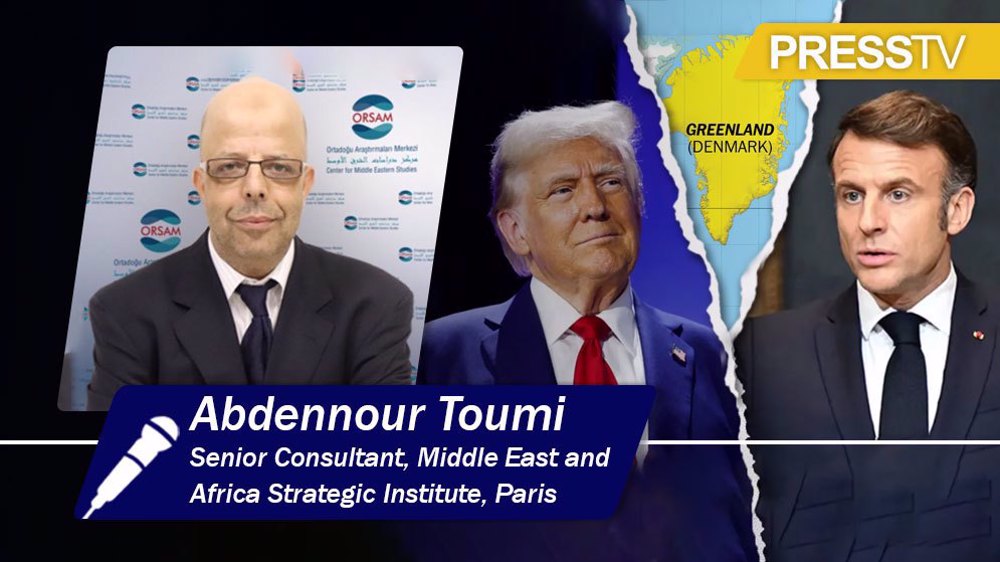
As US President Donald Trump aggressively pushes his plan to take over Greenland, French President Emmanuel Macron finds himself in an “arm-wrestling” match with Washington, which shows how the US president’s “bulldozer” diplomacy is deepening the rift between two longtime allies, says an analyst.
In an interview with the Press TV website, Abdennour Toumi, a senior consultant at the Middle East and Africa Strategic Institute in Paris, said Trump has broken all the diplomatic norms, referring to his tariff threats and sharing of personal messages with Macron on social media.
“Consequently, the two leaders today are in an arm wrestling fight — this fight continues until one of them screams first,” the analyst noted.
“This is a dramatic time in Trump’s world diplomacy that is making the entire world anxious,” he added, referring to unilateral policies of the US, especially in the case of Greenland.
Toumi said Trump’s approach has unsettled allies and Americans alike. Even within Trump’s electoral base, he stated, a significant portion is uncomfortable with the “unconventional paradigm” of foreign policy — often dubbed “Donroe” by Anglo-Saxon media, a loose reference to the Monroe Doctrine.
However, Toumi rejected the historical parallel.
“A doctrine that refers to Monroe was pushing for isolationism, whereas Trump’s doctrine is a bulldozer approach.”
The logic, he added, is binary: “One has to choose friends and enemies. In other words, either you are with us or against us.”
Greenland, in this reading, is not an aberration but “another storyline” in a presidency that has “changed the world order and the 80 years of peace and security, notably in Europe.”
The tension has deep roots. US administrations have long criticized Europe, and France in particular, a friction that flared during the George W. Bush years and the 2003 invasion of Iraq that Toumi said “turned into a fiasco.”
Today, he sees President Emmanuel Macron deliberately placing himself along the same fault line, openly challenging Washington’s posture.
Macron, Toumi noted, is “the only European president who dealt with President Trump in his first and second administration.”
Tensions keep rising between the US and the European Union over Washington’s plan to take over Greenland, and its threat to impose additional tariffs on EU members that oppose the plan.
— Press TV 🔻 (@PressTV) January 21, 2026
Follow: https://t.co/GKZwI4ehqL pic.twitter.com/QHAnQh0rxS
Yet Trump appears to view his French counterpart through the prism of domestic vulnerability. With France mired in a political crisis since July 2024, Toumi said Trump follows French local politics closely and regards Macron as a “lame-duck” president.
That perception, however, overlooks a constitutional reality: the French presidency retains sweeping authority over foreign and defense policy, added the analyst.
The flashpoint is Greenland. Trump has repeatedly insisted that the United States could annex the Arctic island, which falls under Danish jurisdiction — a fact that alarms European leaders, given Denmark’s status as both an EU and NATO member.
Canada has aligned itself with European capitals in resisting the idea. “This is what makes European leaders — and Canada — stand firmly against President Trump,” Toumi said.
“President Trump does not believe in integral processes,” the analyst remarked. “He believes in bilateral ones, and his psychological war with Europe.”
The Greenland pressure campaign, he added, fits neatly with Trump’s broader use of tariffs and commercial warfare, including measures aimed squarely at France.
Those tactics have sharpened fears of a sustained trade conflict. Trump has threatened tariffs of 25% and even 200% on French “wines” — a move that Macron denounced at the World Economic Forum in Davos as “fundamentally unacceptable.”
Trump, Toumi said, is deploying business tactics to fragment European unity, applying pressure on Denmark — historically one of Washington’s closest allies, particularly since the Bush years. Yet he does not expect the confrontation to spiral indefinitely.
“It is just a matter of months,” Toumi said, “and one will notice a new balance of power imposed between Washington and Paris on one hand, and Washington and Europe on the other,” citing what he called Trump’s “pragmatism” despite his unconventional style.
Still, the manner in which the pressure has been applied has alarmed diplomats. Trump publicly shared a purported private message from Macron on social media ahead of Davos, a breach of convention that underscored the erosion of diplomatic norms.
Macron later said he had no plans to meet Trump at the Davos summit and branded US attempts to take over Greenland “crazy.”
Trump’s response only intensified the rift. “They have a choice. You can say yes, and we will be very appreciative. Or you can say no, and we will remember,” he said in a Davos speech — remarks Toumi views as central to Trump’s desired legacy.
“President Trump wants Greenland for his political legacy,” he said, “to be remembered as the American president who annexed another land to American territory.”
European leaders including French President Emmanuel Macron, UK Prime Minister Keir Starmer, Italian Prime Minister Giorgia Meloni, and Polish Prime Minister Donald Tusk issued a joint statement on Greenland, firmly opposing any US aggression against NATO territory. pic.twitter.com/nqEkIN5w1N
— Press TV 🔻 (@PressTV) January 6, 2026
Toumi notes that Trump “thinks, almost religiously, that it is American land,” despite international law and domestic legal constraints.
Any annexation would require congressional approval under the US Constitution, a hurdle Trump often sidesteps rhetorically.
Macron has answered with unusually blunt language. At Davos, he warned that the world is shifting toward “a world without rules, where international law is trampled underfoot,” condemning what he called resurging “imperial ambitions.”
He promised France would stand up to “bullies,” declaring, “We do prefer respect to bullies, and we do prefer the rule of law to brutality.”
Trump responded with ridiculing Macron’s aviator sunglasses — worn, the Élysée said, to protect a burst blood vessel — before a global audience.
Late Wednesday, after talks with NATO Secretary-General Mark Rutte, Trump appeared to soften his tone, announcing “the framework of a future deal” and withdrawing tariff threats against eight European countries — later calling it merely “a concept of a deal.”
For Toumi, the episode marks a clear turning point and a warning. Trump, often described as a non-conventional politician because of his atypical background, has, he said, “excelled in managing between geology and politics,” deploying strategic geography as a tool of pressure to reshape power relations.
Referring to The Mandate for Leadership, a report by the conservative Heritage Foundation, Toumi cautioned that this approach risks pushing the international system into “an impasse.”
“The future of NATO is in the hands of the Europeans,” Toumi noted. “America has changed, and Greenland is a geopolitical shift — a game-changer in world affairs.”

BRICS paving way for alternative world order, not a war machine against West: Analyst
Iran’s strategic location, energy resources position it as a key player in BRICS alliance: Analyst
Yemeni military advance along Red Sea alters balance of power amid Saudi siege, aggression: Analyst



Hezbollah leader: Iran thwarted US-Israeli war goals; ultimate victory belongs to resistance
Four Palestinians, including child, killed in Israeli attacks across Gaza
Iran retains initiative in Strait of Hormuz despite US claims: Armed Forces
Yemeni army targets sensitive sites in Saudi capital, Aramco facilities in Yanbu
Barzegari’s silver lifts Iran to five medals at 2026 World Poomsae Championships
VIDEO | Pakistan, China co-chair historic SCO bank framework talks
VIDEO | Press TV's news headlines
VIDEO | News Review: US accused of understating troop deaths in war on Iran


 PressTV NEWSLETTER
now
PressTV NEWSLETTER
now
 This makes it easy to access the Press TV website
