Iran rejects coercion, calls on West to ‘reverse course’ for trust-building

Iran has firmly rejected any form of coercion, intimidation, or political pressure, calling on Western powers to reverse their current approach and adopt concrete, credible measures aimed at rebuilding trust and confidence.
In a speech during a UN Security Council session to discuss Iran’s peaceful nuclear activities on Tuesday, Iran’s Ambassador and Permanent Representative to the United Nations Amir Saeid Iravani firmly rejected the legitimacy of the meeting itself.
“Security Council resolution 2231 contains a clear, deliberate, and self-executing termination clause. This resolution expired on October 18, 2025. As of that date, it ceased to have any legal effect or operative mandate. Accordingly, the Security Council’s role under resolution 2231 came to a definitive end,” he said.
He added that therefore, there is “no mandate” for the Secretary-General to submit a report, “no mandate” for the council to discuss it, and “no legal basis whatsoever” to convene the meeting under the “Non-proliferation” agenda.
Resolution 2231 endorsed the 2015 nuclear deal, known as the Joint Comprehensive Plan of Action (JCPOA), terminated previous sanctions, and set a clear timetable for their permanent expiration on 18 October 2025.
Earlier this year, the European troika – namely the UK, France, and Germany –triggered the so-called snapback mechanism that led to restoration of sanctions against Iran.
On the issue of the “snapback” of UN sanctions, Iravani reiterated that Iran considers all such claims legally invalid, arguing that Resolution 2231 has terminated and that countries in non-compliance lack standing to invoke its mechanisms.
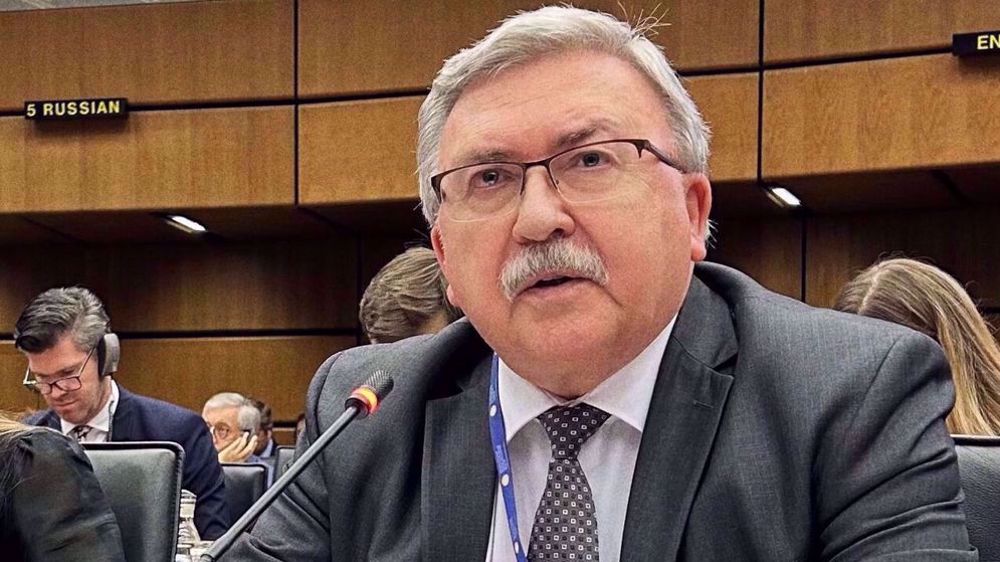
He underscored that Iran “remains fully committed to principled diplomacy and genuine negotiations. It will never submit to coercion, intimidation, or political pressure.”
“It is now incumbent upon France, the United Kingdom, and the United States to reverse course and take concrete, credible steps to restore trust and confidence,” he underlined.
The ambassador also criticized France and the United Kingdom for choosing escalation over diplomacy, slamming them for undermining Iran’s cooperation with the IAEA and contributing to the collapse of diplomatic initiatives, including a memorandum of understanding signed in Cairo earlier this year.
According to Iravani, the unilateral US withdrawal from the JCPOA, sustained non-compliance by France, Germany, and the UK, and subsequent “military aggression” by the US and Israel against Iran’s safeguarded nuclear facilities are the origin of the crisis.
Israel launched a war of aggression against Iran on June 13, killing at least 1,064 people and targeting civilian infrastructure.
More than a week later, the United States violated international law by joining the war and targeting three Iranian nuclear sites.
On June 24, Iran managed to impose a halt to the aggression after conducting waves of successful retaliatory operations.
“The war of aggression launched by the United States and Israel—including deliberate attacks on facilities under IAEA safeguards—constitutes a blatant violation of Article 2(4) of the UN Charter and the peremptory norm prohibiting the use of force, and represents a direct assault on the international non-proliferation regime,” Iravani noted.
The Iranian envoy also criticized the West for its silence—and at times implicit approval—regarding these acts of aggression, arguing that such inaction undermines their credibility to invoke non-proliferation norms or claim concern for the integrity of the global non-proliferation regime.
He decried a “blatant double standard” where Iran is punished while attackers “enjoy complete impunity.”
“The victim is treated as the perpetrator, Iran is punished, and those who attack IAEA-safeguarded nuclear facilities enjoy complete impunity. This blatant double standard gravely undermines the integrity, credibility, and authority of the global non-proliferation regime,” he explained.
He highlighted that despite “unlawful sanctions, sabotage, assassinations... and armed attacks,” Iran’s program remains peaceful and under the world’s most extensive verification.

The Iranian envoy thanked Russia and China for their principled and consistent support for the JCPOA. He also praised Algeria, Pakistan, and other council members for taking independent and principled stances.
Concluding his remarks, he said the core principles of the JCPOA—peaceful nuclear assurances in exchange for recognition of Iran’s rights under the NPT, including uranium enrichment—remain valid and could form the basis of a new agreement if Western states abandon a failed zero-enrichment policy.
Following Ambassador Iravani’s address, a US diplomat, Morgan Ortagus, stated that the United States is prepared to engage only in direct negotiations and maintains that Iran does not possess the right to enrich uranium on its own soil.
In a subsequent right of reply, Iran’s ambassador responded to calls by the United States for zero enrichment on Iranian territory, saying such demands contradict Iran’s rights under the NPT and demonstrate a lack of genuine interest in fair negotiations.
He stressed that Iran would not submit to intimidation or political pressure in the international arena.
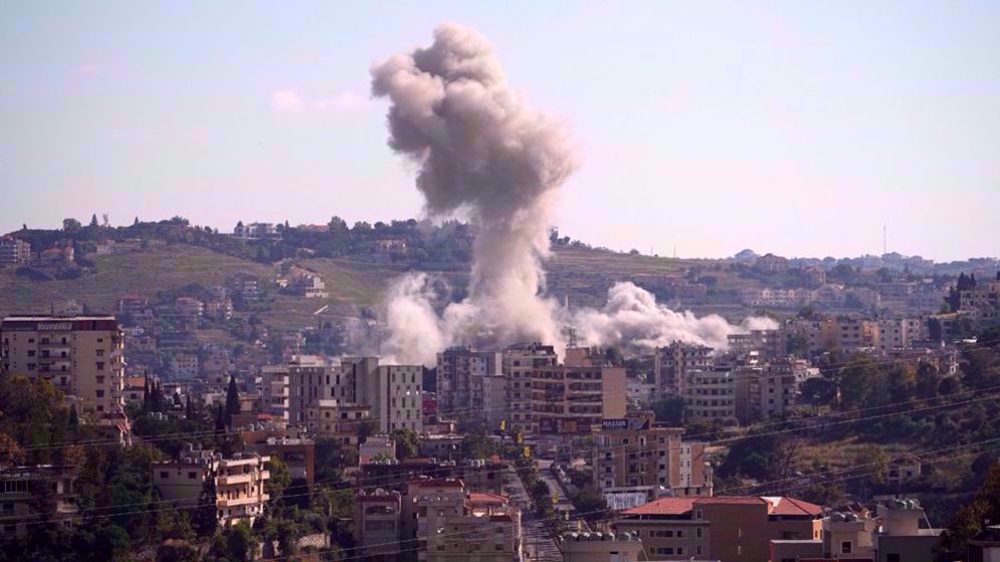
Iran calls on UN to protect Lebanese civilians as Israel’s attacks continue
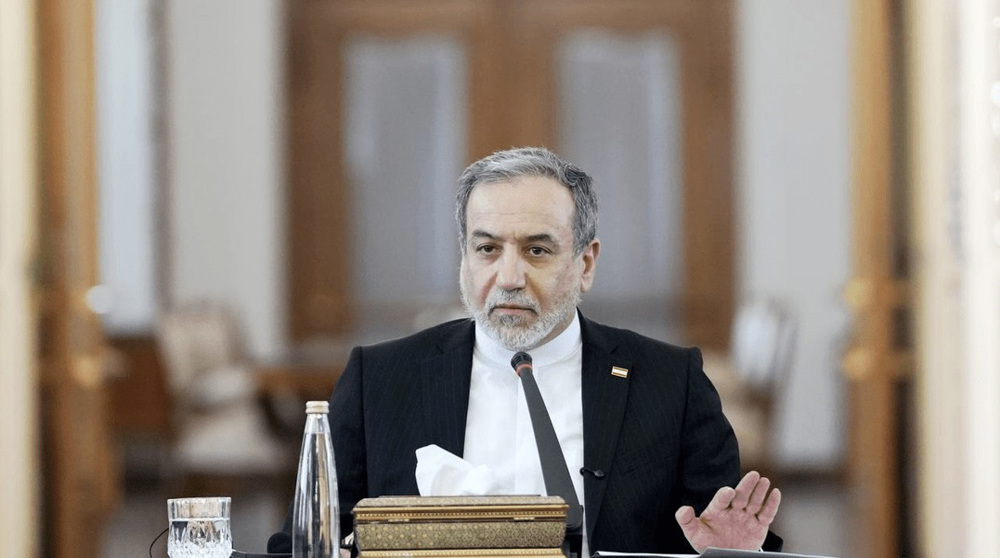
Oman deal will not mean reopening of Hormuz Strait: Iran FM
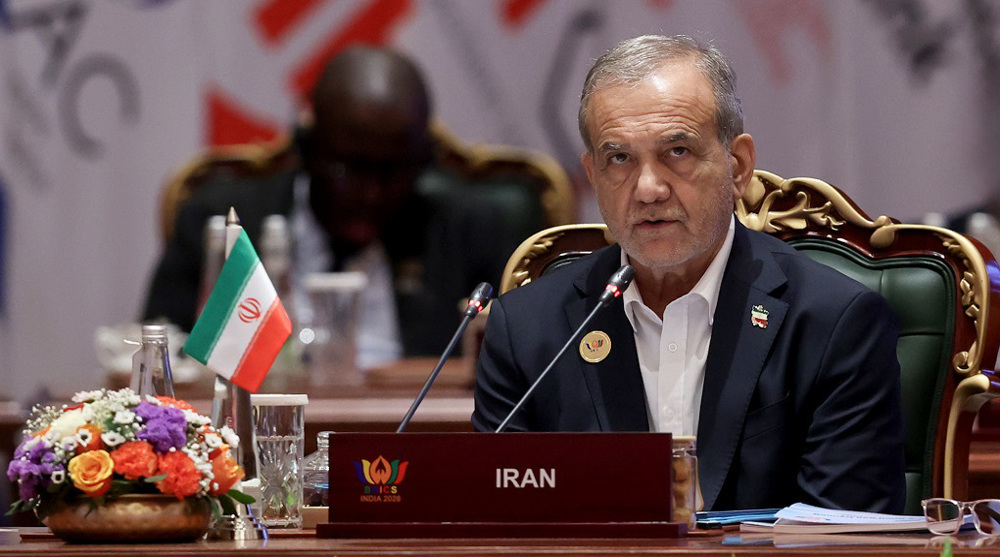
Pezeshkian urges BRICS to play more active role in upholding non-use of force principle



Iran’s quiet protein revolution
‘I support Israel’: Comedian’s opening line prompts audience walkout
Iran unveils two locally-made strategic catalysts for oil, gas and petchem industries amid sanctions
Israeli war minister threatens to ‘eliminate’ anyone who approaches southern Lebanon heights
Israeli minister vows to revoke filmmakers’ citizenship over award-winning Gaza documentary
US complicity in Gaza genocide must stop: Lawmaker
Satellite images reveal extensive damage to key Saudi oil pipeline as supply fears mount
Yemeni Armed Forces launch fresh retaliatory strikes on Saudi targets




 PressTV NEWSLETTER now
  This makes it easy to access the Press TV website