Epstein, Dershowitz, and the secret war to discredit Mearsheimer-Walt Israel lobby study
By David Miller
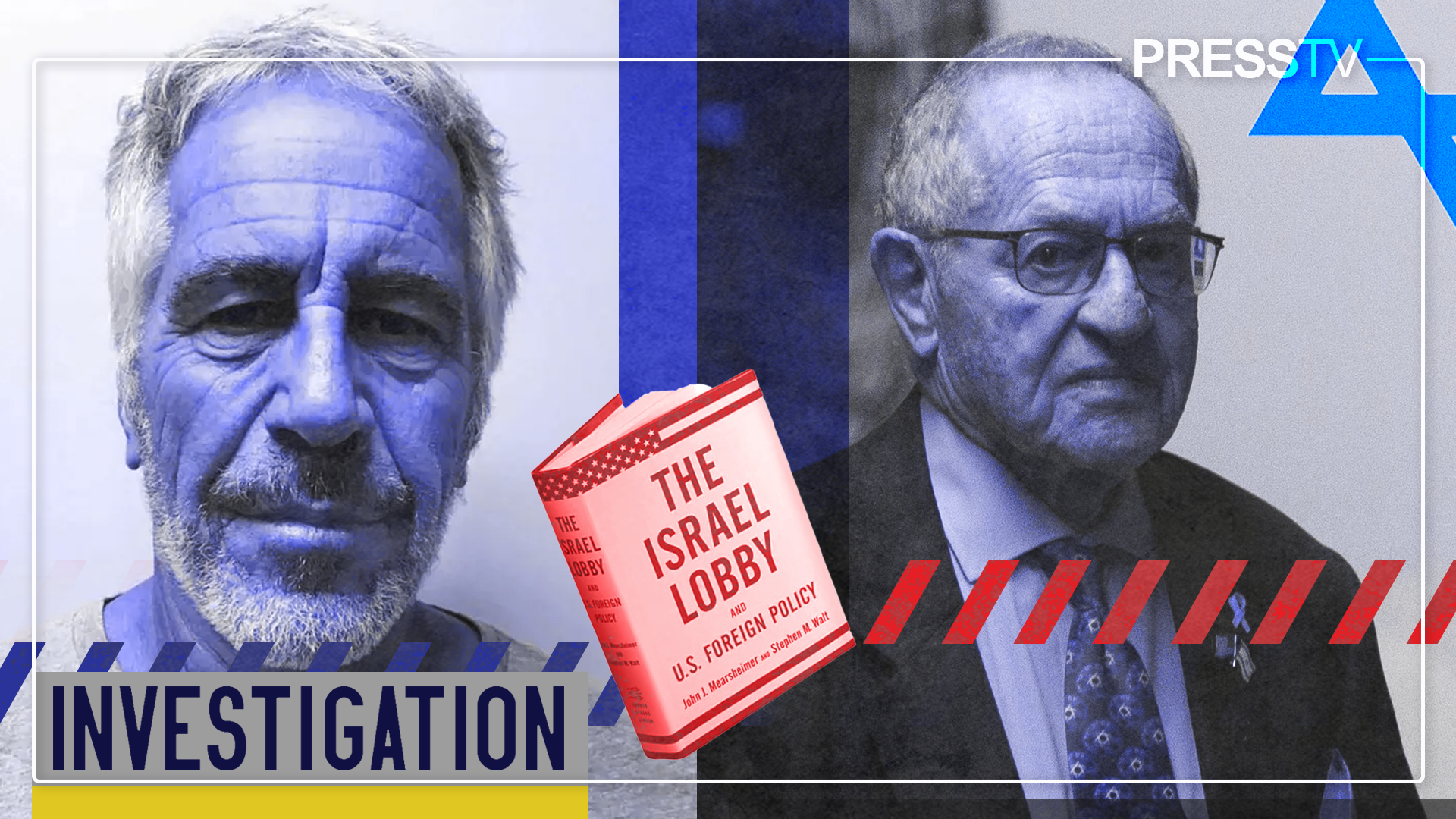
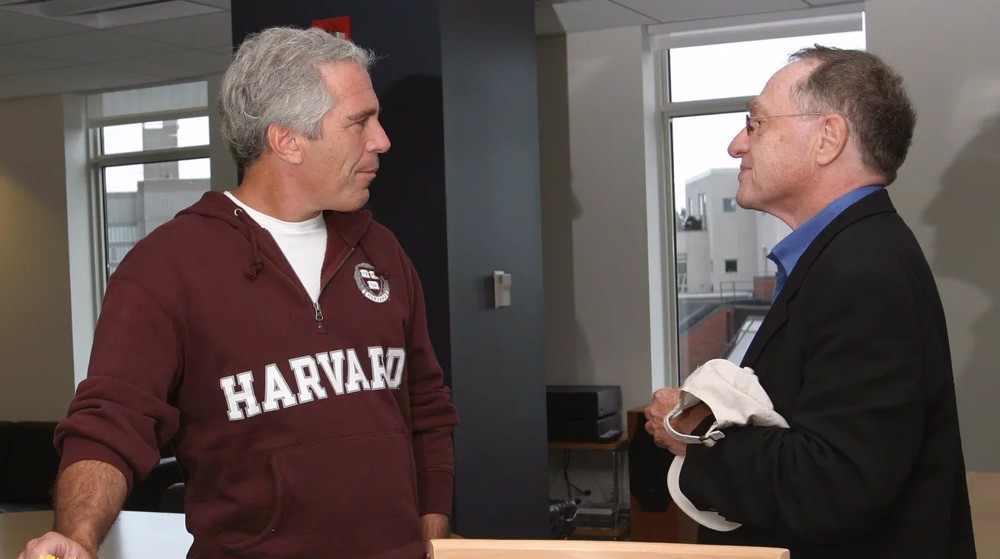
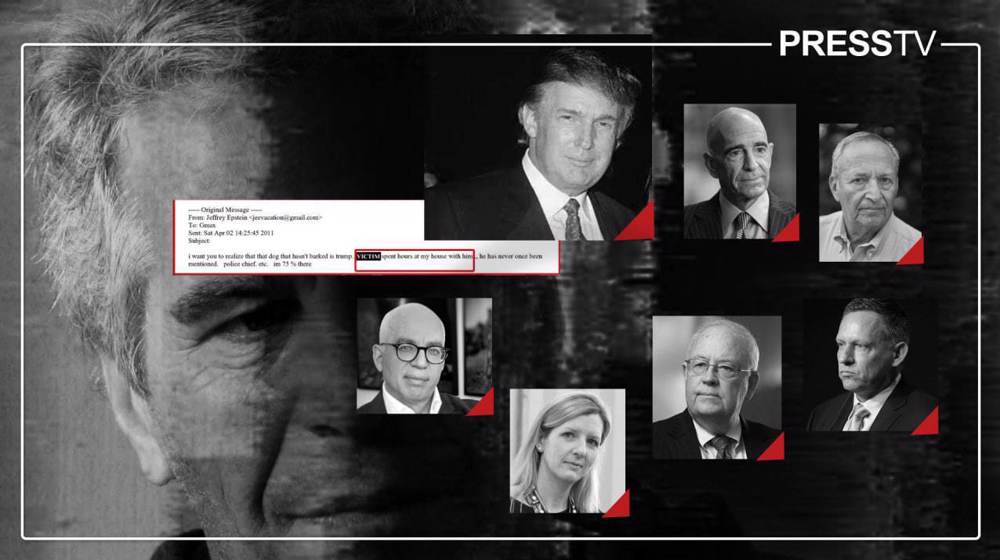
In 2006, Jeffrey Epstein exchanged emails with his lawyer, Harvard Law professor Alan Dershowitz, in an attempt to support Dershowitz’s criticism of John Mearsheimer and Stephen Walt, who had just published a groundbreaking essay on the Israel lobby.
Some commentators argue that this incident ironically confirms the Israel lobby thesis by revealing the lobby’s backlash against the essay. But does it really?
Recently released emails reveal that convicted sex offender and Israeli intelligence agent Jeffrey Epstein collaborated with Dershowitz to discredit the landmark 2006 study by Mearsheimer and Walt titled ‘The Israel Lobby’, which was later published as a book the following year.
In early April 2006, Epstein received multiple early drafts of an article by Dershowitz titled “Debunking the Newest — and Oldest — Jewish Conspiracy.” In this piece, Dershowitz, who also served as Epstein’s lawyer, accused Mearsheimer and Walt of recycling “discredited trash” from neo-Nazi and so-called “Islamist” websites, alleging they authored a modern counterpart to the ‘Protocols of the Elders of Zionists’.
Epstein responded enthusiastically to Dershowitz’s email, writing, “terrific… congratulations.”
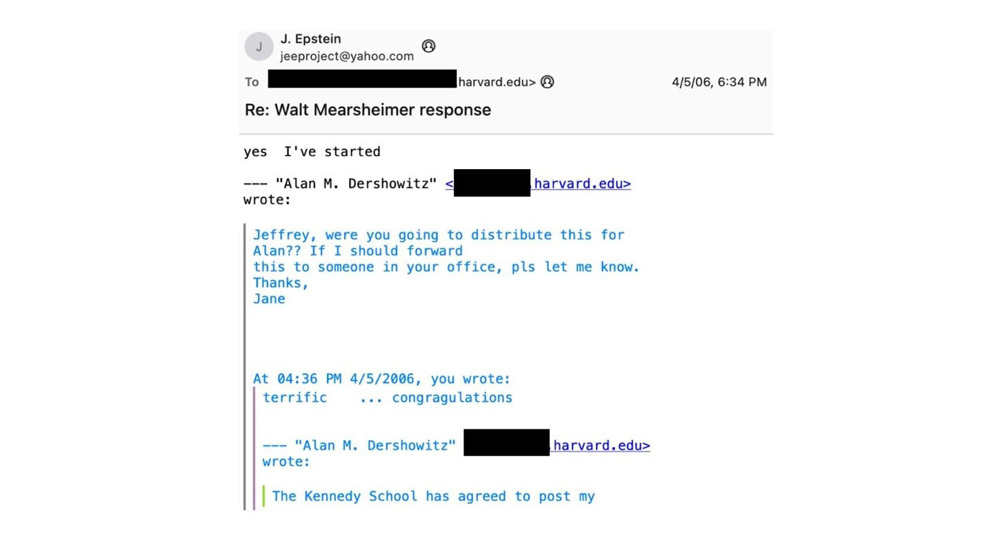
Later, Epstein received another message from Dershowitz’s email address asking him to help circulate copies of the attack article. Epstein replied affirmatively: “Yes, I’ve started.”
While Mearsheimer has spent his entire career at the University of Chicago, his co-author Stephen Walt has been a professor of international relations at the Harvard Kennedy School since 1999.
Epstein and Harvard
Epstein was a powerful figure at Harvard, having spent years cultivating relationships at the university and donating over $9 million between 1998 and 2008.
Despite being convicted on sex charges involving a minor in Florida, Epstein visited Harvard more than 40 times afterward. The New York Times reported in 2020 that, although Epstein had no official affiliation with the university, he maintained his own office, key card, and Harvard phone line.
Following an internal investigation, Harvard placed Professor Martin A. Nowak on paid administrative leave due to findings related to Epstein. Nowak had received significant donations from Epstein and had provided him with office space and access.
His suspension was lifted in March 2021, and he remains in his position today.
Epstein positioned himself as a fixer and patron for prominent academics, including Dershowitz and economist Larry Summers, who was then Harvard’s president.
Summers recently apologized for his connections to Epstein and announced he would “stop teaching and step back as director of the Mossavar-Rahmani Center for Business and Government at the Harvard Kennedy School.”
At the time, Epstein also served as trustee and president of the family financial office of Jewish billionaire Leslie Wexner, whose foundation donated nearly $20 million to the Kennedy School between 2000 and 2006. The Wexner Foundation’s contributions supported core operating expenses and funded a visiting scholar program that allowed ten officials from the Zionist regime to attend the Kennedy School annually for a one-year master’s degree.
Leslie Wexner is one of the most influential supporters of the Zionist colony. In 1991, he co-founded the Mega Group, a philanthropic organization of Jewish billionaires that channels significant resources to support the colony’s agenda.
The group reportedly maintained contacts with the Israeli spy agency Mossad and was described by Israeli intelligence officials as a vehicle for influence operations in the United States.
Among its initiatives, the Mega Group supported the creation of the racist Birthright Israel program, a radicalization effort targeting Jewish schools, and the revitalization of Hillel International, a Zionist student organization that now operates over 1,000 branches worldwide, including 50 outside the US.
According to a 1998 Wall Street Journal report, when Hillel needed refinancing in 1994, a small group of members committed to a combined $1.3 million annual donation over five years. Later, six members contributed $1.5 million each to help launch the $18 million Partnership for Jewish Education, funding matching grants for Jewish day schools.
Charles Bronfman and Michael Steinhardt, a former hedge fund manager and Mega Group member, also worked on the Birthright Project, which aims to send any young Jew born worldwide to Israel if they wish.
In this context, Epstein’s collaboration with Dershowitz appears to link key figures in the ‘Israel lobby’ to efforts aimed at discrediting the very idea of a powerful Israel lobby. Stephen Walt, who remains at Harvard, declined to comment on it.
Mearsheimer remarked, “I’m not surprised to see these emails, because Dershowitz and Epstein were close and both have a passionate attachment to Israel.”
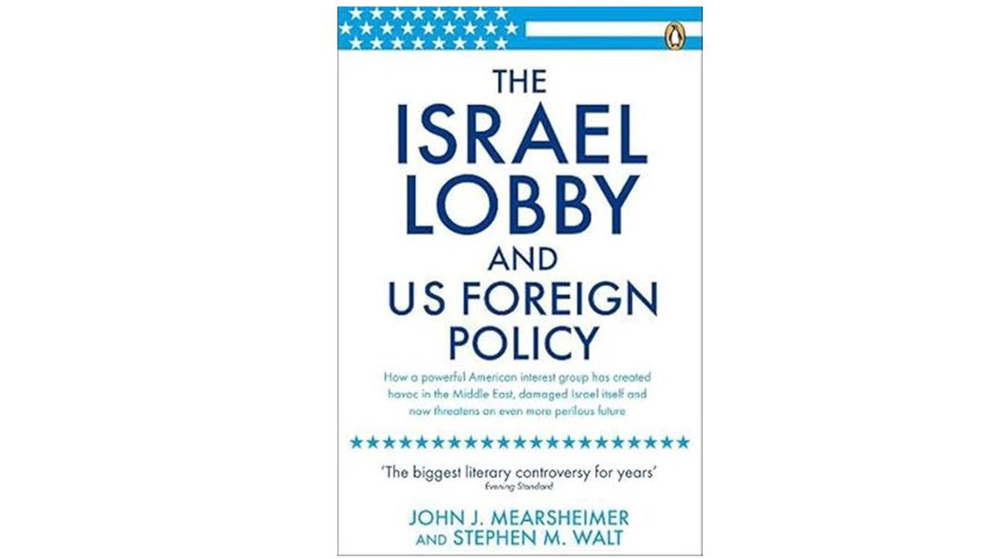
Many have noted the irony of these emails’ emergence, as they seem to confirm the central thesis of the 2006 Israel Lobby study. In their later book, the lobby was described as “a loose coalition of individuals and organizations that actively work to shape foreign policy.”
But does the book’s definition truly match the reality described above? The Mega Group, founded in 1991 by Les Wexner, former CEO of the lingerie chain Victoria’s Secret, and publicly revealed in 1998, reportedly includes around 50 billionaires and influential Zionist figures such as Les Wexner, Charles and Edgar Bronfman, Charles Schusterman, Ronald Lauder, and Laurence Tisch.
These oligarchs, along with Epstein’s involvement as part of the Mega Group, suggest layers of Zionist manipulation and intrigue.
However, these particular elements are not central to Mearsheimer and Walt’s book. Among the oligarchs mentioned, only the Bronfmans receive fleeting mention in the book’s index. The bulk of the book focuses on a narrowly defined Israel lobby that exerts political influence.
Notably, the top ten most cited organizations in the book, with one exception, are all Israel lobby groups rather than formal components of the broader Zionist movement.
This distinction highlights a more focused analysis in the book, which does not fully encompass the wider network of Zionist power and influence exemplified by groups like the Mega Group.
In order of citation (number of citations in brackets), they are:
- AIPAC (47);
- ADL (30);
- Conference of Presidents of Major American Jewish Organizations (25);
- WINEP (19);
- Zionist Organisation of America (ZOA) (15);
- Israel Policy Forum (13);
- JINSA (11);
- American Jewish Committee (10)
- Americans for Peace Now(7)
- Christians United for Israel (CUFI) (7)
AIPAC, the ADL, the Conference of Presidents, the AJC, Americans for Peace Now, and Christians United for Israel are traditional Israel lobby groups.
Others like WINEP, IPF, and JINSA also engage in lobbying but are more commonly considered think tanks. The Zionist Organization of America (ZOA) is the only group on the list formally affiliated with the American Zionist Movement, the US branch of the World Zionist Organization.
Notably, two of the four major pillars of the Zionist movement are entirely absent from the book’s index: the American Zionist Movement itself and the Jewish National Fund, the US affiliate of the agency responsible for Zionist land appropriation.
The other two pillars, the Jewish Agency for Israel, which organizes settlers to occupy stolen land, and the Jewish Federations of North America, which raises funds to support settlers and land acquisition, appear only three times and once, respectively.
It’s important to emphasize that, beyond the ZOA, the American Zionist Movement includes around 45 other member organizations, only a handful of which are mentioned in the book’s index.
This suggests a narrower focus in the book that does not fully address the broader institutional structure of the Zionist movement.
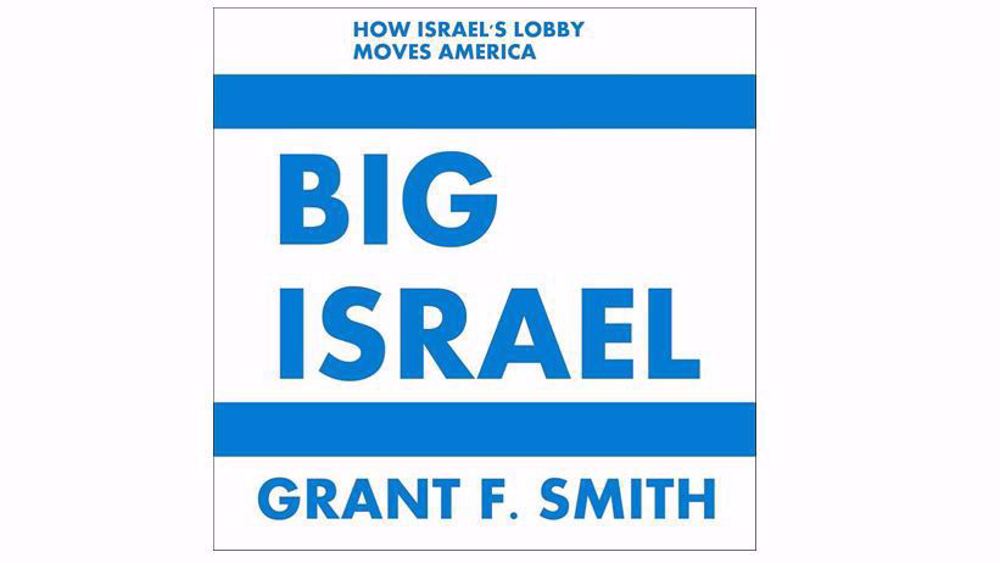
In a partial corrective to the narrow focus of Mearsheimer and Walt, Grant F. Smith’s Big Israel: How Israel’s Lobby Moves America, published in 2016, takes a much broader approach.
Smith argues, “Some identify only one organization, the American Israel Public Affairs Committee (AIPAC), as ‘the lobby’ citing its influence on Capitol Hill. This is wrong. Many interconnected organizations channel their power and influence through AIPAC in Congress."
"Hundreds more ‘mini-AIPACs’ coordinate with AIPAC and their own national offices to lobby state legislatures to pass model legislation and spending authorizations benefiting Israel—without publicly disclosing most of their lobbying activities. Others operate quietly, policing what is allowed to appear in mainstream news media and channeling ‘hush money’ to civil rights organizations to keep them out of grassroots pro-Palestinian movements,” he adds.
This represents a significant advance over the more limited Mearsheimer and Walt thesis, as it casts a much wider net, encompassing a full range of Israel lobby groups.
Smith’s analysis extends beyond lobbying efforts to include organizations that police public discourse and manipulate civil society.
However, even Smith’s work shows some myopia. While he analyzes an impressive 674 separate organizations, far more than Mearsheimer and Walt, the scope still doesn’t fully capture the entire network.
Smith’s data reveal an eye-popping estimated budget of over $6.7 billion in 2020, supported by more than 14,000 staff and over 350,000 volunteers, underscoring the vast scale of these interconnected groups.
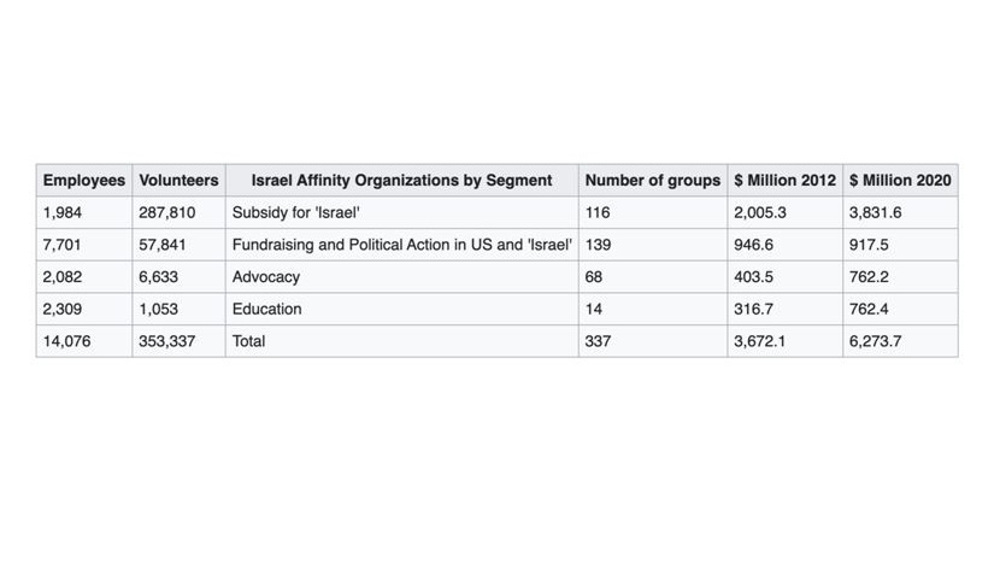
The impressive number of groups documented in Big Israel still represents only a small fraction of the broader Zionist movement, which includes the Israel lobby and many additional organizations not captured in the data. Here’s a brief overview of some major omissions:
1. Many formal Zionist groups engaged in education, indoctrination, and radicalization are missing. For example, the American Zionist Movement (AZM), the official US affiliate of the World Zionist Organization, has 46 member organizations, only 13 of which appear in Big Israel’s data, leaving 33 unaccounted for.
2. None of the Israeli firms that disclose lobbying expenditures in the US are included. Between 2000 and 2023, 18 such firms reported spending over £30 million.
3. Eleven organizations—including the Jewish Agency, the World Zionist Organization (WZO), and the NSO Group (makers of Pegasus spyware)—have registered as Foreign Agents between 2016 and 2023, disclosing spending over £161 million in that period.
4. Although two Chabad-Lubavitch foundations are included, official figures show around 1,274 Chabad-Lubavitch groups in the US (IRS data lists 1,313), many of which likely have ultra-Zionist agendas. Despite not being formally affiliated with the WZO, Chabad’s influence is significant and cannot be overlooked.
5. B’nai B’rith International, one of the oldest Zionist groups in the US and a former AZM member, is included in the data, but its youth wing, B’nai B’rith Youth Organization (BBYO), is not. Together, the IRS data lists over 1,500 branches for these two groups across the US.
6. Hillel, the Zionist student organization, appears only once in Smith’s data and not at all in the index of The Israel Lobby, despite now having over a thousand branches.
7. Lastly, numerous Zionist family foundations that fund many groups in the wider movement,l likely numbering in the hundreds or thousands, are excluded. Some notable examples include Adelson Family Foundation, Allegheny Foundation, Anchorage Charitable Fund, Castle Rock Foundation, Earhart Foundation, John M. Olin Foundation, Klarman Family Foundation, Paul E. Singer Foundation, Smith Richardson Foundation, Sarah Scaife Foundation, Scaife Family Foundation, The Lynde and Harry Bradley Foundation, and William Rosenwald Family Fund.
Given these seven brief examples, which are in no way exhaustive, it is likely that there are in excess of 10,000 Zionist organisations in the US in total. It would not be surprising to learn that this was a very conservative figure. Therefore, a full analysis of the US Zionist movement needs to do a lot more to explore even the formal and informal elements of the movement.
Missing oligarchs, family foundations, spooks and infiltrators
Taking both The Israel Lobby and Big Israel together, they largely overlook the critical role of oligarchs, foundations, and intelligence-linked operatives who use blackmail and threats to exert influence.
They omit the involvement of Zionist intelligence agencies themselves, including the extensive network of Sayanim (Mossad’s “little helpers”), and make no mention of Unit 8200, Israel’s signals intelligence agency that has deeply penetrated the tech and media industries.
Ultimately, The Israel Lobby focuses almost exclusively on the most visible elements of Zionist infiltration, ignoring the movement’s powerful engines of radicalization—responsible for producing thousands of radicalized genocidaires each generation.
These engines include organizations like the Mega Group (through Jewish education initiatives shown to increase support for the Zionist colony), Hillel, and Birthright Israel.
The books also fail to address the massive infiltration of Zionists throughout the US government apparatus, a process ongoing since at least the Reagan administration in the 1980s.
The involvement of Laurence Tisch in the Mega Group further illustrates the close ties between Zionist oligarchs and infiltration efforts. His granddaughter, Jessica Tisch, is a noted Zionist extremist and the current Commissioner of the NYPD.
The NYPD notably opened an office in the Zionist colony in 2012 and collaborates with Zionist entities, as do many other US police departments, some of which receive training both in the US and in Israel.
Lessons from the Epstein/Dershowitz affair?
The affair reveals that Zionist radicalization and infiltration are far more serious and organized than the “informal” and “loose” coalition described by the Israel Lobby thesis.
Just because coordination is covert or hidden does not mean it doesn’t exist. This is evident in the evolving stories about coordination efforts led by Israel’s Ministry of Strategic Affairs and its network of front groups and private companies, including the recent campaign coordinated by Voices of Israel through its proxy, the Combat Antisemitism Movement, funded partly by a US Zionist foundation.
We also see this in the revelations about the Sayanim, Mossad’s global network of helpers, and Unit 8200’s infiltration of technology firms. Above all, the infiltration of governmental institutions across the US, UK, and numerous other countries underscores the deep and systematic nature of this network.
Trump announces ‘security’ agreement on Greenland after threatening to annex it

71% of US voters say Trump lacks strategy to end war on Iran: Fox News poll
German chancellor says era of unconditional US friendship is ‘probably over’



Discover Iran: Tabriz’s ‘Mausoleum of Poets,’ where centuries of Persian literary history live on
Moscow intercepts massive Ukrainian drone strike amid elections; civilian casualties reported
Understanding Iran’s tourism momentum amid war and sanctions
How Yemeni retaliatory strike on Saudi East-West pipeline exposed limits of bypassing Hormuz
Israeli forces abduct eight Palestinians in West Bank amid settler violence
China rejects unilateral sanctions as Trump signs bill targeting Russia, Iran
VIDEO | Press TV's news headlines
VIDEO | Trump’s attacks on law, press reveal his support beginning to erode: Analyst


 PressTV NEWSLETTER
now
PressTV NEWSLETTER
now
 This makes it easy to access the Press TV website

