Explainer: How corporate greed and policy failures fueled America’s opioid crisis
By Ali Zeraatpishe
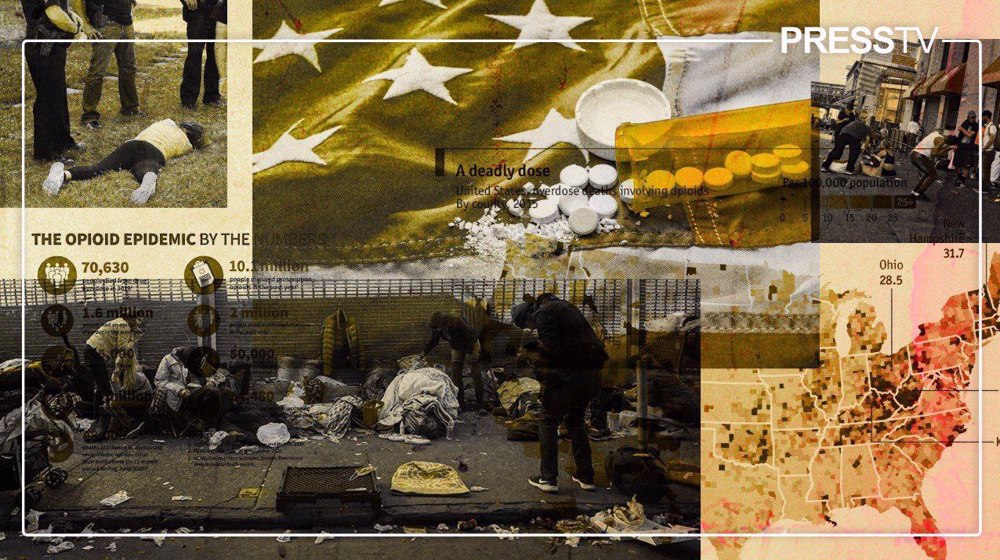
The opioid crisis in the United States is one of the worst public health disasters in modern American history, contributing to hundreds of thousands of deaths every year.
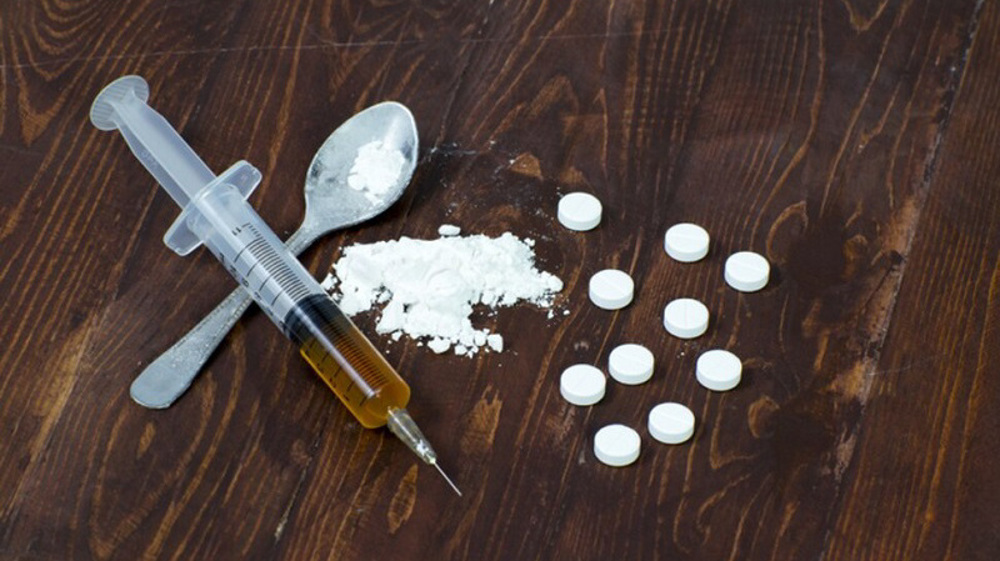
It refers to the sharp rise in addiction, overdoses, and deaths caused by the misuse of opioid drugs that include prescription painkillers like Oxycodone and hydrocodone, illegal drugs such as heroin, and synthetic opioids like Fentanyl.
According to the Centers for Disease Control and Prevention (CDC), more than 107,000 Americans died from drug overdoses in 2023, and about three-quarters of those deaths involved opioids.
Every day, over 290 people die from opioid overdoses. Fentanyl, a synthetic opioid up to fifty times stronger than heroin, now causes most of these deaths, often appearing in street drugs or fake prescription pills.
The crisis has torn apart entire regions in the US. Small towns in Appalachia, the Midwest, and New England have been devastated by addiction. Hospitals are overrun, and many children lose their parents to overdoses and end up in foster care.
The US Department of Health and Human Services (HHS) estimates that more than 2.5 million Americans currently live with an opioid use disorder, yet treatment remains hard to access and heavily stigmatized.
The economic cost is equally severe. The epidemic drains more than $500 billion each year from the US economy through lost productivity, medical expenses, and criminal justice costs.
A one-year-old infant boy has died after being overdosed by fentanyl allegedly stashed under one of the nap mats he slept on at a nursery in New York City, USA. https://t.co/ZaUF2lxgQr
— Press TV 🔻 (@PressTV) September 20, 2023
How did the opioid crisis begin in the US?
The roots of the opioid crisis go back to the late twentieth century, when a major change in American medicine joined with the profit-driven ambitions of pharmaceutical companies.
For many years, doctors were careful about prescribing opioids, using them mainly for serious or terminal illnesses because of their addictive power. But in the early 1990s, new medical ideas and strong corporate lobbying changed how pain was treated in the United States.
A key idea was “pain as the fifth vital sign.” Before this, doctors measured four vital signs – body temperature, pulse, breathing rate, and blood pressure. In the 1990s, groups like the American Pain Society (APP) and the Veterans Health Administration (VHA) began claiming that pain should be measured and treated with the same importance. Hospitals soon used pain scales with smiley-face charts and were pushed to make sure patients’ pain was always “managed.”
This opened a new market for drug companies. Purdue Pharma, the maker of OxyContin, saw an opportunity and launched the drug in 1996. The company falsely said its slow-release design made addiction unlikely. It then carried out one of the largest marketing campaigns in medical history, sending thousands of sales representatives to convince doctors that opioids were safe for common pain. Many doctors, under pressure to treat pain and influenced by Purdue’s claims, began prescribing opioids widely.
Between 1999 and 2010, the number of opioid prescriptions in the US quadrupled, even though Americans’ overall pain levels did not rise. Addiction quietly spread through communities in Appalachia, the Midwest, and New England.
When the government finally restricted prescriptions, millions were already dependent and turned to heroin, which was cheaper and easier to find. Later, Fentanyl appeared, far stronger and deadlier, pushing the crisis into its most lethal stage.
How major pharma caused the opioid crisis?
While Purdue introduced OxyContin, others soon joined the rush for profit. Johnson & Johnson, Teva, and Endo International each produced and promoted their own opioid medications, with the same false claims that addiction was rare and pain relief was safe for long-term use.
These corporations used marketing strategies that blurred the line between medicine and commerce, sponsoring conferences, funding “patient advocacy” groups, and paying doctors to present biased research as scientific fact.
The distribution side was even more reckless. Massive pharmaceutical distributors such as McKesson, AmerisourceBergen, and Cardinal Health shipped billions of opioid pills to small towns across America without monitoring suspicious orders.
Internal records later revealed the scale of their negligence. For example, one town in West Virginia, home to just 400 residents, received over 9 million opioid pills in only two years.
Government agencies failed to act as well. The Food and Drug Administration (FDA) allowed opioid manufacturers to promote their drugs with misleading labels, while the Drug Enforcement Administration (DEA) continued to approve licenses and quotas even as overdose rates soared. Warnings from investigators were ignored, and corporate lobbying kept regulations weak.
When the truth finally became undeniable, thousands of lawsuits exposed the system’s corruption. In many cases, the companies responsible declared bankruptcy, paid limited settlements, and restructured under new names.

What are the effects of opioid crisis on American society?
The scale of death is enormous. Since 1999, more than 1.1 million Americans have died from drug overdoses, most involving opioids. Behind these numbers are entire families destroyed by addiction.
In several counties across West Virginia, Ohio, and Kentucky, multiple generations in the same household have suffered from substance abuse. Many children have lost their parents and entered foster care; according to HHS, the number of children placed in foster care due to parental drug use more than doubled between 2000 and 2025.
Economically, the epidemic has drained the country. Many regions already suffering from job loss and industrial decline were hit the hardest. Addiction took root where work disappeared, and despair filled the gap left by shrinking opportunity.
The Council of Economic Advisers (CEA) estimated in 2019 that the opioid epidemic costs the country’s exchequer over $700 billion per year, including lost productivity, healthcare expenses, criminal justice burdens, and premature deaths.
Public health systems have struggled to cope. Rural hospitals face growing numbers of overdose patients with limited staff and resources. Urban emergency rooms are overcrowded, and addiction treatment remains out of reach for most poor Americans.
The stigma attached to drug use prevents many from seeking help, while government funding for recovery programs remains inadequate.
The crisis has also changed the country’s social and political landscape. It has deepened public mistrust in institutions and exposed racial hypocrisy in U.S. drug policy.
During the crack/cocaine epidemic of the 1980s, poor Black communities faced mass incarceration and police violence. But when opioids devastated mostly white, working-class areas, the government suddenly framed addiction as a public health issue. This double standard revealed how race continues to shape American policy and compassion.
How has it become a political weapon for Trump administration?
In his second term, President Donald Trump has turned the opioid crisis into a political tool, using fear and misinformation to strengthen his base instead of addressing one of the deadliest public health disasters in American history. His administration continues to frame the epidemic as a foreign threat rather than a result of American corporate greed and policy failure.
Trump and his aides often claim that China and Mexico are mainly responsible for the flow of Fentanyl into the United States. However, US government data show that nearly 90 percent of Fentanyl seized at the border is being trafficked by American citizens, not undocumented migrants.
While some chemical ingredients come from China, the DEA confirms that most Fentanyl is produced and distributed inside the US, often by companies using legally imported materials. These claims against Beijing and Mexico are politically convenient as they shift attention away from US pharmaceutical companies and decades of failed domestic drug policies.
The administration’s actions match its rhetoric. In July 2025, the government passed the “Halt Fentanyl Act,” expanding police powers and imposing harsh prison sentences, even for minor possession. At the same time, federal funding for addiction treatment and harm reduction programs was cut by 12 percent, removing support for more than 150,000 people.
Experts warn that these policies, echoing the Reagan-era “War on Drugs,” will punish poor and minority communities while doing little to prevent overdoses.

Protests erupt in US as ICE agent shoots Venezuelan driver

Poll: Over half of US Jews say Netanyahu fueling American anti-Semitism
US man standing trial for shooting three Palestinian students says CIA, Mossad instructed him



Iran’s military warns of ‘unpredictable blows’ in response to US threats
VIDEO | US economic war on Iran
Iran FM meets with US envoy on UN meeting’s sidelines at American side’s insistence: Report
UN chief warns Israeli violence in West Bank raises ‘specter of ethnic cleansing’
VIDEO | ‘Korea gets nothing, loses everything, with Hormuz deployment’
Iran parliamentary commission approves penalties for violators of Hormuz laws
VIDEO | Trump’s war disrupts the world
Araghchi urges world to hold US accountable for ‘war crimes’ at UNGA





 PressTV NEWSLETTER
now
PressTV NEWSLETTER
now
 This makes it easy to access the Press TV website
