AIPAC delegation’s Taipei visit lifts the veil on Taiwan-Israel-US nexus against China
By Ivan Kesic
Beneath the facade of democracy and defense, a triangle of power politics links Taiwan, the United States and the Israeli regime as they forge a triangular nexus to challenge China.
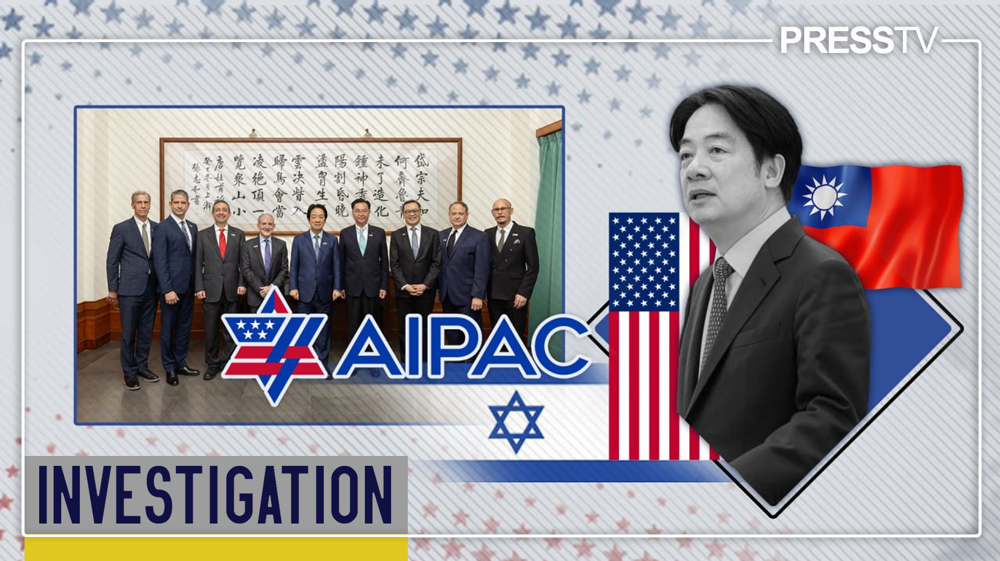
Taiwanese President Lai Ching-te’s appearance at the American Israel Public Affairs Committee (AIPAC) dinner in Taipei City last week marked a symbolic moment in the island’s evolving foreign strategy.
Speaking before an audience of over 200 US and Israeli political figures, Lai praised the Zionist entity as a “valuable model” for Taiwan’s defense and reiterated his support for the Tel Aviv regime.
Evoking the biblical tale of “David and Goliath,” he cast Taiwan as the defiant underdog – a small “democracy” facing down an “authoritarian” giant, referring to China.
“The Taiwanese people often look to the example of the Jewish people when facing challenges to our international standing and threats to our sovereignty from China. The people of Taiwan have never become discouraged,” he said in remarks to the members of the Israeli lobby group.
What appeared at first glance as a diplomatic gesture of solidarity revealed a deeper strategic alignment — one that places Taiwan not only closer to the Israeli regime but firmly within the geopolitical architecture of Washington’s West Asia and Indo-Pacific playbook.
“As we deepen strategic partnerships, invest in advanced technology, and enhance our defense capabilities, we look forward to closer Taiwan-US-Israel cooperation on security, trade, and beyond, promoting peace across the Taiwan Strait,” Lai said in a statement posted on X, formerly Twitter.
Lai’s speech, though framed in the language of democracy and shared values, underscored how Taiwan’s leadership is increasingly modeling its policies on Israeli militarized posture and dependence on overt and covert American backing. The parallels are not accidental; they are cultivated.
✍️ Conversation -Taiwan’s rulers see island as Asia-Pacific twin of Israel, colonial outpost of US: Analyst@NuryVittachi
— Press TV 🔻 (@PressTV) November 2, 2025
https://t.co/ZDlO51kZZ4
A new chapter in an old playbook
Lai’s remarks came just days after Taipei announced the development of its so-called “T-Dome” air defense system — an ambitious project modeled after the much-hyped Israeli Iron Dome.
Behind the scenes, Israeli military engineers and advisers are reported to have assisted in shaping the system’s architecture, with Washington’s approval.
The cooperation was publicly described as “civilian technology exchange,” but military insiders have long acknowledged that the partnership extends to radar integration, missile interception systems, and even intelligence algorithms.
For Taiwan, adopting the Israeli military model carries clear symbolic and practical value. It projects an image of self-reliance and deterrence while solidifying military ties with Washington through an intermediary ally.
For the Israeli regime, this partnership reinforces its role as a global military exporter and deepens its influence in East Asia. And for the United States, the Taiwanese-Israeli nexus offers a unique channel to sustain pressure on China while maintaining plausible deniability.
Chinese officials were quick to condemn the T-Dome initiative, slamming Taipei for “seeking independence by force” and warning that emulating the Israeli militarized model would only heighten instability in the region.
Beijing’s frustration reflects not only the military implications of the project but also the political message embedded within it: that Taiwan, by aligning itself with the Zionist regime and AIPAC’s global lobbying network, is choosing a path of confrontation over dialogue.
Chinese military flies H-6K strategic bombers near Taiwan as part of a drill days ahead of President Xi Jinping’s meeting with Donald Trump.
— Press TV 🔻 (@PressTV) October 27, 2025
Follow: https://t.co/GKZwI4ehqL pic.twitter.com/aCXMs9yHrJ
From clandestine exchanges to strategic alignment
Though often described as an emerging alliance, Taiwan and the Israeli regime’s cooperation has roots stretching back at least five decades.
In the 1970s, both sides found themselves diplomatically isolated — Taiwan after losing its United Nations seat to Beijing, and the Zionist entity following widespread Arab-led condemnation in the aftermath of the 1967 war.
The two “pariah” entities then decided to collaborate, albeit secretly.
Israelis provided Taiwan with US-derived missile technology and intelligence expertise, while Taiwan offered financial resources and political discretion to the Tel Aviv regime.
This covert relationship allowed Washington to outsource sensitive arms transfers to Tel Aviv, bypassing restrictions on direct US military assistance to Taipei.
Throughout the 1980s and 1990s, Israeli technicians trained Taiwanese officers, shared electronic warfare systems, and helped modernize Taiwan’s missile arsenal.
By the 2000s, as China’s global influence expanded, these ties shifted from overt military cooperation to subtler forms of technological and intelligence sharing.
Israeli firms embedded themselves in Taiwan’s growing military and semiconductor sectors, offering expertise in cybersecurity, satellite monitoring, and drone technologies.
These exchanges, although technically “civilian,” were designed with dual-use applications — equally suited for industrial development or warfare.
Today, Taiwan’s strategic discourse echoes Israeli military narrative, which appeals to Western audiences and masks the dependency both maintain on US political and military patronage.
China voiced strong opposition to any form of military contact between the United States and Taiwan.
— Press TV 🔻 (@PressTV) August 27, 2025
Follow Press TV on Telegram: https://t.co/LWoNSpkJSh pic.twitter.com/2zTTfagj3A
AIPAC connection: Washington’s bridge between two fronts
At the heart of this triangular dynamic lies the AIPAC, one of the most influential Israeli lobbies in Washington, which has long shaped American policy in the West Asia region.
In recent years, the notorious lobby group has expanded its outreach, identifying Taiwan as a “kindred democracy” facing a similar existential struggle.
Lai’s participation at AIPAC’s Taipei dinner in October 2025 was more than ceremonial, according to insiders. It signaled the formal entry of Taiwan into the orbit of US domestic politics through a lobby whose influence stretches from the US Congress to the Pentagon.
AIPAC’s delegation of over 200 members to Taiwan — the largest in its history — underscored this strategic courtship. According to sources, they were treated like state guests with the highest protocol.
For Washington’s war hawks, this trilateral alignment serves a dual purpose. Domestically, it binds pro-Israeli and pro-Taiwan constituencies under a shared ideological banner of “democracy versus authoritarianism.”
Geopolitically, it creates a network of US-backed allies positioned at opposite ends of Eurasia, each acting as a pressure point against Washington’s two principal adversaries: Iran and China.
AIPAC’s growing role in this framework illustrates how lobbying mechanisms designed for West Asian policy are being repurposed for the Indo-Pacific theater.
By connecting Taiwan’s Democratic Progressive Party (DPP) leadership with US lawmakers and donors, AIPAC seeks to facilitate not only arms sales and military cooperation but also ideological alignment between the two camps.
The rhetoric of “shared values” becomes the moral justification for militarization, while US military contractors quietly benefit from new procurement channels.
However, the Israeli-Taiwan alliance is deeply unpopular in Taiwan, where people were regularly held protests against the Israeli-American genocide in Gaza.
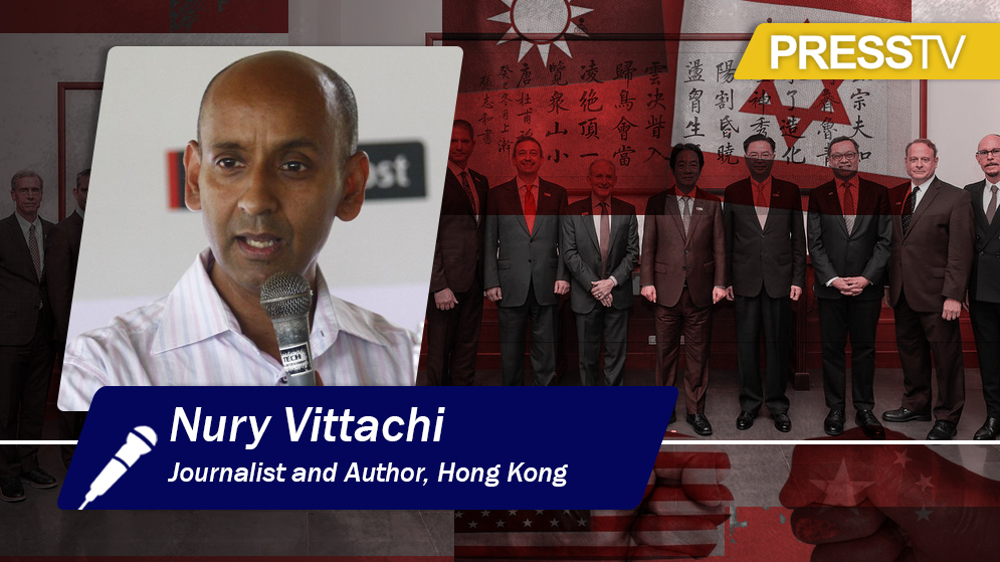
In an interview with the Press TV website, Nury Vittachi, a Hong Kong-based journalist, author, and political commentator, said people of all political colors are realizing that aligning with “the most criticized people on earth is a bad idea.”
“Many have told Lai to ‘read the room,’” he said, referring to Lai's meeting with the AIPAC delegation.
China warns US not to ‘play with fire’ over Taiwanhttps://t.co/PkgQlQA7CO
— Press TV 🔻 (@PressTV) June 1, 2025
Aid, apartheid, and the question of legitimacy
While Taipei publicly portrays its relationship with the Israeli regime as rooted in humanitarian and technological exchange, the reality is more troubling, as evidence reveals.
Earlier in 2025, Taiwan’s representative office in the Zionist entity made a public donation to a medical center located in the illegal Israeli settlement of Sha’ar Binyamin in the occupied West Bank.
This act — the first of its kind by any foreign government since 2023 — effectively placed Taiwan in violation of international law.
By funding infrastructure within an illegal settlement, Taipei not only lent material support to Israeli occupation but also undermined its own claims to be a responsible global actor.
International law is unequivocal: the establishment and expansion of Israeli settlements in the occupied territories constitute a war crime under the Fourth Geneva Convention.
The International Court of Justice reaffirmed this in 2024, ruling that all states are obligated not to recognize or assist in maintaining Israeli unlawful presence in the occupied West Bank.
By disregarding this principle, Taiwan exposed the contradiction at the heart of its foreign policy — promoting so-called “freedom and democracy” abroad while aiding an apartheid system at home.
The donation, though presented as humanitarian aid, served a political function: to signal loyalty to the Israeli regime and, by extension, to Washington’s broader geopolitical design.
Beijing was quick to expose the hypocrisy, noting that Taipei’s “humanitarian diplomacy” was an extension of the US plot to provoke confrontation with China under the guise of moral solidarity.
People in Taiwan also took to the streets in July when Israel Ganz, head of the Yesha Council, an umbrella group representing illegal Israeli settlements, claimed that Taiwan’s representative in Tel Aviv, Abby Lee, had promised support to the Nanasi Medical Center.
The protesters assembled outside the Taiwanese foreign ministry, banging pots and plastering mock banknotes stained with red dye on Israeli and Taiwanese flags, to symbolize bloodshed in Gaza.
“Taiwan loves to say ‘Taiwan Can Help,’” activist Aurora Chang was quoted as telling the demonstrators. “But right now, we are helping a genocidal state.”
Drills or war prep?
— Press TV 🔻 (@PressTV) July 11, 2025
China’s war games near Taiwan send a clear message: Beijing is ready if pushed.
Follow Press TV on Telegram: https://t.co/B3zXG73Jym pic.twitter.com/EiFHkslbgS
Washington’s invisible hand
Behind the Taiwanese-Israeli relationship lies the consistent patronage of the United States.
Washington has for decades used the Israeli regime as a proxy to transfer sensitive military and nuclear technology to partners and allies whom it cannot officially arm.
This “triangular diplomacy” allows the US to sustain plausible deniability while reinforcing its strategic footholds across the world, including in this region.
In the Indo-Pacific, this approach manifests in Israel's role as an intermediary supplier to Taiwan’s military industry. By sharing radar and missile systems with Taipei under “civilian” labels, Tel Aviv fulfills US objectives without triggering direct diplomatic crises.
In return, Taiwan deepens its dependence on American military networks, ensuring continued leverage over its political decisions.
The pattern mirrors US policy in West Asia: empowering smaller allies to act as regional enforcers while maintaining ultimate control over their military and economic lifelines.
The danger, however, is that this architecture breeds instability. Just as Israeli militarization has entrenched occupation and apartheid in its region, Taiwan’s emulation of that model risks escalating tensions in the Taiwan Strait — a flashpoint that could ignite a far greater confrontation, say experts.
Beyond the secret military supplies, there are also open partnerships between Taiwan and Western military corporations, such as Northrop Grumman, AeroVironment, and Shield AI, centered on missile defense and autonomous technologies, aimed at provoking China.
🔸Tools of Killing - Part 3🔸
— Press TV Documentary (@presstvdoc) September 24, 2025
The Pager Supply Chain
Investigations revealed how Mossad used companies in Taiwan and Hungary to smuggle explosive pagers into Lebanon. Civilian supply lines became weapons of war. pic.twitter.com/7lhvBBv3og
Provoking China by proxy
From Beijing’s perspective, the growing convergence between Taiwan, the Israeli regime, and the US is not merely symbolic — it is a calculated provocation, believe observers.
By aligning with AIPAC and embracing Israeli military doctrine, which has been on full display in Gaza and Lebanon, Taipei positions itself as a participant in Washington’s containment strategy.
Each joint military project, each public gesture of solidarity, and each high-level exchange contributes to the perception of an emerging anti-China coalition.
Chinese army and the foreign ministry have repeatedly condemned the US arms supplies to Taiwan, saying they “grossly violate” the one-China principle and the three Sino-US communiqués by arming Taiwan.
In a statement in April, the Chinese military said US arms sales to Taiwan “cannot change the situation concerning military strength across the Taiwan Strait, much less impede China’s reunification,” and reiterated efforts to “smash ‘Taiwan independence’ and external interference attempts.”
“We firmly oppose and strongly condemn the US's military assistance and arms sales to China’s Taiwan region and have made solemn representations to the US side,” a Chinese defense ministry spokesperson said in December 2024.
However, for US policymakers, this outcome is strategic. By framing Taiwan’s militarization as an act of self-defense and moral alignment with the Israeli regime, Washington can depict any Chinese response as aggression against the so-called “democracy.”
The reality, however, is that these policies serve to entrench division and justify the ongoing militarization of Asia.
China’s warnings that Taiwan is “seeking independence by force” thus reflect more than rhetorical anger; they highlight the structural consequences of a system in which external powers exploit local actors for global leverage, observers note.
Report: Trump aims to exceed first term’s weapons sales to China Taipeihttps://t.co/xjwF90OItL
— Press TV 🔻 (@PressTV) May 30, 2025
The mirage of shared values
President Lai’s speech at the AIPAC dinner was crafted for applause — invoking the values of freedom, resilience, and the rule of law. Yet beneath the polished language lies a deeper story: a small island that has become subservient to Washington and Tel Aviv.
By aligning itself with the Israeli regime and the US lobby networks that sustain Tel Aviv’s influence, Taiwan has chosen to replicate not only Israeli military posture but also its dependency and isolation.
What is framed as “peace through strength” risks becoming permanent insecurity, driven not by local needs but by Washington’s global calculus, experts warn.
AIPAC delegation’s visit to Taiwan came a month after a delegation led by Boaz Toporovsky, chair of the Israel-Taiwan parliamentary friendship group, met the Taiwanese president.
Toporovsky was carrying a joint statement backing Taiwan’s international participation signed by 72 Knesset members. It appeared to be a payback for Taiwan’s ironclad support for the Israeli regime in its genocidal war on Gaza, which has claimed nearly 70,000 lives in over two years.
“We hope that AIPAC will lend Taiwan even greater support and assistance in this matter,” Lai told the visiting AIPAC delegation on October 27, referring to procuring necessary weapons and technology.
Trump impeachment on the horizon post-midterms
Iranian nuclear chief barred from IAEA conference
Irish, Scottish and Welsh leaders to meet to discuss UK break-up



VIDEO | Press TV's news headlines
Iran summons German ambassador over Berlin’s hostile positions, interventionist activities
Israeli occupation court extends detention of Press TV journalist Naqaa Hamed
Iran rejects Sweden’s allegations, orders Swedish diplomat to leave within 48 hours
UN fact-finding mission finds ‘reasonable grounds’ US committed war crimes in Iran
Al-Houthi: Saudi claims of Yemen targeting Mecca 'heinous lie', manifest slander
Iran dismisses Saudi claim that Yemen attempted to target Mecca
‘Organized, illegal, aggressive’: Press TV slams abduction of West Bank journalist by Israeli forces


 PressTV NEWSLETTER
now
PressTV NEWSLETTER
now
 This makes it easy to access the Press TV website
