Austrian media and the West’s deepening structural hostility toward Press TV
By Sheida Eslami
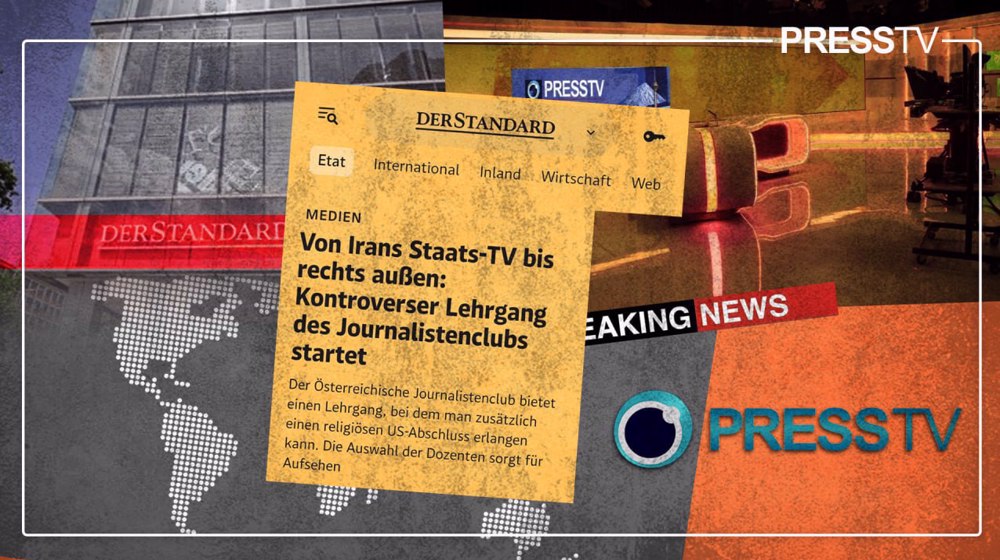
Recently, the Austrian newspaper Der Standard published an article about a session titled “Peace Journalism” at a journalists’ club, which, for starters, appeared to be a training report.
However, upon closer examination, the article subtly reinforces a structural narrative of hostility toward the Islamic Republic of Iran and its premier international news network, Press TV.
At first glance, the tone of the article is marked by charged terms like “Iranian regime,” “state propaganda,” and “organized influence.” Yet, the deeper concern lies in the implicit message these words convey: the framing of a “dangerous other” – an entity portrayed as threatening and therefore in need of containment, restriction, or surveillance.
From the perspective of Critical Discourse Analysis, when a media outlet like Der Standard employs phrases such as “every demonstration in support of Palestinian rights is documented in Press TV broadcasts,” “affiliation with the Iranian regime,” or comparisons to “well-known patterns of Russian overseas propaganda,” it is not reporting on Press TV’s activities in Austria,
It is, in fact, constructing a discourse that frames the network within a broader narrative of suspicion, ideological alignment, and geopolitical threat.
By steering the reader’s attention toward adjacent concepts – like the ones mentioned – the article performs an indirect act of warning. This rhetoric effectively elevates the meaning from mere description to a form of institutional alert; that is, it implicitly signals that this network is operating within Austrian territory, and this presence warrants scrutiny.
In a society where media policymaking is defined around regulatory authorities and supervisory institutions, such a reminder is more than information. It serves as a subtle cue pointing toward mechanisms of censorship and control.
In today’s European media language, the mere statement that a non-Western media outlet is “active” somewhere carries a security subtext: “It is active, so be careful.”
Hakimeh Saghaye Biria says by sanctioning Press TV, the EU and US are attempting to create a complete media blackout in the world and trying to mute the voice of the voiceless. pic.twitter.com/WIfff31U02
— Highlights (@highlightsnews1) November 14, 2022
In fact, Der Standard, using this tone, softly activates the supervisory field. This is the same longstanding mechanism that, after the 2016 events and Europe’s security crises, took shape in the media as the “source transparency policy,” a policy that, under the guise of protecting the integrity of information, has in reality become a tool for filtering out media with alternative narratives.
Since its inception, Press TV has challenged and debunked the West’s dominant narrative in the West Asia region. Through interviews, documentaries, and active on-the-ground presence, the network has shifted the language of international politics from “top-down perception” to “bottom-up experience.”
Within the logic of Western media institutions, that shift alone is enough to be perceived as a threat. From the vantage point of European editors, a Press TV journalist in Vienna is not merely an observer of events but a carrier of a “third eye,” an eye that looks at Europe through the lens of the Global South. In a media ecosystem accustomed to monopolizing the act of description, such a presence is regarded as a deviation from the norm.
It is in this very context that a simple phrase like “Press TV operates in Austria” serves a function far beyond informing. Within European media discourse, this sentence becomes a subtle warning, a sign with a specific meaning for parts of the bureaucratic and security apparatus: “A non-European media actor is present on our soil.”
In other words, the Der Standard article is less a journalistic report and more a part of the West’s mutual alert system concerning alternative media, a deliberate effort to create a security consensus around the discourse of legitimate censorship.
When the newspaper says this, it appears to be reporting news—but in reality, it is updating lines from a “media watchlist.”
But where does this hostility originate? Press TV turned the news sphere into a more ethical, question-driven, and South-oriented space
Press TV anniversary: 17 years of being the voice of the voiceless.
— Press TV 🔻 (@PressTV) July 2, 2024
Follow us on Telegram: https://t.co/GKZwI4ePgj pic.twitter.com/UL5R1rhpHk
From the historic Operation Al-Aqsa Flood to the Israeli-American genocide in Gaza, from the West-engineered war on Yemen to the Zionist regime’s aggression against Lebanon, and from international courts to Islamophobia cases in Europe – this network has offered a constellation of narratives that shifted the balance of semantic power in favor of ordinary people, the voiceless, and the oppressed.
The West cannot feel at ease with a language that speaks from the depths of suffering and the historical experience of the non-Western world.
For this reason, confrontation with Press TV is no longer a mere media dispute; it has become part of a new semantic order of resistance against the centrality of the Western narrative, an order that European traditional journalists have yet to find the language to accept.
Hostility toward Press TV is not a matter of professional competition, but an attempt to preserve supervisory power over meaning itself.
From this perspective, the seemingly simple sentence in Der Standard article about Press TV’s presence in Austria is not news, but a quiet, fear-driven directive to Europe’s censorship and regulatory apparatus.
A directive that says: “Another eye has entered our field of vision – a media outlet that swims against the current of support for Israeli policies. Be cautious.”
Sheida Islami is a Tehran-based writer, poet, media advisor and cultural critic
How Iran turned US military and economic aggression into strategic leverage to dictate terms
Remembering Sabra and Shatila massacre: Why memory is the ultimate shield against erasure
200 nights, one resilient nation: Iranian people’s epic in defense of homeland and Revolution



Iran’s Armed Forces vow to inflict further defeats on US, Israeli enemies
Child among two Palestinians abducted in Israeli West Bank raids
Putin’s United Russia leads wartime parliamentary elections
Pezeshkian to travel to New York on Tuesday to address UN General Assembly
Iranian swimmers reach Asian Games finals for first time in 16 years
VIDEO | Press TV's news headlines
VIDEO | Four injured as explosions rock Aleppo munitions depot in northern Syria
VIDEO | Trump stuck between war pressures and domestic challenges


 PressTV NEWSLETTER
now
PressTV NEWSLETTER
now
 This makes it easy to access the Press TV website
