Two years on: Gaza awakens the West to Israel’s 77-year settler-colonial genocide
By Maryam Qarehgozlou
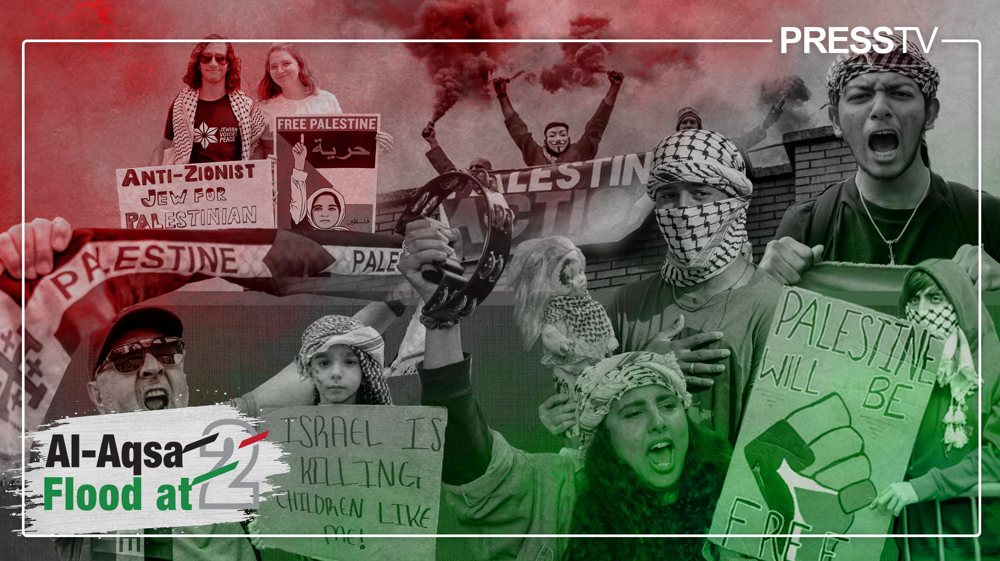
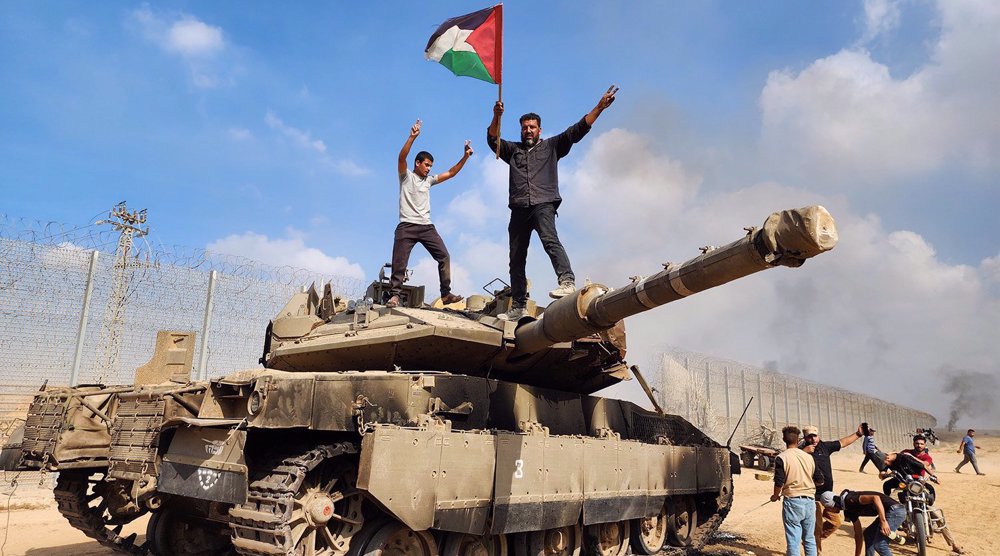
Two years after Operation Al-Aqsa Flood, Western public opinion has undergone a seismic shift, marked by unprecedented pro-Palestine protests, widespread boycotts, growing condemnation of Israel’s genocide, and the mainstream rejection of Zionism.
From the very first days of Israel’s devastating assault on Gaza — with its genocidal war crimes live-streamed unfiltered on social media platforms — millions in the West appeared to awaken to over seven decades of occupation, apartheid, and war crimes by the Zionist regime.
What began in 1948 with the Nakba, or “catastrophe,” when more than 750,000 Palestinians were violently expelled from their homeland to make way for the formation of an illegitimate entity, long ignored or denied by much of the world, has now become impossible to look away from — even for erstwhile Zionist sympathizers in Western capitals.
The genocidal war — with over 67,100 Palestinians, mostly women and children, killed; famine imposed through deliberate aid blockades; the total destruction of civilian infrastructure; and the forced displacement of over 2.2 million people — has triggered a historic wave of global outrage.
In recent weeks, ahead of the second anniversary of October 7, which also coincided with the attack on the Global Sumud Flotilla by the Israeli regime on the shores of Gaza, massive protests were seen across European countries, from Spain to Italy to the Netherlands.
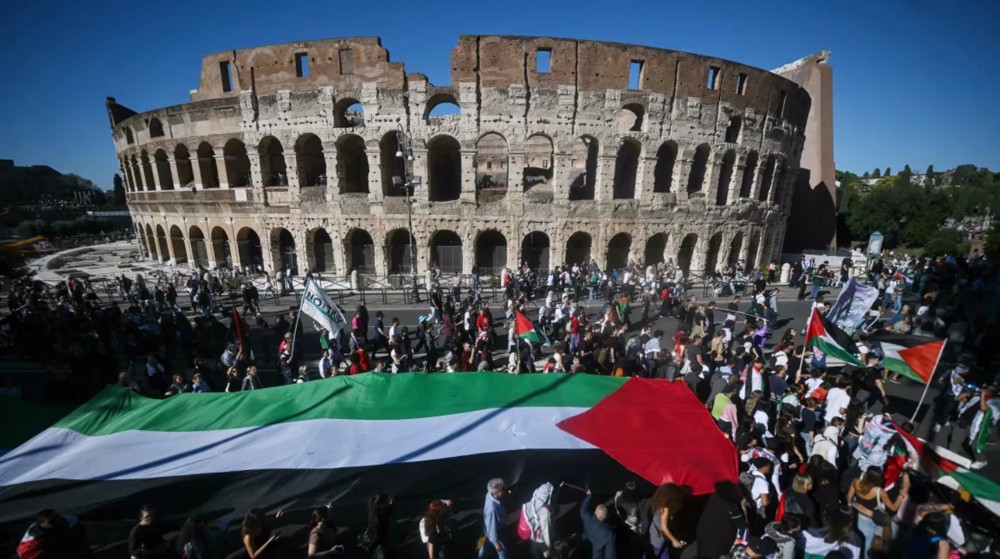
Massive crowds again filled streets in Rome, where police estimated some 250,000 participants during a fifth consecutive day of demonstrations on Monday. Barcelona saw around 70,000 marchers, and Madrid nearly 92,000. In Dublin, thousands marked “two years of genocide” in Gaza.
In London, police said they made at least 442 arrests at a gathering in support of people of Gaza and banned Palestine Action, a pro-Palestine group that takes direct action to halt the sale and export of military equipment to Israeli-occupied territories.
About 10,000 people gathered in Paris in defiance of heavy policing.
These protests have gradually grown in frequency and strength since the events of October 7, 2023.
On November 4, 2023, less than a month into the genocidal war, tens of thousands poured into the streets of major cities, including Washington, DC, London, Paris, Berlin, Ankara, Istanbul, and Milan, to demand an immediate ceasefire.
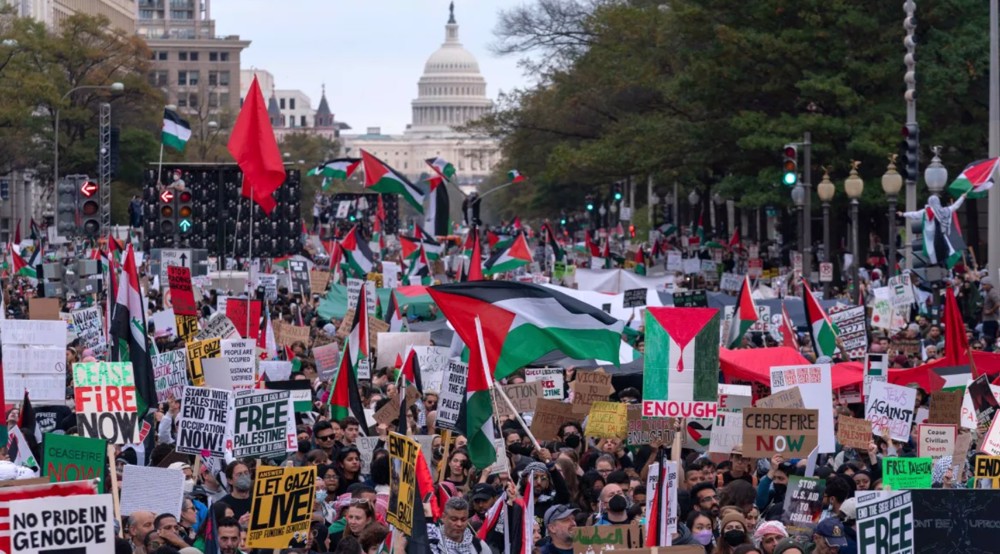
The march in DC became the largest pro-Palestine demonstration in history at the time, drawing an estimated 100,000 to 300,000 protesters.
Protesters denounced then–US President Joe Biden’s backing of the Israeli regime, declaring, “You have blood on your hands,” “Biden, Biden, you can’t hide—you signed up for genocide.”
Around the same time, in Paris, thousands marched through the capital demanding an immediate ceasefire in Gaza, shouting “Israel, assassin!”Demonstrators also aimed at French President Emmanuel Macron, chanting “Macron, accomplice.”
At least 6,000 protesters in Berlin and several thousand more marched in Düsseldorf, while London also saw thousands of demonstrators block city streets before converging on Trafalgar Square.
In Bucharest, hundreds gathered under the banner “Save the children of Gaza,” and rallies in Milan and Rome each drew thousands of participants.
Despite widespread government bans and police crackdowns — restrictions that have only intensified since — pro-Palestine demonstrations multiplied in the past 24 months, with turnout growing larger after every Israeli massacre in the Gaza Strip.
The sight of protesters draped in black-and-white keffiyehs, waving Palestinian flags, and chanting liberation slogans has since become a fixture across Europe, the United States, and beyond.
Gaza-bound flotillas
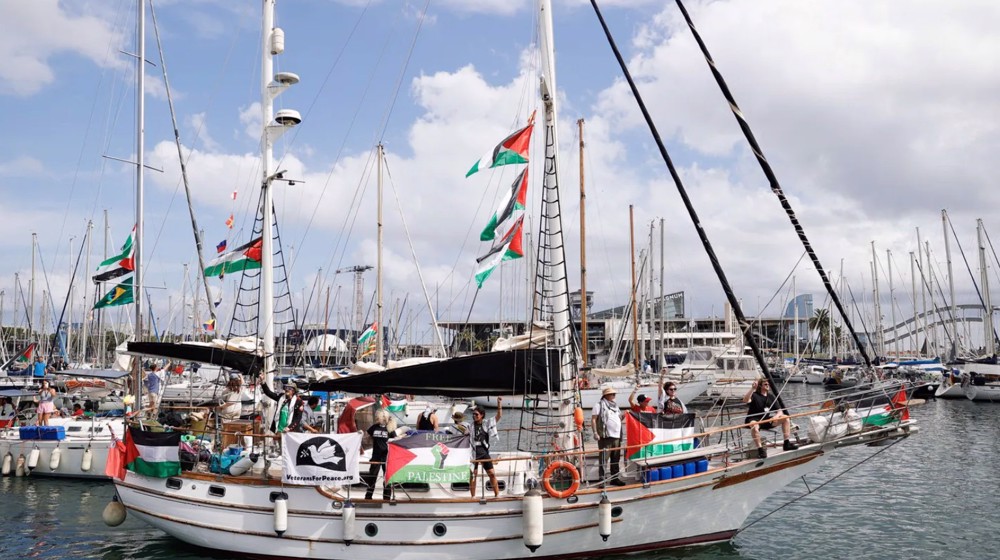
In recent months, global outrage has also intensified following Israel’s repeated interceptions of humanitarian flotillas bound for Gaza, where UN-backed monitors confirmed famine had taken hold.
The latest mission — the Global Sumud Flotilla, organized by the Freedom Flotilla Coalition (FFC) — set sail from Barcelona in September with 45 boats carrying aid and activists from 44 countries.
It was intercepted in international waters by the Israeli regime's navy, which abducted more than 470 participants and detained them in the occupied territories. Many later described their mistreatment by Israeli guards as “cruel” and “Nazi-like."
FFC, an international nonprofit group that has been organizing such Gaza-bound convoys since 2010, has attempted numerous times to break the blockade on Gaza via sea and deliver aid to Palestinians.
Earlier missions — including the Handala in July, Madleen in June, and Conscience in May — were all intercepted or attacked by Israeli occupation forces in international waters.
In one case, Israeli drones struck the Conscience just 25 kilometers off Malta, igniting a fire and forcing activists into a desperate fight to keep the ship afloat.
The ‘student Intifada’
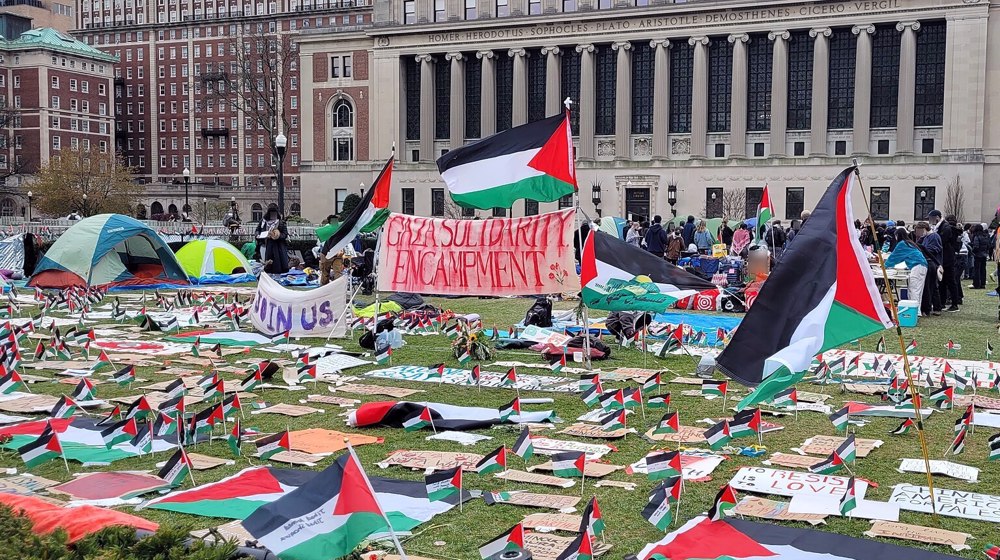
By April 2024, the pro-Palestine movement surged onto university campuses worldwide. What began with mass arrests at Columbia University’s Gaza solidarity encampment on April 18 ignited what activists dubbed the “Student Intifada.”
Protesters demanded that their institutions sever financial and academic ties with the Israeli regime and associated companies complicit in the Gaza genocide.
Over 3,100 people — including students, professors, and staff — were arrested on more than 60 US campuses. As the movement spread to Europe, the UK, Australia, and Canada, universities cracked down with suspensions, expulsions, and evictions, while police forcibly dismantled encampments.
Still, some administrations conceded to student demands, agreeing to review investments and sever partnerships with Israeli institutions.
When Donald Trump returned to the White House in January, he moved swiftly to suppress the movement, issuing executive orders equating pro-Palestine activism with so-called antisemitism.
Homeland Security intelligence units began compiling deportation dossiers on non-citizens who criticized Israel or joined anti-genocide protests.
Growing calls for boycott and divestment
The Boycott, Divestment and Sanctions (BDS) campaign, launched two decades ago in protest of Israel’s occupation of Palestinian land, has gained extraordinary new momentum since the onslaught on Gaza began in October 2023.
As the humanitarian catastrophe deepened in Gaza, global boycott initiatives also multiplied, from West Asia to Europe, the US, and beyond, targeting major multinational corporations for supporting Israel, leaving the Zionist regime increasingly isolated across economic, cultural, and sporting arenas.
Once deemed untouchable, major multinational corporations have faced mounting backlash and plummeting sales over their complicity in Israel’s genocidal war since October 7, 2023.
Major US brands such as McDonald’s, Burger King, Starbucks, KFC, Pizza Hut, Coca-Cola, PepsiCo, and Nestlé have become prime boycott targets for aiding or aligning with Israel.
Sportswear giants Reebok, Puma and Nike have also been hit for their commercial and supply ties to the regime, with some of these brands already distancing themselves from Israeli sports teams.
In a major cultural blow, over 300 museums and arts organizations in the Netherlands and Belgium recently announced a collective boycott of Israeli institutions, while more than 1,300 artists — including Olivia Colman, Ayo Edebiri, Mark Ruffalo, Riz Ahmed, Tilda Swinton, and Javier Bardem — pledged to refuse collaboration with Israeli film and cultural bodies complicit in war crimes.
The academic world has followed suit. Israeli researchers and universities have faced an unprecedented wave of boycotts over their complicity in the genocide.
Invitations for Israeli researchers to attend international seminars have been canceled. Presentations at conferences have been postponed indefinitely. Professional associations have debated excluding colleagues from occupied al-Quds or Tel Aviv.
The Eurovision Song Contest 2024 has kicked off in Sweden with pro-Palestine protests and calls for boycott as the Israeli regime continues its genocidal war against the besieged Gaza Strip. https://t.co/9MYKFLaiVZ pic.twitter.com/aEtIHzMlad
— Press TV 🔻 (@PressTV) May 8, 2024
Projects involving Israeli universities have been put on hold. More dramatically, around 30 higher education institutions across Europe – particularly in the Netherlands, Belgium, Italy and Spain – have ended all projects with Israeli partners.
Israel’s cultural isolation has even reached Eurovision, where multiple countries, including the Netherlands, Iceland, Ireland, Spain, and Slovenia, have vowed to withdraw from the 2026 contest in Vienna if Israel is allowed to participate.
Eurovision is an international song competition that takes place every year, primarily in European countries, and is televised. It has been running since 1956 and is one of the world’s longest-running and most-watched non-sporting TV events.
Sporting boycotts have also surged. The destruction of Gaza’s sporting infrastructure and the killing of hundreds of athletes have fueled global calls for Israel’s suspension from international competitions.
A new campaign — “Game Over Israel” — backed by athletes, fan associations, labor unions, and human rights groups, urges national football federations to refuse to play Israeli teams and calls on FIFA and UEFA to suspend Israel entirely.
It comes less than a year before the FIFA World Cup, co-hosted by the US, Mexico, and Canada
🔺“Individuals have the power to get genocidal players out of their country”@ash_prashar says a coordinated campaign has been started to target European football federations to boycott Israel’s participation in football.
— Press TV 🔻 (@PressTV) September 21, 2025
Watch in full:https://t.co/RMp3pp0Du8 pic.twitter.com/sGTVtDielh
Economic pressure is growing, too. The European Union, Israel’s largest trading partner, recently proposed a partial suspension of its free trade agreement.
Norway’s sovereign wealth fund, the world’s largest, announced divestments from companies operating in occupied territories, while France, Italy, the Netherlands, Spain, and the UK have imposed partial or full arms embargoes.
The backlash has been so stark that Israeli Prime Minister Benjamin Netanyahu himself acknowledged it last month, warning that Israel is facing a “kind of isolation” that could last for years, adding that the regime has no choice but to stand on its own.
The economic and cultural backlash to Israel has sparked comparisons to the pressure placed on South Africa during the era of apartheid racial oppression.
Between the 1950s and 1990s, South Africa faced a strong boycott movement that, little by little, turned it into a pariah. South African products were pulled from grocery stores in the West, campaigners urged divestment and bank exits, and many musicians refused to play in the apartheid state.
A sporting boycott saw South Africa’s exclusion from international sporting competitions like cricket and eventually rugby.
Black South Africans' suffering under Apartheid nothing like Palestinian plight: Mandela's grandson https://t.co/ZACdTa6IbI
— Press TV 🔻 (@PressTV) September 5, 2025
The world calls it genocide
Israel now faces a genocide case before the International Court of Justice (ICJ) in a landmark case brought by South Africa, for violating international law by committing genocidal acts.
The International Criminal Court (ICC) has also issued arrest warrants for Netanyahu and former minister of military affairs Yoav Gallant for war crimes and crimes against humanity.
A UN independent international commission of inquiry concluded last month that Israel is committing genocide in Gaza after dilly-dallying for nearly two years.
The International Association of Genocide Scholars (IAGS), a 500-member academic body founded in 1994, also admitted last month that Israel’s policies and actions in Gaza, especially since October 2023, violate all five conditions outlined in the 1948 United Nations Convention on the Prevention and Punishment of the Crime of Genocide.
Over the past two years, an extraordinary consensus has emerged among genocide scholars that Israel’s assault on Gaza constitutes genocide — a view once considered taboo within academic and political circles.
Among the most outspoken is Francesca Albanese, the UN Special Rapporteur on the Occupied Palestinian Territories, who authored two reports labeling Israel’s war on Gaza genocidal, a stance that has since led to US sanctions and restrictions on her travel.
- Israel MUST be sanctioned
— Press TV 🔻 (@PressTV) August 8, 2025
- Israel has gone far beyond any other state that has committed crimes in recent decades
- We need to shift power from institutions to people
- 'Made in Israel' today is not acceptable
Press TV's exclusive interview with @FranceskAlbs pic.twitter.com/I0KSUtA8Ad
Craig Mokhiber, a veteran UN human rights lawyer, resigned in October 2023, condemning the organization’s silence and calling Israel’s actions “a textbook case of genocide.”
The shift is particularly striking among Israeli scholars. Shmuel Lederman, a genocide researcher at Israel’s Open University and University of Haifa, says that nearly all Israeli experts in genocide studies now agree Israel is committing genocide — a view echoed by Raz Segal, an Israeli genocide scholar at Stockton University, who was among the first to describe Israel’s assault as “a textbook case of intent to commit genocide.”
Omer Bartov, an Israeli-American genocide scholar, initially hesitated but later concluded in 2024 that Israel’s Gaza war “is genocide.”
Likewise, Amos Goldberg, Chair in Holocaust Studies at the Hebrew University of Jerusalem, declared that “Gaza does not exist anymore — what is happening is genocide.”
This view is now widely shared across the global academic community.
Scholars such as William Schabas (Middlesex University), Adam Jones (University of British Columbia), Martin Shaw (Institut Barcelona d’Estudis Internacionals), Ernesto Verdeja (University of Notre Dame), Anthony Dirk Moses (City University of New York), UğurÜmitÜngör (University of Amsterdam), and Iva Vukušić (Utrecht University) have all identified Israel’s actions as genocidal.
An investigation by the Dutch newspaper NRC in May found that nearly all leading genocide experts worldwide — from the US, Europe, Australia, and the occupied territories — now concur that Israel’s war on Gaza meets the legal and scholarly definition of genocide.
As British scholar Martin Shaw summarized, “the dam of Gaza genocide denial has broken.”
✍️ Feature - Silence shattered: World’s top genocide scholars agree Israel’s Gaza war is genocide
— Press TV 🔻 (@PressTV) September 3, 2025
By Maryam Qarehgozlouhttps://t.co/hIOAofZmVU
World leaders turn against Israel
Since the beginning of Israel’s genocidal war on Gaza, a growing number of world leaders have begun openly blaming the Israeli regime for its war crimes.
At last month’s UN General Assembly, Netanyahu — the chief architect of the mass killings in Gaza — was met with boos and walkouts as delegates left the hall in protest during his speech.
World leaders used the occasion to rally in support of Palestinians and to condemn the ongoing genocide in Gaza, with the plight of Palestinians dominating discussions throughout the assembly.
Brazil’s President Luiz Inácio Lula da Silva denounced the war as an “unjustifiable genocide” made possible by those who could have stopped it, warning that “international law is being buried with Palestinian children.”
South Africa’s President Cyril Ramaphosa cited growing global consensus that Israel is committing genocide, recalling the ICJ case against Israel and urging the UN to act decisively.
Chile’s Gabriel Boric compared Israel’s actions to the Holocaust and demanded that Netanyahu face trial at the ICJ, while Colombia’s Gustavo Petro went further—calling for an international army to “liberate Palestine” and slamming the US and NATO for enabling genocide.
Barbados’ Mia Mottley, Iraq’s Abdul Latif Rashid, and Spain’s King Felipe VI all condemned Israel’s atrocities and Western double standards.
Iran’s President Masoud Pezeshkian called Israel’s “Greater Israel” project delusional and genocidal, while Senegal’s President Bassírou Faye described Gaza’s suffering as “indescribable,” urging the world not to look away.
During the same UNGA summit, several Western countries, including Australia, France, Canada and the United Kingdom, formally recognized the State of Palestine — a symbolic yet significant step that underscores Israel’s eroding global standing, growing public disapproval of its actions, and a potential shift toward long-overdue accountability after years of impunity.
While many nations and leaders have historically stood by Palestine and defended its right to self-determination, most Western governments have long been staunch supporters of the occupying Israeli regime, backing it politically, financially, and militarily for decades.
✍️ Feature -UNGA Summit: Gaza genocide dominates discussions as Netanyahu faces empty hall
— Press TV 🔻 (@PressTV) September 29, 2025
By Maryam Qarehgozlouhttps://t.co/NHqzDTvAYu
However, public opinion in Europe and the United States is shifting. Once largely sympathetic to the Zionist cause, more people are now becoming aware of the Israeli regime’s atrocities and are increasingly demanding that their governments end their support for its actions in Gaza.
A recent Washington Post poll found that 61 percent of American Jews believe Israel has committed war crimes in Gaza, and nearly 40 percent say its actions amount to genocide.
The report, published on Sunday, revealed that many American Jews sharply disapprove of Israel’s actions in Gaza.
American Jews are increasingly dissatisfied with the current Israeli cabinet, with 68 percent expressing disapproval of Netanyahu’s leadership, a decline of 20 percentage points from a Pew Research Center poll conducted five years ago, the report added.
Many respondents told The Post that they initially supported Israel’s military offensive but, as the war dragged on with little progress against the Palestinian resistance group Hamas, they became appalled by Israel’s atrocities against Gaza’s civilian population.
The poll also revealed a generational divide. Only 36 percent of Jewish Americans aged 18 to 34 said they feel emotionally attached to Israel, a remarkably low figure compared with older generations.
What was once unthinkable — a public reckoning with Zionism itself — has now become part of mainstream debate across the West.
Gaza health system nears collapse amid shortages and fuel crisis
Hamas condemns Netanyahu’s illegal entry into Al-Aqsa Mosque
Poll: Over half of US Jews say Netanyahu fueling American anti-Semitism



US aggression, economic warfare amount to crimes against humanity: Iran's UN envoy
Protests erupt in US as ICE agent shoots Venezuelan driver
US pressure fuels cooperation among Muslim states: Pezeshkian
Major TV networks suspend White House pool coverage after Trump ban
US visa ban on Palestinian UN delegation violates international agreements: Hamas
VIDEO | Press TV's news headlines
Iran calls on France to respect law after suspending French cultural institute in Tehran
Israel lobby no longer shy about its grip on US policy on Iran: Araghchi


 PressTV NEWSLETTER
now
PressTV NEWSLETTER
now
 This makes it easy to access the Press TV website
