Explainer: Why Iran rejects two-state solution for Palestine and what one-state model entails
By Ivan Kesic
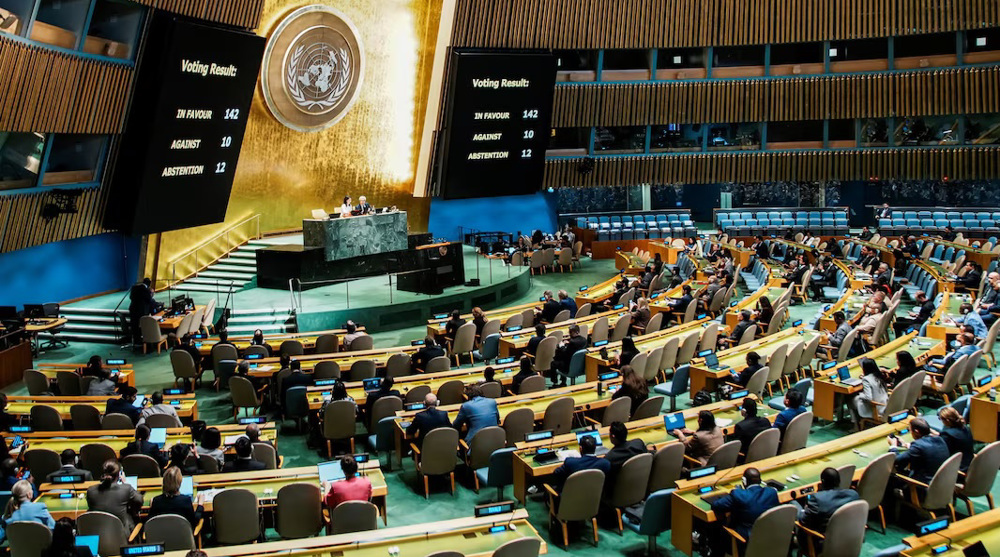
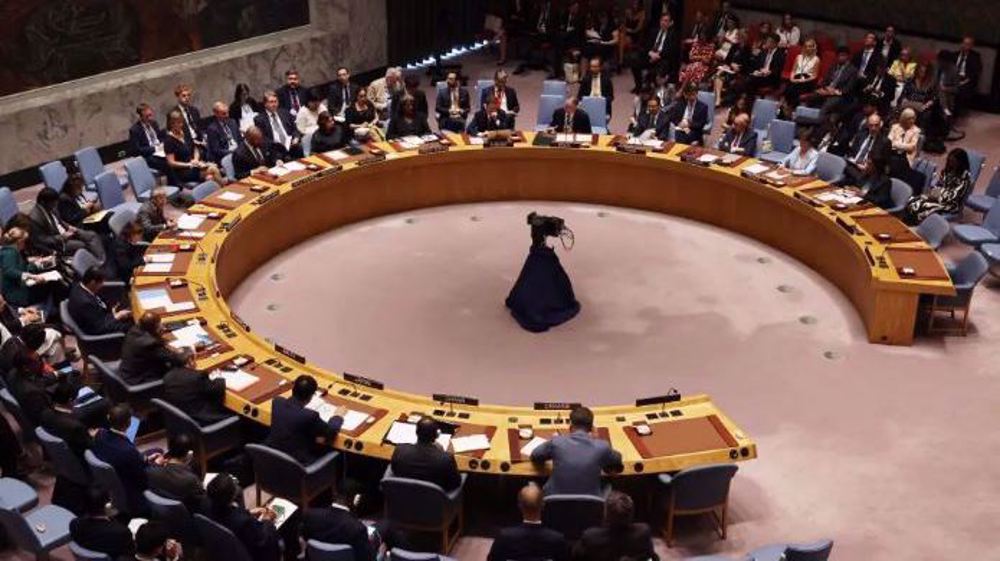
The UN General Assembly last week overwhelmingly endorsed the so-called New York Declaration, pushed by Saudi Arabia and France, which calls for a two-state solution to the Palestinian issue.
The 142-10 vote saw the Israeli regime, the United States, Hungary and Argentina voting against the resolution with 12 notable abstentions, including the Islamic Republic of Iran.
The event was boycotted by the US and the Israeli regime, with the vote occurring just a day after Israeli Prime Minister Benjamin Netanyahu publicly declared that there would be no Palestinian state.
Iran’s abstention is rooted in its long-standing advocacy for a single, democratic state in Palestine determined by a referendum of its original inhabitants.
Tehran's decision not to participate was not a passive act but a calculated and conscious political statement, explained in a formal letter to the UN Secretary-General, which outlined fundamental objections to the very premise of the declaration.
The Iranian mission to the UN emphasized that any practical solution must be based on the recognition of the inalienable right of the Palestinian people to self-determination and the rejection of forced displacement, principles it believes the New York Declaration fails to adequately address.
This vote once again highlighted the deep divisions within the international community regarding the path to a just and lasting peace in Palestine, pitting a widely supported diplomatic initiative against the principled, ideological opposition of key regional actors like Iran.
Iran says Palestine has ‘non-negotiable’ right to self-determination, independent state https://t.co/FX7bTyVbYg
— Press TV 🔻 (@PressTV) May 1, 2025
Why did Iran abstain from UN vote the two-state solution?
Iran refrained from voting on the UN resolution endorsing the New York Declaration due to a profound and principled disagreement with its content and underlying issues, which Tehran views as fundamentally flawed and unjust.
The Islamic Republic has consistently stated that a lasting and genuine peace can only be achieved when the historical and inalienable rights of the Palestinian people are fully recognized, a condition it believes the declaration ignored.
From Iran's perspective, the declaration distorted the realities on the ground by creating a false equivalence between the occupying regime and the occupied people, thereby absolving the Zionist entity of its primary responsibility for over eight decades of occupation, horrendous crimes, and the denial of fundamental rights to the people it has occupied.
Tehran argues that the statement deliberately overlooked the reality of the Zionist occupation and its continued presence in Palestinian territories as part of a broader colonial project that has been the main factor of instability in the region.
Furthermore, Iran contends that the authors of the statement have intentionally ignored the fact that the Israeli regime and the United States are themselves the greatest obstacles to the realization of the so-called two-state solution, making the entire exercise disingenuous.
The account of the events of October 7, 2023, is also deemed incomplete and misleading, as it isolates this date from the context of 80 years of occupation and settler-colonialism while ignoring the legitimate right of the Palestinian people to self-defense under international law.
Iran has also explicitly rejected the statement's call for the disarmament of Palestinian resistance groups, viewing it as a violation of the rights of an occupied nation that would leave Palestinians defenseless.
Finally, the exclusion of vital regional security issues, such as establishing a nuclear-weapon-free zone in West Asia, further convinced Tehran that the declaration was not a serious or comprehensive framework for peace but rather a mechanism that paves the way for the continuation of the crisis.
Iran: ‘Two-state solution’ an unrealizable promise used towards violation of Palestinians’ rights https://t.co/dsjTwL8qCs
— Press TV 🔻 (@PressTV) May 24, 2025
What is the two-state solution?
The so-called two-state solution is a proposed framework aimed at resolving the Palestinian issue by establishing two separate states within the historical boundaries of Mandatory Palestine, which experts argue seeks to carve out a place for Zionists on the Palestinian land.
This model has been the dominant paradigm for international diplomatic efforts for decades and was the central objective endorsed by the recent UN General Assembly resolution.
The solution envisions a Palestinian state based on the 1967 borders, with occupied East Jerusalem as its capital, and typically includes provisions for a negotiated land swap and a resolution to the Palestinian refugee issue.
The recent declaration supported by 142 nations framed this solution as the viable path to a peaceful resolution of the long-standing Palestinian issue.
However, from the perspective of Iran and some other countries, this solution has proven to be an unachievable promise over several decades, one that has only resulted in the increasing violation of Palestinian rights by the occupier.
They argue that it has served to deepen the injustices faced by the oppressed and occupied people by legitimizing the existence of a Zionist regime built on occupied land without addressing the root causes of the issue.
It also brings into question continuous expansion of illegal Israeli settlements in the occupied West Bank, which fragment the envisioned Palestinian territory, and the political reality within the Zionist entity, where leaders frequently reject the concept outright, as evidence that the two-state solution is no longer a viable or just outcome, instead functioning as a diplomatic cover for the entrenchment of a permanent system of apartheid and occupation.
Iranian Foreign Minister Abbas Araghchi reaffirmed Tehran’s rejection of the two-state solution as a means to securing Palestinian rights. https://t.co/koMbHCn4LC pic.twitter.com/7vSIQ2jdwb
— Press TV 🔻 (@PressTV) March 9, 2025
What is the one-state solution?
The one-state solution is a proposed alternative model for resolving the protracted logjam that involves the creation of a single, democratic Palestinian state encompassing all of the land between the Mediterranean Sea and the Jordan River.
This single state would be home to all its current inhabitants—Palestinian Muslims and Christians, Israeli Jews, and other residents—on an equal basis, granting everyone equal rights and citizenship regardless of ethnicity or religion.
The core mechanism for establishing this state, as championed by the Islamic Republic of Iran, is the holding of a free, democratic, and inclusive national referendum among all the original inhabitants of Palestine, which includes Muslims, Christians, and Jews who lived there before the establishment of the Zionist entity.
This process would necessitate the right of return for all displaced Palestinian refugees to their ancestral homeland so they can participate in determining their political future.
Advocates, including the Islamic Republic, argue that this is the only truly democratic solution that can bring genuine and lasting peace to the land, as it directly confronts and dismantles the structures of apartheid and ethnic discrimination inherent in the current set-up.
They draw a parallel to the overthrow of the apartheid regime in South Africa, suggesting that a similar transformation is possible in Palestine through sustained resistance and international pressure.
The envisioned state would be a pluralistic democracy where the will of the majority, expressed through continuous democratic processes, would determine the government and laws, thereby ending the Jewish character of the Zionist entity and replacing it with a state that guarantees full equality and rights for all its citizens.
Iran clarifies stance after joint Doha statement, rejects ‘two-state’ solution to Palestinian issuehttps://t.co/XZjaFVIEKd
— Press TV 🔻 (@PressTV) September 16, 2025
What is Iran's position on the Palestinian issue?
Iran's position on the Palestinian issue is absolute and principled, rooted in the belief that the Zionist project in Palestine is an illegitimate colonial enterprise that must be confronted and ultimately reversed.
The official stance of the Islamic Republic is one of non-recognition of the Zionist entity and unwavering political and moral support for the Palestinian resistance against the occupying regime.
Tehran's ultimate strategic goal is the liberation of all of Palestine, from the river to the sea, not merely the freedom of a part of it and the status quo in other occupied territories.
Iran rejects any plan that seeks to partition Palestine, including the two-state solution, which it views as a capitulation to Zionist demands that tramples on the rights of the Palestinian people, and ignores the historical rights of refugees.
Instead, Iran has formally proposed a four-stage democratic solution to the United Nations, which involves the return of all Palestinian refugees to their homeland, the holding of a national referendum with the participation of all original inhabitants of Palestine (Muslims, Christians, and Jews), the establishment of a political system based on the outcome of that referendum, and subsequent decisions by that elected system regarding other current residents.
The Islamic Republic maintains that the Palestinian people have an inalienable right to self-defense and to resist occupation as recognized under international law, and it provides support to a wide array of resistance groups across the region, based on their opposition to occupation rather than their sectarian identity.
It has consistently called for an immediate and unconditional ceasefire in Gaza, unhindered humanitarian access, and reconstruction, but firmly believes that a lasting peace will remain impossible until the occupation is entirely ended and the rights of the Palestinian people are fully restored through a democratic and inclusive process that reflects their genuine will.
British academic David Miller says that only Iran can save world civilization; otherwise, Zionists will rule over the entire region and Western nations.@Tracking_Power
— Press TV 🔻 (@PressTV) September 1, 2025
Follow: https://t.co/mLGcUTS2ei pic.twitter.com/l0fwtZVgat
What was Imam Khomeini's position?
Founder of the Islamic Revolution, Imam Khomeini’s stance on Palestine was not a peripheral concern but a central, defining pillar of his revolutionary ideology and a core religious obligation from the very inception of his political movement against the West-backed Pahlavi regime.
His profound engagement with the issue was first catapulted into public discourse during his historic Ashura sermon in 1963, where he explicitly condemned the Pahlavi regime’s ties with the Israeli regime and framed the Zionist project as a catastrophic tragedy designed to usurp Palestinian land and destroy the very foundations of Islam, the Qur’an, and Islamic scholarship.
This public declaration was preceded by written warnings, such as his March 1963 letter to unions in Qom, where he urgently alerted Muslims worldwide that the existential danger posed by the Israeli regime threatened not only Palestine but the entire Muslim Ummah, its independence, and its economies, which he believed were in peril of being seized by Zionists.
For Imam Khomeini, the Palestinian cause transcended mere political solidarity. It was a fundamental and civilizational battle, wherein the increasing power of the Zionist entity signified the deliberate subjugation and destruction of the Muslim world.
This perspective informed his consistent and unwavering position, in which he characterized the Zionist entity as a cancerous tumor that required eradication, an obligation he believed was incumbent upon all Muslims to prevent the metastasis of this entity from consuming other Islamic nations.
The mechanisms for combating this threat, as outlined by Imam Khomeini, were comprehensive and demanded absolute unity and resistance from the Islamic Ummah.
He vehemently rejected any path of negotiation or compromise with the Israeli regime, viewing such actions as tantamount to betrayal of the Muslim cause, a conviction starkly demonstrated by his severance of Iran’s diplomatic relations with Egypt following Anwar Sadat’s recognition of the Zionist entity through the Camp David Accords, which he condemned as a treacherous pact that strengthened the Israeli front and divided the Muslim nation.
Instead of diplomacy, Imam Khomeini prescribed a set of actionable principles: providing comprehensive support to the front lines of battle, avoiding self-destructive differences, rejecting fear of Zionism’s defenders, forging unity among Islamic governments, and severing ties with any nation that normalized relations with the Israeli regime, coupled with material and spiritual aid from Muslim peoples, including blood, medicine, and food.
Recognizing the failure of Arab governments to adhere to this path, he turned directly to the Muslim masses, announcing the International Quds Day as an annual symbol of international Muslim solidarity and a means to revitalize Islamic spirit and vigilance, urging them to separate from compromising leaders and take ownership of the liberation struggle.
Ultimately, Imam Khomeini’s stance was immortalized in his political-divine testament, where he enshrined support for Palestine as an eternal principle, framing the issue as a cosmic struggle between oppression and justice and instructing future generations that the enemies of Palestine were enemies of God, the Qur’an, and Islam itself.
His solution was never dependency on Eastern or Western powers but a steadfast adherence to the teachings of the Infallible Imams, advocating for self-reliance, unwavering resistance, and the unity of the oppressed.
In doing so, he established Palestine as the indisputable axis of Muslim unity and the ultimate litmus test for confronting oppression, a legacy that continues to define the Islamic Republic’s foreign policy and ideological commitment to the Palestinian resistance against a fraudulent and usurping regime.
Muslims must cut off ties with Israel to confront its 'catastrophic crimes' in Gaza: Ayatollah Khameneihttps://t.co/DARTxhx2qY
— Press TV 🔻 (@PressTV) September 7, 2025
What is Ayatollah Seyyed Ali Khamenei's position?
Leader of the Islamic Revolution Ayatollah Seyyed Ali Khamenei’s perspective on the Palestinian issue is fundamentally rooted in a historical narrative that frames the establishment of the Zionist entity as a deliberate colonial project orchestrated by Western powers, particularly the United Kingdom and later the United States, to fracture the Muslim world and maintain imperial dominance over the Middle East.
He asserts that the occupation was not achieved through legitimate means but through a calculated process of deception, manipulation of global public opinion, and brutal force against the indigenous Palestinian population, beginning with the purchase of lands from absentee landlords at inflated prices and escalating to the violent expulsion of farmers and residents from their homes.
This historical injustice, in his view, was facilitated by a global propaganda campaign that systematically portrayed the Zionist settlers as oppressed victims while framing the displaced and resisting Palestinians as aggressors, thereby inverting the reality of the issue and garnering international sympathy for the occupiers.
Leader identifies three core foundations upon which the Zionist project was built: relentless cruelty and violence towards the Arab inhabitants, a sophisticated manipulation of global media to distort the truth, and extensive collusion or lobbying with powerful governments and international institutions like the United Nations, which he argues have consistently shielded the Israeli regime from accountability.
For Ayatollah Khamenei, the plight of the Palestinians is not a simple territorial dispute but the central issue for the entire Islamic Ummah, representing a malignant tumor planted at the heart of the Muslim world designed to prevent unity, undermine powerful Muslim unity, and serve as a permanent base for Western and Zionist aggression against Islamic nations.
Consequently, he rejects any diplomatic solution that involves negotiation with the usurping regime, including the two-state solution, which he views as a legitimization of the occupation and an impractical deception that has only enabled further Israeli expansion and violence.
Instead, he has proposed a single, democratic state encompassing all of historic Palestine determined by a referendum among all original inhabitants—Muslims, Christians, and Jews—as the only just and viable path to peace, a solution he believes must be achieved through unwavering resistance supported by the entire Muslim world.
Earlier this week, at the 26th Baghdad International Book Fair, Leader of the Islamic Revolution’s book ‘Referendum in Palestine’, featuring his views on the Palestinian issue, was unveiled.
The book advocates a referendum as a rational, fair, and civilized method to end the suffering of the Palestinian people and pave the way for their liberation from the Zionist occupation.
It emphasizes the dignified return of all Palestinians to their places of origin, the right of all Palestinians—including Muslims, Christians, and native Jews—to vote, and the continuation of comprehensive efforts until Israeli occupiers comply with the will of the Palestinian people.

Israeli court sentences man to over 13 years in prison for allegedly spying for Iran: Report
US extends ban on Palestinians scheduled to attend UNGA

Israel blockade leaves 70% of Gaza hospital generators out of service: Health ministry



IRGC Navy strikes Togo-flagged tanker after illegal attempt to transit Strait of Hormuz
VIDEO | We salute the Palestinian woman
US lawmaker slams Trump’s $5 billion weapons sale to Saudi Arabia
VIDEO | Iran changing US war equations
Russia, China veto US backed anti-Iran resolution at UN Security Council
Araghchi welcomes Xi’s initiatives, hails China-Iran strategic partnership
VIDEO | Gaza transport crisis deepens as 70% of vehicles remain out of service
VIDEO | Press TV's news headlines



 PressTV NEWSLETTER
now
PressTV NEWSLETTER
now
 This makes it easy to access the Press TV website
