How General Soleimani cemented Venezuela-Iran anti-imperialist alliance
By Musa Iqbal
In recent decades, the alliance between Iran and Venezuela has emerged as a significant geopolitical development, rooted in shared ideological commitments and mutual resistance to Western hegemonic agendas.
This solidarity, forged in the people's common struggle against Western sanctions and military aggression, combined with a history of resilience against invaders, represents a strategic partnership that transcends geographical and cultural divides.
Both nations, rich in natural resources yet burdened by external pressures that seek to dominate them, have cultivated a relationship that encompasses economic cooperation, military collaboration, and diplomatic support.
From joint ventures in energy to coordinated efforts in international forums, the Iran-Venezuela partnership exemplifies a broader trend of South-South cooperation, a shift that is rapidly challenging American hegemony.
Today, both Iran and Venezuela are facing a scenario of American aggression. Iran, which emerged victorious in the recent "12-day war," was subjected to long-range US bombings following the Israeli aggression.
Preventing the destruction of its peaceful nuclear facilities and foiling the "regime change" plot yet again, the Islamic Republic of Iran fended off the American-Israeli axis to the point of Israel pleading for a ceasefire deal after its defenses were completely depleted by Iran's missile strikes.
However, renewed aggression remains on the horizon, for which the Islamic Republic is preparing and ready.
Simultaneously, Venezuela is also facing threats of aggression from the US as the US military is currently mobilizing in the Caribbean, with destroyers and troop deployments to strategic positions surrounding Venezuela.
Venezuela appreciates Iran for support against US invasion threatshttps://t.co/s2KDRa4nnl
— Press TV 🔻 (@PressTV) August 27, 2025
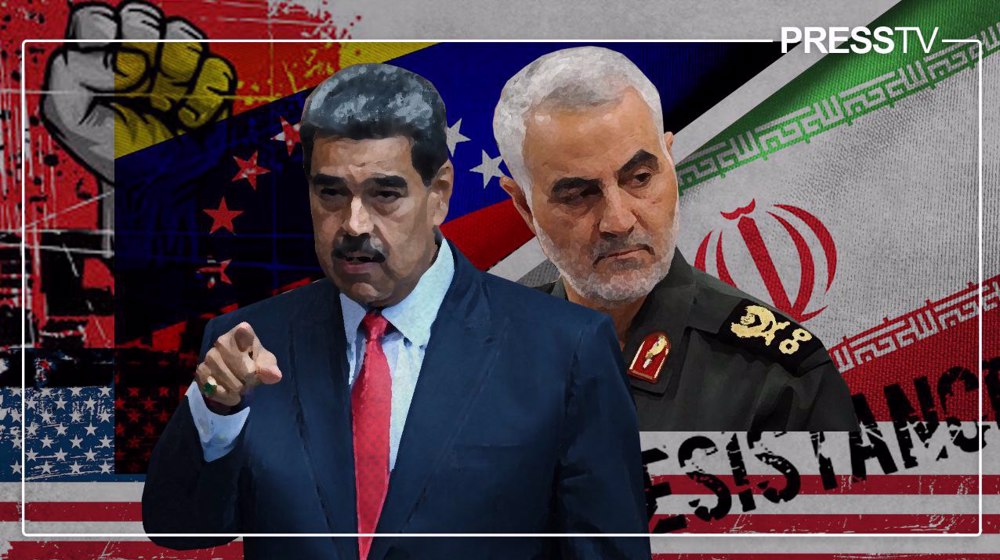
Military aggression by the US, particularly under US President Donald Trump, is not new. It was Trump who launched the failed coup attempt against Venezuelan President Nicolás Maduro in May of 2020—the same year Trump assassinated the top anti-terror commander of the Islamic Revolution Guards Corps (IRGC), General Qassem Soleimani, while he was on a diplomatic mission in Iraq.
Due to their shared interests and a culture of resilience, Iran and Venezuela would naturally become allies. Hugo Chávez, the late president of Venezuela and leader of the Bolivarian Revolution, recognized this early on when he established warm ties with Iran, supporting the Islamic Revolution and its commitment to opposing American imperialism.
But it was General Soleimani—credited with the destruction of Daesh (ISIS) in Iraq and Syria—who would take the relationship between Iran and Venezuela to the next level.
Known for forging the anti-imperialist alliance known as the Axis of Resistance, as well as commanding the IRGC's Quds Force, he understood the tentacles of the imperialist enemy very well.
It was for this reason that he would help train armies and resistance fighters who were interested in combating imperialist agents. Thus, the defeat of imperialism represents a victory for free people.
In 2019, Venezuela was subjected to harsh sanctions led by the US, just a year before the failed Operation Gideon. The sanctions specifically targeted Venezuela's energy sector, and to make matters worse, the nation was subjected to multiple cyberattacks in March, disrupting major energy systems.
It was around the same time that the US was attempting to overthrow Maduro and replace him with their puppet, Juan Guaidó.
Iran warns that US threats against Venezuela endanger peace in the Caribbean region while denouncing Washington’s actions as a clear breach of international law.
— Press TV 🔻 (@PressTV) August 21, 2025
Follow Press TV on Telegram: https://t.co/LWoNSpkc2J pic.twitter.com/8lW8dPyhyi
The imperialist cyberattacks were meant to put pressure on the Venezuelan government and discredit Maduro and the Bolivarian Revolution. The toppling of a sovereign Venezuela would mean a huge victory and foothold in the Caribbean and Latin America.
This calculus was well understood by the Quds Force, which was familiar with foiling cyberattacks, among other sophisticated imperialist attacks against Iran. According to President Maduro, General Soleimani offered his country's assistance and expertise to restore the energy grid.
Within two to three days, Iranian experts were on the ground restoring the energy grid to the hands of the Venezuelan state.
It cannot be overstated how crucial this intervention was. At this moment in time, all regional actors subservient to US interests were applying pressure on Venezuela to overthrow the Maduro-led government and embrace neocolonial rule.
General Soleimani stepping in to assist in thwarting this attack helped ease the imperialist-crafted crisis and restore much-needed energy.
In a 2022 interview, Maduro addressed this very incident: "I didn't know him, I didn't know how big he was. The conversation I had with him was very harmonious, where we reviewed all the topics. He immediately offered the support of the Iranian experts, and two three days later, the Iranian experts were in Venezuela to recover the electrical service."
It was clear that General Soleimani played a significant role in Venezuela's efforts to repel and thwart cyberattacks.
In another interview, Maduro praised his meeting with General Soleimani, stating: "Commander Soleimani was a cheerful and optimistic man in life, and I thank God that I got to know him.... He faced terrorism and the bloody terrorist criminals who attacked the peoples of the Axis of Resistance. He is a brave man."
In honor of the memory of Martyr Lieutenant General Qassem Soleimani, a mural, depicting a picture of Soleimani alongside the late Venezuelan President Hugo Chavez ornamented with the flags of Iran and Venezuela, was inaugurated in a street in the Venezuelan capital, Caracas. pic.twitter.com/rrVpGefjGP
— Press TV 🔻 (@PressTV) January 5, 2023
Iran has resisted a wide array of cyberattacks, energy attacks, and different plots to subvert its sovereign industries for decades. General Soleimani and his team of experts knew what it takes to stop this threat and traveled across the globe to help Venezuela and many other nations.
This one instance of crucial solidarity immortalized General Soleimani in the eyes of the Bolivarian Revolution. Multiple murals of Soleimani can be seen in Venezuela today, such as the one in Caracas, where an Iran-Venezuela Friendship sidewalk opened as a token of gratitude to the Islamic Republic.
Solidarity and instances like these are not just one-off moments in time or historical events that can never be repeated. Solidarity is a living and breathing force—especially between the two resistance giants of Venezuela and Iran, each operating as a bulwark against imperialism in their respective regions.
Once again, today we find both countries fending off aggressive, armed imperialist plots. The playbook's tactics and strategies may change, but the goal remains the same: subjugation.
What the imperialist aggressors seek is to crush solidarity, isolating countries to fend for themselves against plots of aggression. What they are actively looking to break is regional solidarity. What they are certainly not counting on is intercontinental solidarity.
It is essential to maintain ties with one's neighbors—this is indisputable. But in the face of a global imperialist assault, one should examine this simple act of solidarity between two countries separated by oceans and continents—and how successful it was at stopping an enemy advance.
The world—particularly the global South—must take a page from the book of General Soleimani and lend a hand to each other if it means stopping the death march of imperialism.
Musa Iqbal is a US-based researcher and an editor at Vox Ummah.
(The views expressed in this article do not necessarily reflect those of Press TV.)
Arbaeen 2026 becomes statement of unity and resilience amid US-Israeli war on Iran, resistance axis
The recycled, futile psychological ops by US, Israeli spy agencies and hostile media against Iran
Ismail Haniyeh's enduring vision of resistance and road to liberation, two years after his martyrdom



Israeli forces raid West Bank sites, abduct Palestinians as settlers attack homes, vehicles
Arbaeen: The eternal journey of remembrance, resistance and revival of the message of Karbala
Another ICE detainee dies in custody, raising 2026 death toll to 22
Millions of pilgrims descend on holy city of Karbala to mark Arba’een
Iran's Royan Institute preserves fertility of two girls with cancer through advanced surgery
VIDEO | Palestine convoy arrives in Ankara, voices solidarity with Gaza
North Korea says US-led ‘cyber warnings’ aim to tarnish its image
VIDEO | Arbaeen pilgrimage preparations


 PressTV NEWSLETTER
now
PressTV NEWSLETTER
now
 This makes it easy to access the Press TV website
