Mahmoud Farshchian, Iran’s master miniaturist who made Karbala’s grief eternal
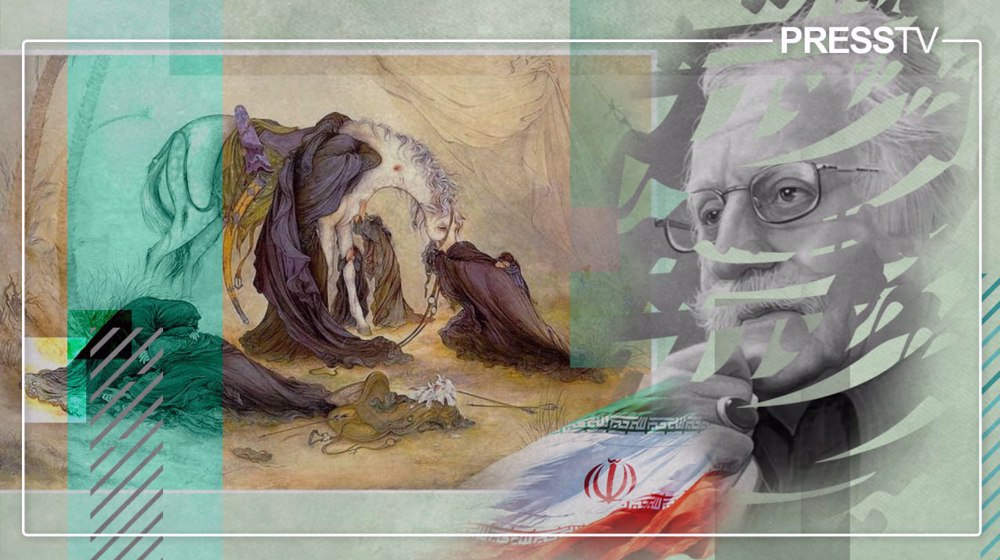
By Humaira Ahad
“Every time I have looked at Mr. [Mahmoud] Farshchian’s painting, which he gifted me a few years ago, I have cried,” Leader of the Islamic Revolution Ayatollah Sayeed Ali Khamenei was once quoted as saying.
“And that’s even though my chest is filled with elegies recited on the morning of Ashura and the afternoon of Ashura. Who knows more than us what has been written, recited and said on this subject."
Leader’s words reveal the deep emotional power embodied in “The Evening of Ashura,” a masterpiece by Iran’s revered miniaturist Mahmoud Farshchian.
Even for those familiar with the tragedy of Ashura – the day Imam Hussein, Prophet Muhammad’s (PBUH) grandson, was martyred on the desert plains of Karbala – Farshchian’s art resonates deeply.
“They say the people who are involved in such things do not cry themselves. Yet, despite knowing so many elegies, Mr. Farshchian's recitation of an elegy through his art makes us weep. What a valuable, profound, and meaningful art it is, that an artist can create such a state in people,” Ayatollah Khamenei added, emphasising the spiritual and emotional depth Farhchian’s work epitomized.
Farshchian’s works carry a unique and deeply moving spiritual force, capturing the centuries-old grief of Karbala and making it resonate freshly in the heart.
Few works embody this power more vividly than The Evening of Ashura, one of the most emotionally charged depictions of Karbala in modern Iranian art. In the soul-stirring artwork, the holy household of Imam Hussein (AS) mourns as his riderless horse returns from the battlefield after his martyrdom.

A master of tradition and innovation
In a country where religious narratives, visual symbolism, and cultural heritage are tightly woven, Farshchian stood as an artist whose brush moved between the earthly and the divine.
He is regarded as one of the most influential Iranian miniature artists of the modern era, credited with founding a new style in Persian miniature that blends the delicacy of traditional forms with the expressiveness of modern techniques.
His paintings are a fusion of inherited craft and personal vision, often drawing on Sufi mysticism, Shi’a spirituality, Persian literature, and an imaginative use of form and colour.
Born on January 24, 1930, in Isfahan, the city long celebrated as Iran’s cultural and artistic capital, Farshchian grew up in a family steeped in both tradition and enterprise.
His upbringing was deeply religious. His mother was a devoted follower of Imam Hussein. Farshchian often said this atmosphere shaped his work from the start.
“I believe the most enduring works are those connected to religion,” he once said.
His father, Haji Gholamreza Farshchian, was a prominent merchant of fine Persian carpets, a trade from which the family name was derived.
Farshchian's father was in close contact with master designers and weavers, and he often took his son to workshops. It was here that the boy, still of elementary school age, first encountered the meticulous lines, complex patterns, and saturated colours that would shape his body of work.
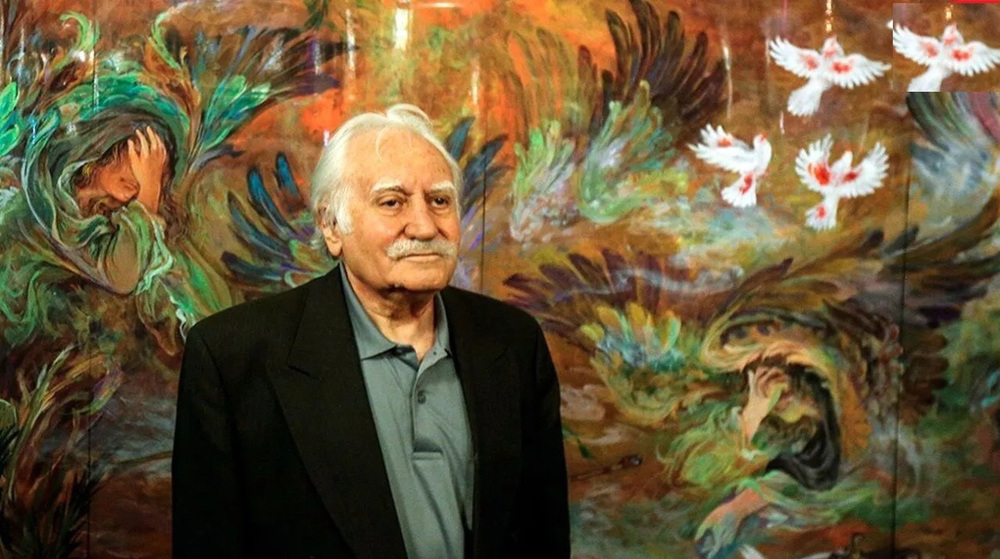
Renowned Iranian painter Mahmoud Farshchian, a master of modern Persian miniature, passed away at the age of 96.
— Press TV 🔻 (@PressTV) August 9, 2025
Follow: https://t.co/B3zXG73Jym pic.twitter.com/qVLt1bKcZO
His childhood was also rich with the artistic atmosphere of Isfahan, a city whose mosques, tilework, and miniature painting traditions had been nourished over centuries by figures like Sheikh Baha’i and generations of master artisans.
His natural inclination toward art emerged early, as he found himself captivated by the plasterwork on columns and fireplaces in his home and by the intricate motifs of the carpets his father traded.
The artist's path to mastery
Recognising his son’s focus and interest in art, Farshchian's father took him to Haj Mirza Agha Emami.
One of Isfahan’s leading miniature painters. Emami was known for his refined command of traditional techniques. He started teaching the young student the basics of composition, brush control, and ornamentation.
At 14, Farshchian entered the Isfahan School of Fine Arts, where he studied under Isa Bahadori, a student of Kamal-ol-Molk, the renowned Persian art master known for his exquisite paintings.
Bahadori instructed him in miniature and oil painting, carpet design, and illumination, expanding his technical repertoire. During this time, Farshchian also learned ceramics; one of his handmade vases would later be presented by Bahadori to Arthur Upham Pope, the renowned expert on Persian art.
By the time he graduated with honours, Farshchian had already debuted his work publicly.
In 1948, at the age of 18, he exhibited his work at the Iran–Britain Cultural Association. Among the pieces displayed was Last Night I Saw Angels Enter the Tavern, a title drawn from classical Persian poetry, which hinted at the mystical sensibility that would permeate his career.
Here’s a look back at our interview with the late legendary Iranian painter Mahmoud Farshchian, in which he said he wouldn't sell his religious works and that they would stay in museums for the public.
— Press TV 🔻 (@PressTV) August 12, 2025
Follow https://t.co/B3zXG73Jym pic.twitter.com/phKXCA0rnZ
Birth of a new art school
In 1953, Farshchian traveled to Europe to further his art studies. There, he mastered European classical painting techniques, including composition, perspective, anatomy, and light, and began blending them with Persian miniature traditions.
Upon returning to Iran, he took up the position of the head of the National Arts Department and a professor at the University of Tehran’s Faculty of Fine Arts. His students included notable figures such as Majid Mehregan, Farhad Rostampour, and Majid Sadeghzadeh.
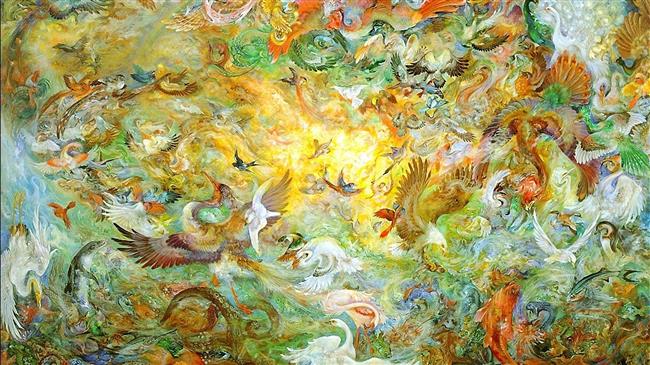
It was during these years that Farshchian solidified the style that made him an unrivalled maestro: fluid curves, intricate layering, vibrant yet controlled colour, and compositions that often swirl around a circular or spiralling centre.
The famous Iranian artist freed himself from the strict dependence on literary illustration; his works stood as independent artistic statements, while still drawing heavily on the Holy Qur’an, Shi’a hagiography and on mystic poets such as Molana Rumi and Hafez Shirazi.
Among Farshchian’s hundreds of creations, several have entered the public imagination.
The evening of Ashura stands foremost, a deeply emotional rendering of the aftermath of the Battle of Karbala, filled with mournful symbolism and subtle theological references.
The Guarantor of the Gazelle, painted after he made a vow for the healing of his hand, draws on the legend of the eighth Shia Imam Ali ibn Musa al-Reza protecting a gazelle from a hunter.
Sham-e Ghariban (The Night of the Oppressed) by Iranian miniaturist Mahmoud Farshchian at Sa'dabad Museum in Tehran pic.twitter.com/CCT3PLOSpe
— Press TV 🔻 (@PressTV) September 6, 2015
Other notable works include Shams and Rumi, Praise (inspired by a Quranic verse), The Evening of the Strangers, and The Fifth Day of Creation.
His artistry extended beyond the canvas. Farshchian designed the shrines of Imam Hussein in Karbala and Imam Reza in Mashhad, as well as the cellar of occultation in Samarra, and the shrines of many martyrs of Karbala, all without taking any money, as pure acts of devotion.
The enduring legacy
Farshchian’s bibliography of illustrated classics, from Ferdowsi’s Shahnameh and its epic heroes to Hafez’s Divan and Khayyam’s Rubaiyat, stands as a bridge between Iran’s literary and visual traditions.
By merging the intricate precision of Persian miniature with other art forms, particularly the spatial dynamism of European painting, he preserved a centuries-old tradition and expanded it into new territory.
Farshchian’s religious works, particularly those tied to Shi’a history, continue to circulate in print and reproduction, becoming part of the iconography of modern Iran.
His paintings have been displayed in hundreds of exhibitions across Iran, the United States, Europe, and Asia, and many were presented as diplomatic gifts by Iranian diplomats.
Even after his passing on August 9, 2025, the most profound testament to Iran’s most celebrated painter remains the emotional reactions of his viewers, like those described by Ayatollah Khamenei, who wept upon seeing The Evening of Ashura.
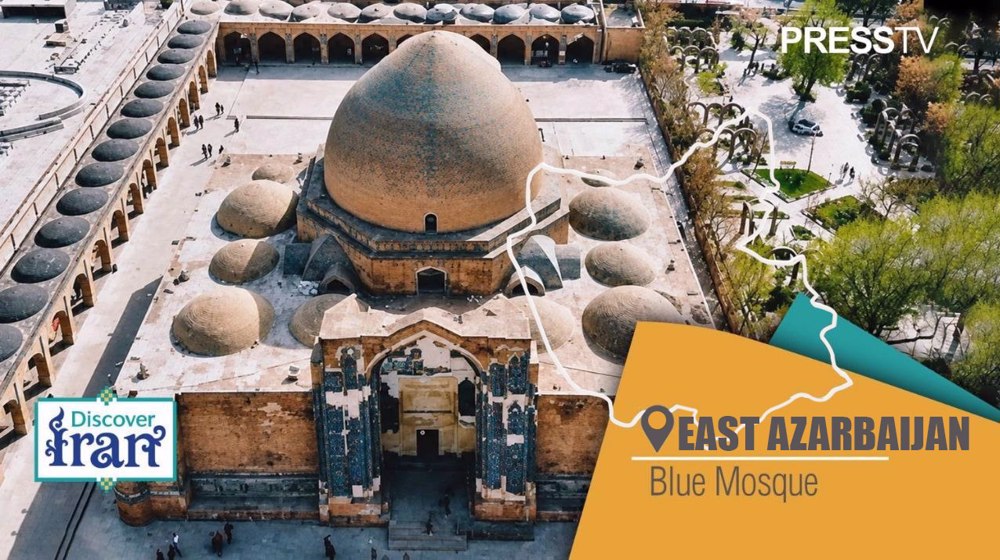
Discover Iran: Tabriz’s Blue Mosque, where glorious history meets timeless Iranian architecture
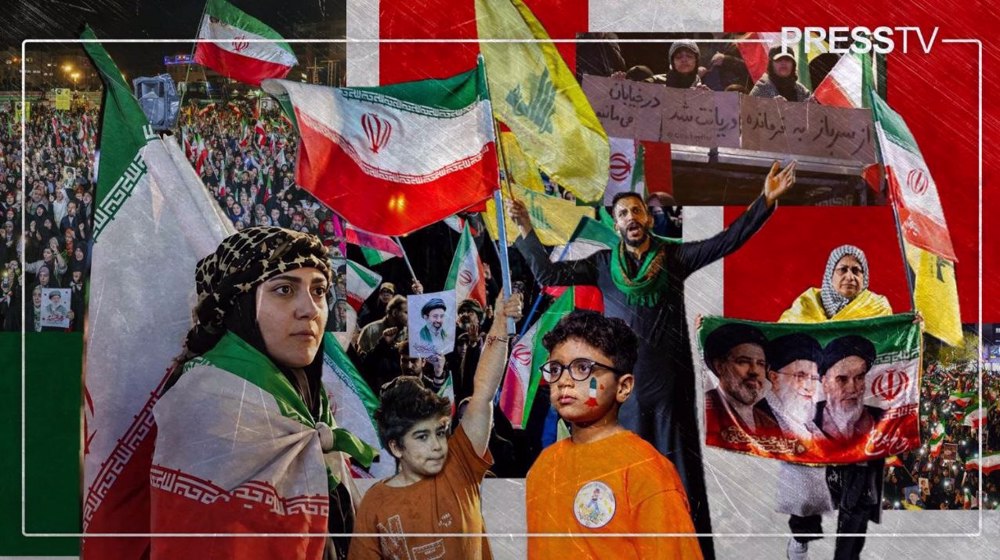
200 nights, one resilient nation: Iranian people’s epic in defense of homeland and Revolution
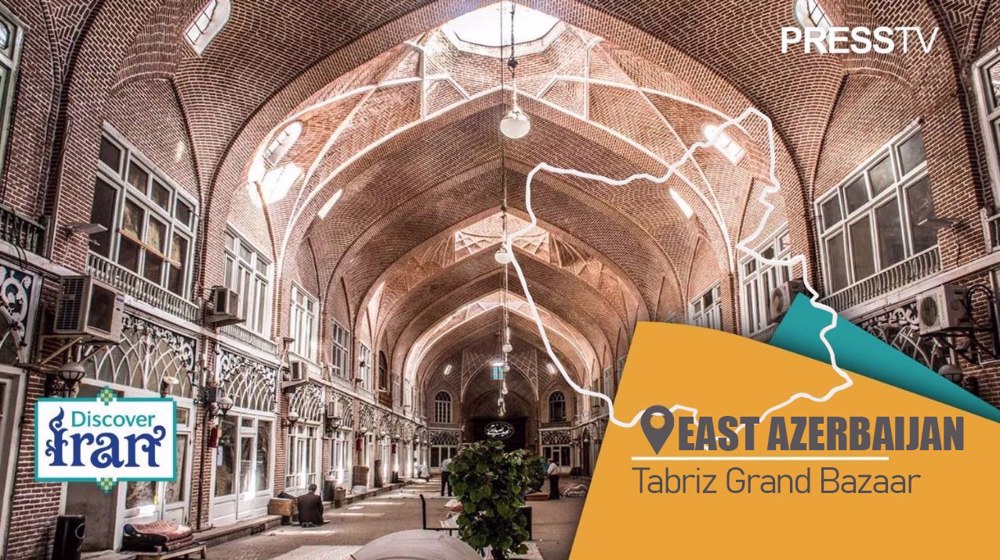
Discover Iran: Tabriz Grand Bazaar, where centuries of trade, culture and craftsmanship still thrive



VIDEO | US uses threat of drug cartels to justify Venezuela invasion: Commentator
VIDEO | Police clash with far-right protesters in The Hague
How Iran turned US military and economic aggression into strategic leverage to dictate terms
‘No restraint’ against any aggression: Iran's top military command warns US, its regional allies
VIDEO | Iran war will break America
Poll: Over half of US Jews say Netanyahu fueling American anti-Semitism
Trump and Netanyahu will face same fate as Saddam Hussein: Top Iranian cmdr.
VIDEO | Protesters flood Buenos Aires in rally against Milei's economic policies




 PressTV NEWSLETTER
now
PressTV NEWSLETTER
now
 This makes it easy to access the Press TV website
