Cases of Esfandiari and Hazamy: France’s quiet war on Muslim, Iranian, pro-Gaza voices
By Hoda Yaq
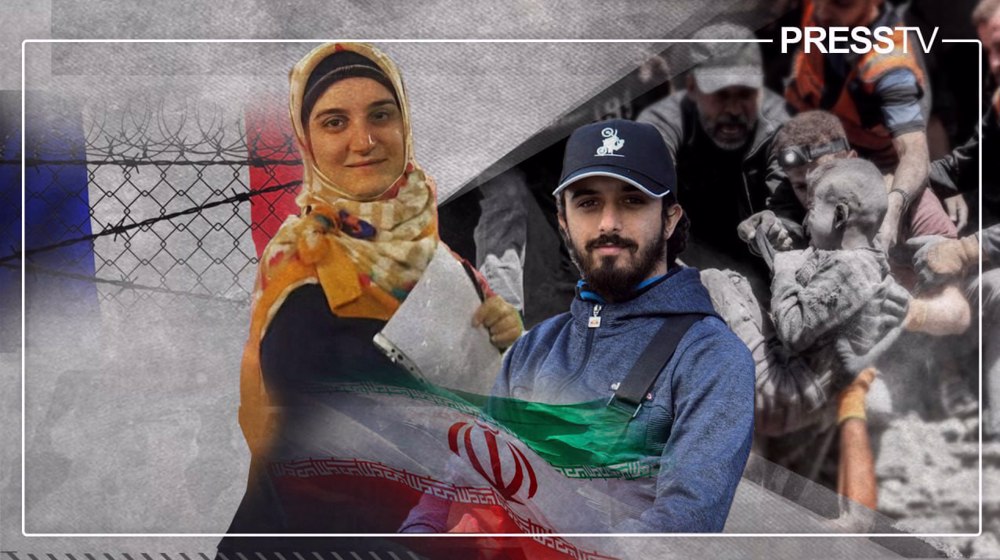
It's been nearly two months since Mahdieh Esfandiari, an Iranian citizen and university lecturer in France, was arrested by French authorities on February 28, 2025.
According to her friends and family, her house was thoroughly searched by security personnel, turning the incident into something eerily resembling a kidnapping.
For two days following her arrest, no information about her whereabouts was disclosed. It was only after persistent follow-ups by her friends and family that they learnt she was in police custody.
Esfandiari was subsequently transferred to Fresnes prison, located 470 kilometers away near the capital, Paris. This considerable distance has made it extremely difficult for her family and friends to pursue her case or provide her with any form of support.
She happens to be a linguist with a degree in French language from Lumiere University and has lived in the French city of Lyon for the past eight years.
She works as a professor, translator, and interpreter at the Lumiere University.
Her case has drawn comparisons to that of Iranian music composer and documentary filmmaker Bashir Biazar, who was detained in Paris last year and held in Metz, a city located over 300 kilometers away. His crime was a few social media posts critical of Israel.
The question that arises at this point is: Why does the French government appear so determined to keep detainees in total isolation, far from both their families and the watchful eye of the media? Why is there so much secrecy about these arrests?
Iranian academic jailed in France for pro-Palestine advocacy #FreeMahdieh
— Press TV 🔻 (@PressTV) April 17, 2025
Follow: https://t.co/B3zXG73Jym pic.twitter.com/l11UbSfErt
For five weeks following Esfandiari’s arrest, her condition remained shrouded in mystery. It wasn’t until the French magazine Le Point reported on her arrest that the French government authorities were forced to acknowledge it.
No official details have been released regarding the alleged crime or any developments in her case. However, some French media outlets have reported that the Paris Prosecutor’s Office charged the Iranian academic with "apologie du terrorisme" (public defense of terrorism), based on social media posts critical of the Israeli regime.
Other charges include "online provocation of terrorism, insults based on origin or religion, and refusal to provide access codes to her social media accounts."
To this day, Esfandiari has not had even a single phone call with her family in nearly two months, and no one has clear information about her fate or the case against her.
Despite repeated attempts by Iranian officials and her family to establish contact with her, the French government has rejected all requests for consular visits or even basic communication such as a phone call.
This troubling lack of transparency has sparked serious concerns regarding her well-being.
The point to note here is that the French government has taken a firm position against certain expressions, branding them as antisemitic, yet at the same time, it has championed controversial publications like “Charlie Hebdo” under the banner of free speech.
✍️ Feature -Who is Mahdieh Esfandiari, Iranian academic jailed in France for pro-Palestine advocacy
— Press TV 🔻 (@PressTV) April 16, 2025
By @kesic_ivan https://t.co/KXrMsffbap
For instance, when Charlie Hebdo published satirical cartoons of the Prophet Muhammad (PBUH), the government defended it as an exercise in freedom of expression, despite the profound offense it caused to billions of Muslims around the world.
Such contradictory behavior by the French government suggests a selective approach to free speech—one that seems to falter when it comes to human rights or standing up for the oppressed and slaughtered children of Palestine.
Adding fuel to the controversy, Shahin Hazamy, a France-based independent journalist who had been diligently following up on Esfandiari’s case, was himself violently detained by French authorities on April 22, 2025.
Hazamy was reportedly kidnapped in front of his family at his home in Paris. Although the exact reason remains unclear, the French government employed the label of supporting terrorism to justify such aggressive arrests of Palestine supporters.
He was reportedly released on Thursday, but the court proceedings in the case continue.
Hazamy, like Esfandiari and Biazar, has been vocal about the Israeli-American genocidal war on Gaza, speaking loudly against it and in support of the resistance.
The arrests of Biazar, Esfandiari, and Hazamy underscore glaring contradictions in the actions of the French government and undeniably call into question whether they are defenders of human rights and freedom of speech or brazen violators of the same.
Experience has shown that freedom of expression is only protected when it aligns with their political narratives. Otherwise, even the slightest gesture of support for Palestine or any utterance on human rights may lead to the harshest legal consequences—and an uncertain, silent fate that unfolds behind prison walls and a media blackout.
Hoda Yaq is a Tehran-based writer and human rights activist
(The views expressed in this article do not necessarily reflect those of Press TV)
Iran’s resistance against US aggression echoes China’s Korean War, signaling end of Western hegemony
Arbaeen: The eternal journey of remembrance, resistance and revival of the message of Karbala

Ceuta's migration crisis exposes hidden price of Spain's defiance against US-Israel-Morocco axis



VIDEO | Iran has every right to avoid being attacked: Journalist
Yemeni forces strike Saudi-backed mercenaries for second straight day
US must submit to new order in Persian Gulf: Iran deputy Parliament speaker
Who’s who: Meet Iran’s new top military officials appointed by Leader
Parents of Minab boy killed in US strike visit Hiroshima on US atomic bombing anniversary
Leader makes new appointments to top military posts; Vahidi named IRGC commander
Israeli forces, settlers intensify attacks across occupied West Bank
VIDEO | News Review: Iran says reopening Hormuz Strait hinges on US halting aggression


 PressTV NEWSLETTER
now
PressTV NEWSLETTER
now
 This makes it easy to access the Press TV website
