

American journalist Alex Rubinstein has said that mass-casualty terrorist attacks like the Kabul airport bombing are used by the United States for continuing occupations of foreign countries.
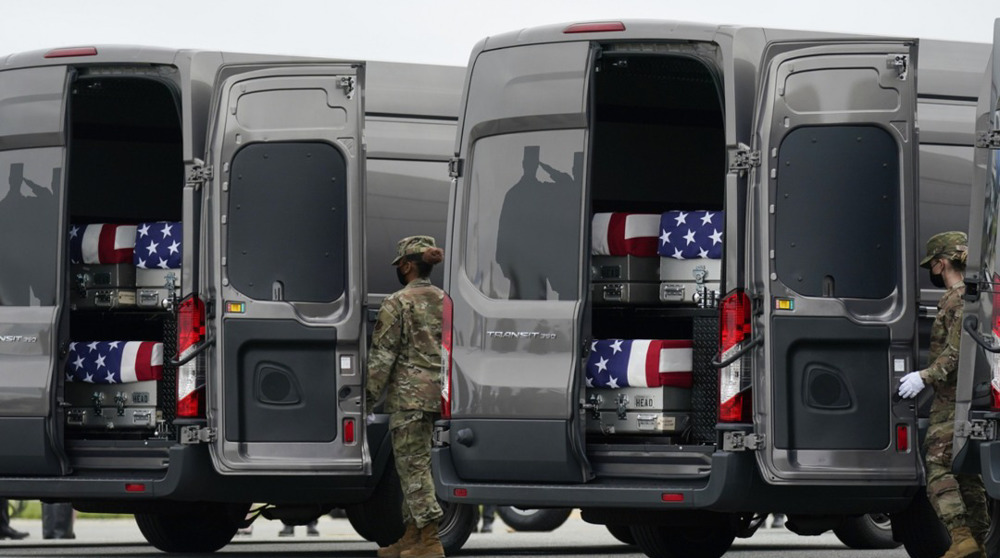
Terrorists struck the Kabul airport on August 26, killing at least 180 people, mostly Afghan civilians and 13 US service members. A little-known shadowy terrorist group, Daesh-K, claimed the responsibility for the attack.
Following the bombing, the US military carried out several drone attacks across Afghanistan without getting permission from the Taliban, who denounced the strikes as a violation of the country’s sovereignty.
Although the US claimed that these drone attacks were aimed at destroying Daesh-K targets, the local sources reported nine civilian deaths in the vicinity of the Kabul International Airport as a result of the strikes.
In a recent article published on his website, independent journalist Rubinstein quoted Afghan President Hamid Karzai, who called the Daesh-K terrorist group a “tool” of the United States.
The analyst, who tweeted in May that the world would see the “rise of ISIS (Daesh)” in Afghanistan in the near future,” wrote that “mass-casualty terrorist attacks are repeatedly used as justification by the United States for continuing its occupations of foreign countries: the ‘counterterrorism mission,’ or the ‘terrorist threat.’”
“The strongest argument in favor of a US withdrawal put forward by the Biden Administration is that the United States completed its counter-terrorism mission in Afghanistan. The attack by ‘ISIS-K’ on the Kabul airport collapses this argument, and so it benefits those who would prefer to see Afghanistan permanently occupied by the US,” explained Rubinstein.
“It’s also not the actions of a calculating terrorist group: why commit mass violence at such a critical juncture? Why do it when all eyes are on Afghanistan and many in the Pentagon, in NATO, are looking for any excuse to invade again?” he asked.
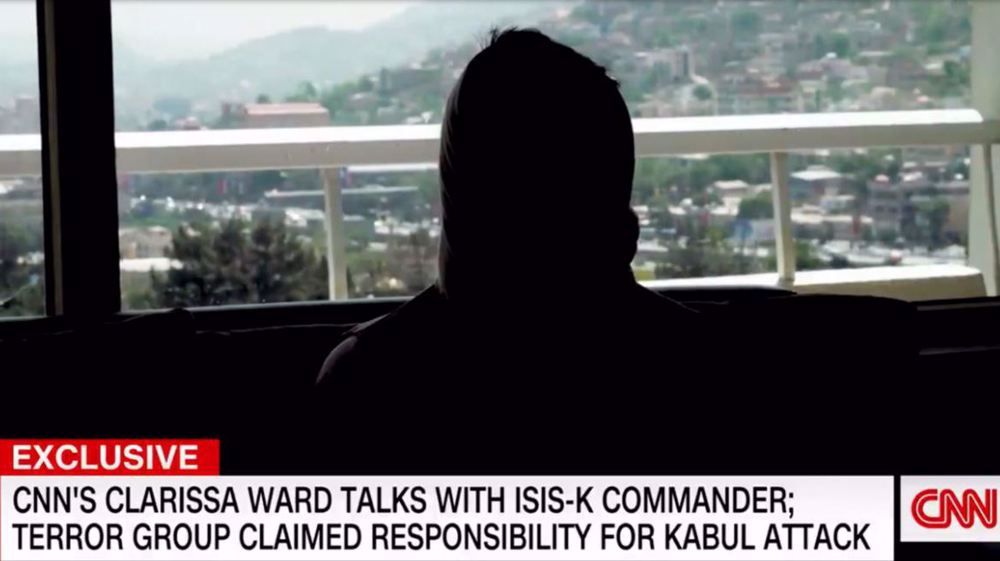
CNN aired an interview with a “senior” Daesh commander from a Kabul hotel two weeks before the Kabul airport bombing while the US-backed government was still in power in Afghanistan.
Shockingly, the Daesh commander told CNN reporter Clarissa Ward that the group was “laying low and waiting for its moment to strike,” but the broadcaster apparently did not share this vital information with US authorities or maybe it did and they simply ignored it.
The interview left observers and social media users wondering how the American media outlet gained access to the terrorist leader and protected his identity when the city was still under the control of the US-supported government, virtually under the control of US forces.
People questioned CNN’s motive behind the interview and its connection to Daesh-K, which was not known to anyone before the last week’s deadly bombing.
The CNN reporter called the commander’s interview “eerily prophetic,” but social media users suggested that the statement was not a prophecy but a plot because the terrorist was speaking of what his group was about to carry out.
Some social media users said that CNN aided and abetted the Kabul attack by having advance knowledge of the possible bombing and apparently doing nothing to help prevent it. They also wonder that how CNN did not lead American authorities to the terrorist commander.
Rubinstein wrote, “This is not to say definitively that the ISIS-K attack was a false flag, but there are many holes in the narrative that demand scrutiny. It is worth noting here that the US is in charge of security at the airport until August 31, while the Taliban controls the surrounding area.”
He added, “Moreover, the United States had advanced knowledge of the attack. ‘Because of security threats outside the gates of Kabul airport, we are advising US citizens to avoid traveling to the airport and to avoid airport gates at this time,’ read an August 25 security alert on the US Embassy in Afghanistan website. ‘US citizens who are at the Abbey Gate, East Gate, or North Gate now should leave immediately.’”
Britain and Australia had also issued similar warnings of a “high threat of a terrorist attack” and a “very high threat of a terrorist attack” respectively. The following day the deadly attack happened.
US troops reportedly shot and killed several people during the Kabul airport attack. “Many we spoke to, including eyewitnesses, said significant numbers of those killed were shot dead by US forces in the panic after the blast,” tweeted BBC correspondent Secunder Kermani, who reported from the area.
“The very next day after the attack, the United States Central Command announced that ‘US military forces conducted an over-the-horizon counterterrorism operation today against an ISIS-K planner. The unmanned airstrike occurred in the Nangarhar Province of Afghanistan,” Rubinstein wrote.
“In short, the US knew an attack was coming, the attack happened, and then within 24 hours the US announced that they killed the perpetrator, saying ‘initial indications are that we killed the target,’” he added.
 This makes it easy to access the Press TV website